
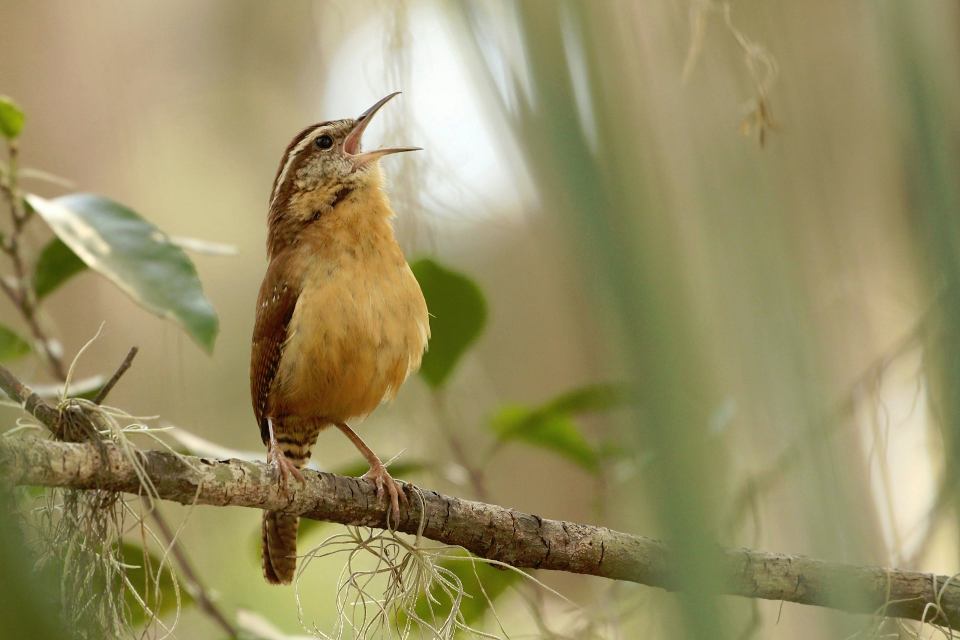
Learning how to identify birds by song is the single most powerful upgrade any beginner can make to their field-craft toolkit, because it extends species identification capability to every moment when visual access is blocked by foliage, distance, or low light.
Novice observers consistently struggle with acoustic tracking because they treat bird vocalizations as chaotic, unpredictable noise rather than structured, predictable acoustic frameworks built from fixed frequency signatures, rhythmic pacing patterns, and species-specific tonal qualities that repeat with remarkable consistency across all individuals of a given species.
Mastering the audio filtering discipline described in this guide rounds out the complete four-pillar field diagnostic routine that transforms morning property counts from guesswork into replicable citizen science data.
The full visual identification framework that pairs with this acoustic guide is documented at the Feathered Guru backyard bird identification guide, which covers size assessment, bill geometry, plumage contrast boundaries, and behavioral kinetics as the complementary visual channels to the acoustic skills developed here.
Quick Answer: How do you identify birds by song?
You identify birds by song by filtering every vocalization through three universal properties: pitch frequency, rhythmic pacing, and phonetic language mnemonics. Breaking complex melodies into structural rhythm patterns and familiar spoken catchphrases allows you to instantly isolate look-alike species inside dense foliage without requiring specialized audio equipment.
Mapping Bird Songs and Pitches: Visual Whiteboard Guide
Reviewing these acoustic core concepts on a visual whiteboard animation gives you a clear mental blueprint before diving into our step-by-step memory guides below. This conceptual training lesson breaks down the structural shapes of pitch and rhythm on a clean drawing canvas, helping you easily recognize overlapping outdoor melodies without getting overwhelmed by chaotic field noise.
Show Transcript:
0:00
Welcome to this explainer. I am absolutely thrilled to share this with you today because honestly, we are talking about a total game changer here. For
0:09
a really long time, I’d walk around the woods or even just out in my own backyard relying entirely on my eyes. I
0:16
was completely ignoring this incredible symphony happening right above my head.
0:20
But let me tell you, learning to identify birds by their sound, it was the single most powerful upgrade I ever made to my personal field toolkit. It
0:28
literally transformed how I experienced the outdoors. I remember I used to come back from my morning walks just incredibly frustrated and I kept asking myself, why am I missing so many birds?
0:39
Well, the reality was I was treating morning bird vocalizations as chaotic, unpredictable noise. I was constantly craning my neck, you know, trying to
0:47
spot movement through dense foliage or squinting into that really harsh low morning light. If a bird was hidden by leaves or just a bit too far away, it
0:55
practically didn’t exist to me. I was missing countless species simply because I hadn’t trained my ears to actually see them. Okay, let’s jump right into part
1:04
one, decoding backyard noise and understanding vocals. So, my first big breakthrough was learning to separate a bird’s song from a bird call. They are
1:13
very different things. Songs are these complex sustained multi-note melodies, and they’re produced mostly by territorial males during the breeding
1:21
season. Now, when I hear a full song ringing out from a shrub, it gives me an exact species-level identification without me ever needing to lay eyes on
1:28
the bird. Calls, on the other hand, well, they’re short, sharp, and highly functional. They’re used year round by both sexes for things like alarm bells
1:36
or flock contact. For example, when I hear a really quick, thin, high-pitched “seet” coming from the bushes, I immediately know it’s a small passerine
1:44
like a sparrow or a warbler. It gives me that family-level clue instantly. But what truly fascinated me was learning how birds actually produce these complex
1:52
songs. They originate from specialized neural control nodes in what’s known as the avian song control system or the SCS.
2:00
When I read this landmark 1976 Science research paper by Nottebohm and Arnold, it totally blew my mind. They documented that these
2:08
complex multi-syllable songs aren’t just genetically hardwired reflexes. No, they are neurologically complex learned
2:15
behaviors driven by this highly specific network in the brain. The birds are actually out there learning and refining these intricate musical sequences. And
2:24
that brings me to part two, my three-step audio filter for systematic decoding. I want to show you the exact field routine I developed to decode
2:33
these vocalizations. And trust me on this, you do absolutely not need an ounce of musical training to pull this off. When I hear an unfamiliar sound, my
2:41
brain immediately goes to work filtering it through three distinct steps. Pitch frequency, rhythmic pacing, and phonetic mnemonics. First, in just a second or
2:49
two, I toss the sound into one of four pitch bands. I ask myself, is it a high, thin note like a kinglet, or maybe a low, resonant hoot like an owl? Second,
2:58
I count the rhythmic pacing. If I hear a three-note phrase repeating about once per second, my brain says, “Okay, thrush or vireo.” But if I hear a single
3:06
explosive burst of say 15 notes per second, boom, I know I’m listening to a wren. I always anchor my ears to this rhythm before moving on. Finally, I
3:14
apply the third step, phonetic mnemonics. Basically, I use human language phrases to anchor these complex melodies into my long-term memory. Take
3:23
the Carolina wren for instance. Its song perfectly matches the explosive rhythm and pitch of “tea kettle, tea kettle, tea kettle.” Or the eastern towhee which has
3:31
this signature phrase that translates flawlessly to “drink your tea.” By attaching a silly phrase to the sound and yeah, even if I feel a little
3:38
ridiculous standing in my yard muttering “drink your tea” out loud, it completely encodes the rhythm, the note count, and the pitch all into one powerful
3:46
cognitive shortcut. Of course, it wasn’t all smooth sailing. Let’s look at part three, falling for audio traps and the environmental distortions that completely embarrassed me in the field.
3:56
Early on, I used to confidently log these rare phantom species in my daily journals, completely convinced they were hanging out right in my yard. But I was
4:05
actually falling victim to three major environmental traps. The mimicry trick, the dawn chorus clutter, and the
4:12
atmospheric attenuation effect. Let me walk you through how these traps totally ruined my early daily logs. The mimicry
4:19
trick was without a doubt my biggest nemesis. I vividly remember hearing the distinct piercing cry of a red-tailed
4:26
hawk right at ground level near my bird feeder. I was frantically looking all over for this massive raptor only to finally spot the source, a European
4:34
starling. Starlings are incredibly accomplished vocal mimics. And as Mountjoy and Lemon documented in their 1996 Behavioral Ecology research, these mimicry sequences aren’t random at all.
4:45
They are actually culturally transmitted within local populations. Those starlings were borrowing the hawk’s call and inserting it right into their own songs with staggering precision. They
4:54
were completely tricking me. Once I finally caught on to this mimicry, my rule became, if I hear a raptor near a
5:02
feeder during peak songbird hours, I absolutely must locate the physical source before logging it. It is almost always a starling or a blue jay. Now, the
5:10
second trap I had to overcome was the attenuation mask. Heavy humid summer air and a really dense leaf canopy actually
5:16
absorb high-frequency sound energy. It artificially flattens out those distant melodies. My fix for this, I physically walk 10 to 20 m closer to the sound
5:25
source. Closing that distance by half essentially doubles the perceived frequency resolution and it brings all those high notes right back to life. Now
5:33
we come to part four, surviving the dawn chorus, which is truly a time of maximum acoustic clutter. So, the dawn chorus is
5:41
this massive, incredibly concentrated burst of territorial male singing. And it happens in this crucial 30 to 60 minute window right around civil
5:50
twilight. The birds are actually experiencing a hormonal response to the rapidly increasing ambient light. They wake up, the light hits, and they just
5:58
start blasting their territorial claims before they have to shift all their priority over to finding food. According to this classic piece of behavioral research by Kacelnik and Krebs from
6:06
1983, this specific morning window represents a low-cost, high-information signaling opportunity for the birds. But for me, standing in my backyard holding
6:15
my coffee, it represented maximum acoustic information and maximum acoustic clutter simultaneously. It was literally just a wall of overlapping
6:23
sound. My personal strategy for beating this morning clutter ended up completely changing my field routine. I stopped trying to spin around in circles and
6:31
scan the whole yard at once. Instead, I established a fixed listening position within about 5 m of a known singing perch. And I did this before the chorus
6:40
even began. I would lock my ears onto the closest individual singer and build out its entire pitch and rhythm profile.
6:46
Once I isolated that one specific bird, all the rest of the noise finally started to make sense. All right, let’s bring it all together for part five.
6:54
Mastering my routine and building rock-solid field habits. Now, I do have to give you a quick warning about digital tracking apps on our smartphones. Look,
7:03
they are amazing tools, but early on, I made the huge mistake of relying on them blindly. Actually, scratch that, it was worse. I would hold up my phone, let the
7:12
automated readout tell me what bird was singing, and I just write it down as fact. But doing that completely prevented me from developing the active
7:19
pattern recognition I so desperately needed. My advice, use those apps only as a quick secondary confirmation. Do not let them become an acoustic crutch
7:27
or you will never train your own ears to isolate those overlapping melodies.
7:32
Integrating this auditory discipline completely transformed my morning property counts from random guesswork into high-resolution data. It allowed me
7:40
to identify species hiding in dense foliage at great distances and even in the pre-dawn darkness. So, as we wrap up
7:47
this explainer, I want to leave you with a question. What will you hear in your backyard tomorrow? I highly challenge you to step outside tomorrow morning,
7:56
trust that three-step sequence of pitch, rhythm, and mnemonics, and start building your own personal acoustic reference library. Thanks so much for joining me, and hey, happy listening.
What Is the Difference Between a Bird Song and a Bird Call?
The difference between a bird song and a bird call is determined by its vocal complexity and biological function. A song is a long, multi-note vocalization used by territorial males to defend boundaries and attract mates, while a call is a short, functional note used year-round by both sexes for alarm signals and flock contact.
A bird song is a complex, sustained, multi-note vocalization produced primarily by territorial males during the breeding season to advertise fitness. These elaborate musical sequences allow individuals to defend territory boundaries against rival males down your viewing columns.
A bird call is a short, sharp, functionally specific vocalization produced by both sexes year-round for immediate communicative purposes. These simpler acoustic alerts include urgent alarm signaling, flock contact maintenance during flight, juvenile food begging, and aggressive displacement at feeding stations.
Complex songs originate from specialized neural control nodes organized within the avian song control system (SCS). This network of discrete brain nuclei coordinates the precise motor output sequences required to produce learned, multi-syllable song structures.
Landmark neurological research published in Science by Nottebohm and Arnold (1976), permanently archived at the Science Journal Repository, first documented the striking structural variations in the vocal regions of the songbird brain. Their physical testing established that song production is a neurologically complex, learned behavior rather than a genetically hardwired vocal reflex.
Contact calls and alarm notes remain remarkably consistent across entire family guilds. This acoustic uniformity provides immediate family-level identification data regardless of season, geographic location, or individual variation within the species.

The sharp, high-pitched “seet” alarm calls produced by most small passerines are acoustically similar across sparrows, warblers, and finches. These thin-toned notes are highly difficult for avian predators to spatially localize, making this call structure a convergently evolved survival adaptation.
The practical implication for backyard observers is that songs provide species-level identification while calls provide family-level identification. Both audio channels carry immense diagnostic value across different outdoor observation contexts.
Learning to separate these vocal channels maps directly into the foundational principles taught across our master backyard bird identification guide. Developing a disciplined listening sequence ensures your morning tracking logs remain completely error-free across all changing seasonal soundscapes.
A brief “chip” note heard from dense shrub cover narrows your candidate list to small passerines. Conversely, a full sustained song from the same shrub resolves the identification to a single species without requiring any visual contact at all.
How Do You Decode Vocalizations Using Pitch, Rhythm, and Mnemonics?
You decode bird vocalizations by breaking every sound down into three universal properties: pitch frequency, rhythmic pacing, and phonetic mnemonics rather than tracking random noise. This topography filter compresses your candidate species list from the full regional bird community down to a single family in under five seconds without requiring specialized audio equipment.
Applying these three filters in sequence to any unfamiliar vocalization allows you to systematically sort backyard visitors. This acoustic tracking sequence eliminates the need for previous musical training and forms an error-resistant baseline for your daily tracking logs.
The Mnemonic Filter
Human language phrases help observers anchor complex, rapidly repeating melodies into long-term memory. This cognitive shortcut connects unfamiliar acoustic patterns to familiar spoken language structures already stored in the brain’s phonological processing network.
The American Robin’s cheerful song is classically described as “cheerily, cheer-up, cheerio,” while the Carolina Wren’s explosive melody maps to “teakettle, teakettle, teakettle.” Similarly, the Eastern Towhee’s signature phrase translates to “drink-your-teeeee,” with each mnemonic capturing the exact rhythm, note repetition count, and terminal pitch emphasis.
The mnemonic approach is not simply a memory shortcut. It encodes multiple simultaneous acoustic dimensions into a single retrievable phrase to speed up your real-time field decisions.
The Cornell Lab of Ornithology’s AllAboutBirds species accounts include phonetic mnemonic descriptions alongside spectrogram visualizations for every North American species. This institutional standard confirms that the mnemonic method serves as the primary acoustic entry point used by leading ornithological research centers.
Applying the Three-Filter Routine
The pitch filter assigns the vocalization to one of four frequency bands to quickly narrow your options. These tiers range from very high and thin notes above 8 kHz typical of kinglets, down to low and resonant calls below 2 kHz typical of owls and woodpeckers.

This frequency band assignment takes approximately one to two seconds to complete in the field. Executing this step eliminates the majority of non-matching species before any rhythmic or mnemonic analysis is ever attempted.
The rhythmic filter counts the number of notes per phrase and the speed of phrase repetition. These two acoustic dimensions remain remarkably consistent within a species even when individual singers vary in pitch based on age, health, or geographic dialect.
A song that repeats a three-note phrase at approximately one phrase per second in a medium frequency band points immediately toward thrushes or vireos. Conversely, a song that delivers a single explosive burst of 15 or more notes per second points straight toward wrens.
Anchoring your ears to rhythmic pacing before filtering for pitch or mnemonic content prevents the most common acoustic identification mistake beginners make. This discipline stops you from fixating on the tonal quality of the first note and missing the structural pattern that extends across the full phrase sequence.
The complete acoustic profiles of these standard territorial tracks and functional alert signals are documented inside our master guide on American Robin songs and calls. Reviewing this dedicated structural breakdown ensures your morning count totals remain accurate without relying on variable visual sightings.
What Are the Most Common Audio Pitfalls for Beginner Birders?
The most common bird audio pitfalls include the mimicry trap, the dawn chorus clutter problem, and the atmospheric attenuation effect. These distinct acoustic scenarios distort raw pitch frequencies and vocalization structures, causing beginning birdwatchers to routinely insert phantom species into their backyard tracking logs.
The three primary acoustic pitfalls that corrupt beginner identification logs are the mimicry trap, the dawn chorus clutter problem, and the atmospheric attenuation effect. Each of these environmental conditions produces a different category of vocalization misread that no basic field guide layout prepares observers to handle without explicit warning.
Each pitfall has a specific diagnostic correction that resolves the identification error immediately down your viewing columns. This acoustic focus allows you to decode audio lines without requiring advanced musical ear training or specialized recording equipment.
The three acoustic pitfalls and their field signatures are organized as follows for rapid reference.
- Audio Trap 1 (The Mimicry Trick): Species like Northern Mockingbirds and European Starlings reproduce external songs borrowed from other birds, creating deceptive tracking cues.
- Audio Trap 2 (The Dawn Chorus Clutter): Overlapping morning vocalizations from multiple simultaneously singing territorial males create intense tracking confusion unless observers isolate a single rhythm.
- Audio Trap 3 (The Attenuation Mask): Heavy, humid summer air and dense leaf canopy absorb high-frequency sound energy, artificially flattening distant melodies.
The European Starling provides the most instructive case study of the mimicry trap in the North American backyard context. Starlings are accomplished vocal mimics capable of accurately reproducing the calls of Eastern Meadowlarks, Red-tailed Hawks, and American Robins with staggering acoustic precision.
They insert these borrowed vocalizations into their own song sequences with sufficient accuracy to deceive casual observers. This optical and audio confusion catches beginning birdwatchers who are not actively scanning for the structural body and bill profile of the physical sound source.

Landmark research on starling song complexity published in Behavioral Ecology and Sociobiology by Mountjoy and Lemon (1996), archived at the Springer Link Database, documented how song complexity impacts species interactions. Their field experiments confirmed that while starling repertoires expand and vary significantly, these mimicry sequences consistently confuse observers who rely purely on initial audio impressions rather than tracking long-term phrase structures.
This social learning mechanism means that starling mimicry is not random but culturally transmitted within local avian populations. This physical transmission explains why starlings in different geographic locations mimic different regional species and why an individual’s repertoire expands across successive breeding seasons.
The diagnostic correction for the mimicry trap is always to locate the physical sound source before logging any identification based on vocalization alone. A Red-tailed Hawk call heard at ground level from a feeder shrub during the morning rush is almost certainly a mimicking Blue Jay or European Starling.
Actual raptors do not vocalize at ground level near active feeding stations during peak songbird activity periods. The specific mimicry capabilities of this species are fully documented with raw audio context inside our comprehensive guide on starling calls, songs, and mimicry.
The atmospheric attenuation trap is corrected by moving toward the sound source by 10 to 20 meters before attempting any frequency-based identification. Closing the observation distance by half approximately doubles the perceived frequency resolution of the high-pitched notes that dampening selectively removes.
The Dawn Chorus Window: Maximum Signal, Maximum Clutter
The dawn chorus is the concentrated burst of territorial male singing that occurs during the 30 to 60 minutes immediately surrounding civil twilight. This explosive event is driven by the hormonal response to the rapid increase in ambient light intensity that signals the approaching breeding activity window.
Classic behavioral research published in Behaviour by Kacelnik and Krebs (1983), permanently archived at the Brill Document Index, documented that dawn singing behavior provides territorial males with a low-cost, high-information signaling window. This morning window occurs before prey activity makes foraging the dominant behavioral priority, creating an immense concentration of local avian signatures.
This biological timeline establishes why the dawn chorus represents both the maximum acoustic information window and the maximum acoustic clutter window for observer identification simultaneously. The practical correction for dawn chorus clutter is to establish a fixed listening position within 5 meters of a known singing perch before the chorus begins.
This localized placement delivers far greater diagnostic clarity than attempting to scan across multiple overlapping audio sources from a central observation point. Locking onto the closest individual singer and building its complete phrase structure, rhythm pattern, and pitch profile produces accurate, repeatable identification results even during the peak density clutter of the spring season.
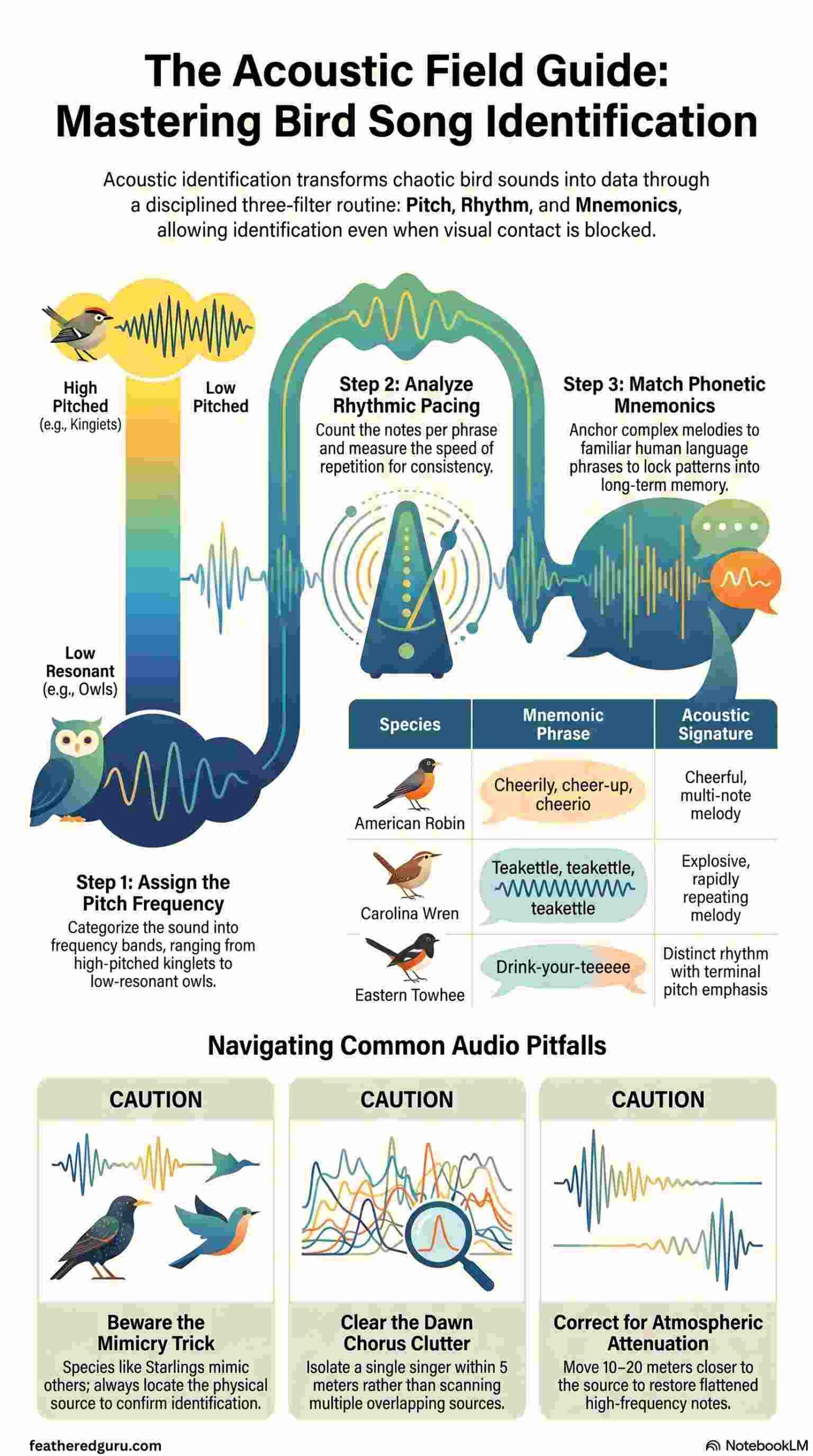
Bird Song Frequency Guide: Comparative Sound Matrix
This comparative sound matrix condenses our full structural guide into a single scannable canvas to help you instantly adjust for audio pitch variations and filter backyard bird species by their true mnemonic zones. Reviewing this acoustic frequency chart allows you to map overlapping melodies into clear, recognizable patterns before checking our detailed family logs below.
Frequently Asked Questions: Bird Audio Identification
What is the easiest way to memorize backyard bird songs?
The easiest way to memorize bird songs is to pair phonetic language mnemonics with strict rhythmic pacing counts. Translating complex avian audio tracks into familiar spoken catchphrases allows your brain’s phonological network to instantly lock the melody into long-term memory.
Why do bird vocalizations sound different depending on the time of day?
Vocalizations sound distinct because shifting humidity levels alter atmospheric attenuation to change how high-frequency notes travel through dense summer leaves. Additionally, birds change their volume based on whether they are defending territory boundaries during the heavy morning dawn chorus or making quiet contact calls while foraging.
Can digital smartphone apps replace real-world ear training skills?
No, digital tracking apps should only serve as a quick secondary confirmation tool rather than an acoustic crutch for your daily logs. Relying blindly on automated software readouts prevents you from developing the active pattern recognition habits required to isolate overlapping melodies during peak outdoor activity windows.
Conclusion: Mastering Your Acoustic Routine
Integrating an auditory scanning discipline into every morning property watch permanently eliminates the tracking errors generated by visual-only identification strategies. Acoustic signatures remain accessible through dense foliage, at significant distances, and during the low-light periods that make visual field marks completely unresolvable.
Building genuine acoustic confidence requires committing to a three-filter sequence. Observers must check pitch band assignment, rhythmic pacing counts, and phonetic mnemonic matching in that fixed order before logging any vocalization-based identification until the routine becomes automatic.
Pairing this structured acoustic routine with the complete species profiles documented at our master backyard birds checklist creates an airtight daily field-craft habit. This practice generates accurate species counts from the first call note of the pre-dawn period through the last territorial song of the evening.
Keeping a structured audio baseline creates a personal acoustic reference library that builds identification accuracy with every session. Maintaining this discipline transforms your morning property count into a high-resolution, four-channel data sheet that no purely visual approach can replicate.