
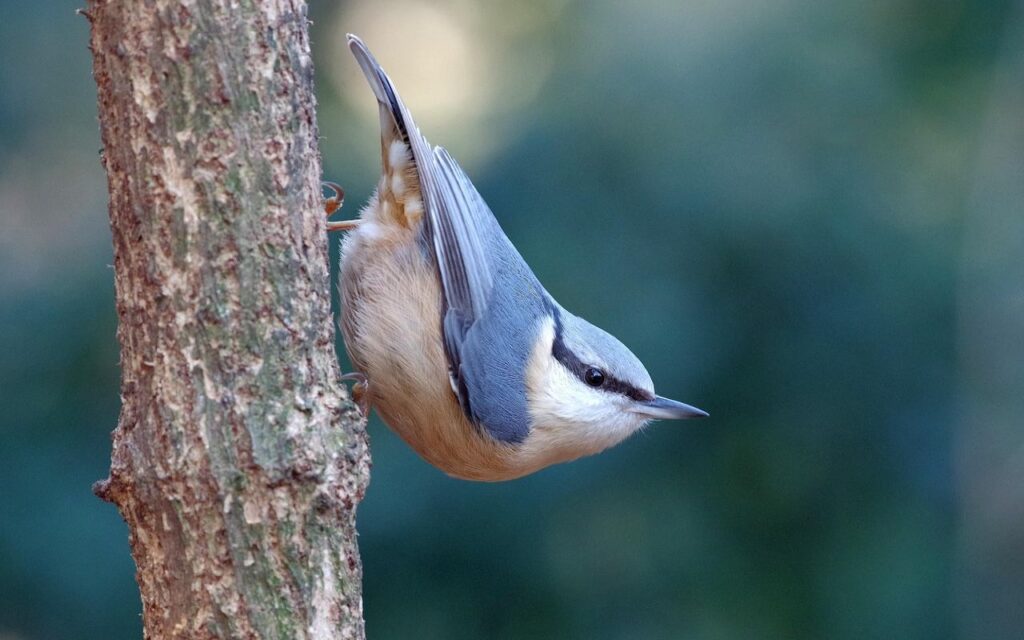
To identify a mystery bird by behavior, you must look at three dynamic action zones in this exact order: ground movement gait, tree-trunk navigation pattern, and foraging execution style.
Filtering your field-craft through these movement rules allows you to pinpoint a bird’s exact family identity within seconds. You can do this at extreme distances, under terrible lighting, or when thick branches completely obscure the bird’s feather colors.
Quick Answer: Why is bird behavior more reliable than feather color?
You identify birds by behavior because a species’ movement habits are hardwired and unchanging. Breaking physical movements into steady ground gaits, tree-climbing paths, and hunting styles allows you to instantly isolate look-alike families inside dense leaves without getting tricked by dark shadows or shifting seasonal feathers.
Why Tracking Bird Behavior Beats Tricky Feather Colors
Many beginners struggle with field guides because they treat birds as static portraits. To become an elite tracker, realize that a bird’s behavioral rhythm is a structural map. Its movement style reveals three immediate clues:
- Family Blueprint: Hardwired neural ticks separate look-alike families under any light.
- Energy Level: Metabolic rates dictate whether a bird moves erratically or methodically.
- Niche Preference: Feeding mechanics showcase exactly how a bird exploits its micro-habitat.
Observing action completes your foundational four-step strategy. This connects physical outlines from our Bird Identification by Shape guide with active field dynamics to stop identification errors.
Bird Behavior Comparison Chart
This behavioral summary map shrinks our entire field strategy into a single scannable cheat sheet. Use it to instantly differentiate overlapping silhouettes by tracking active gaits and foraging styles:
| Dynamic Movement | Common Family Examples | Core Biological Purpose |
|---|---|---|
| Two-Footed Hop | Sparrows, Finches, Thrushes | Low-weight ground foraging |
| Alternating Walk | Doves, Starlings, Crows | High-mass energy-efficient pacing |
| Centrifugal Tail Wag | Waterthrushes, Wagtails | Flushing hidden aquatic/ground prey |
| Vertical Trunk Climb | Woodpeckers, Creepers, Nuthatches | Sub-bark insect extraction |
| Splay-Footed Perch | Upright Flycatchers, Tyrant Guild | Rapid aerial launch preparation |
Decoding the Three Primary Behavioral Filters
1. Ground Movement Gait: Hop vs. Walk
How a bird travels across open turf instantly cuts your list of potential bird families in half.
- The Two-Footed Hop: Sparrows, finches, and thrushes move by springing with both legs simultaneously. This lightweight framework keeps them nimble near cover.
- The Alternating Walk: Doves, starlings, and blackbirds pace by moving one leg forward at a time. This energy-efficient pacing is found in heavy-bodied birds built for long foraging bouts.
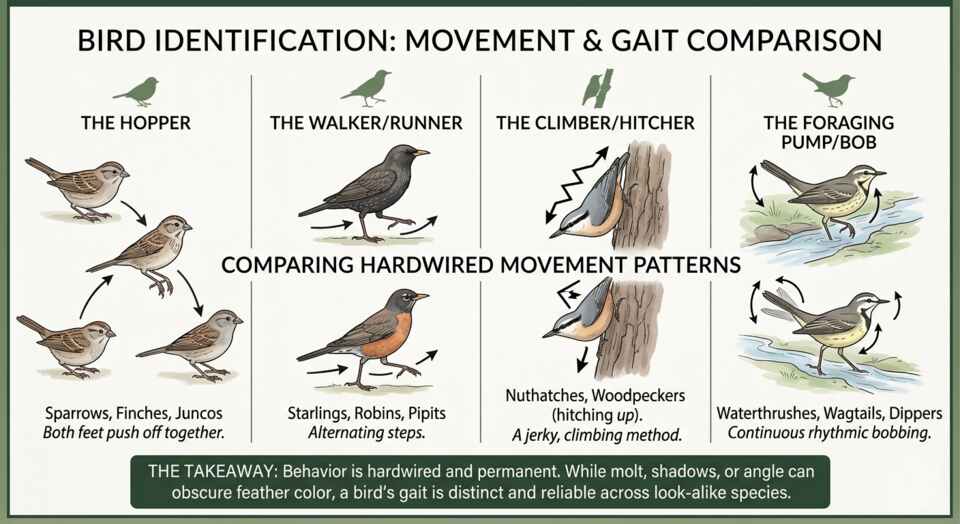
If you see a dark bird across a parking lot, ignore the color. If it hops nervously, it is a native sparrow or thrush. If it struts with an impatient, rhythmic pace, it is an invasive European Starling.
2. Tree-Trunk Navigation: Creep vs. Hitch
When a small brown bird lands on a vertical tree trunk, its travel vector rules out identical families.
- The Spiral Creep (Up Only): Brown Creepers use stiff tails as a prop, traveling strictly upward and outward in a spiral pattern around a tree trunk. When they finish, they fly to the base of the next tree to repeat the ascent.
- The Gravity Defier (Up and Down): Nuthatches do not use their tail feathers for balance. Their unique hip mechanics allow them to walk headfirst down vertical trunks or hang upside down beneath major branches.
- The Heavy Hitch (Vertical Driller): Woodpeckers tap, scale bark, and lean their body weight back on reinforced tails. They scale the tree in direct, sudden vertical hops or lateral hitches.
3. Foraging Mechanics: Dart vs. Glean
Watching how a bird gathers its food shows you its family-level operational blueprint.
- The Aerial Pounce (Flycatching): True flycatchers stand perfectly still on exposed twigs, dart into the air to snap a flying bug, and return to the exact same perch.
- The High-Energy Glean: Warblers are high-energy movers that flick their wings, twist, and pick bugs off leaves with an erratic, non-stop nervous motion.
- The Methodical Search: Vireos hunt in the same canopy leaves but travel slowly and deliberately. They sit still for seconds, peer under leaves, and snap bugs without flying erratically.
What Are the Most Common Behavioral Traps for Beginners?
The three major behavioral traps that trick beginners are the fear-induced posture shift, the foraging mimicry illusion, and the seasonal hyperactivity bias. Failing to adjust for these baseline shifts is one of the most widespread Beginner Bird Identification Mistakes.
Trap 1: The Fear-Induced Posture Shift
When a bird spots a hawk, cat, or human, its baseline relaxed stance changes instantly. A resting, fluffed bird will contract its muscles, raise its neck, and stand perfectly upright to prepare for flight.
- The Correction: Never judge a bird’s family posture while it is actively panicking or staring at you. Wait 10 seconds for it to resume normal, relaxed feeding behavior before logging its silhouette profile.
Trap 2: The Foraging Mimicry Illusion
Extreme hunger forces species out of their natural feeding niches. Drought or freezing cold can force a tree-dwelling pine warbler down onto the dirt to forage alongside sparrows, mimicking ground-hopping behaviors.
- The Correction: Cross-reference the foraging location with the bird’s actual physical hunting movement. A warbler on the ground will still move with rapid wing-flicks and zig-zag darts, completely differing from a sparrow’s steady two-footed scratch-and-hop.
Trap 3: The Seasonal Hyperactivity Bias
Spring migration fills backyards with high-energy birds competing for territory. This extra energy can make slow, methodical birds appear erratic, masking their normal identification profile.
- The Correction: Rely on hard, structural behavioral rules like tail-wagging frequencies or climbing directions. These physical ticks are locked in and stay stable during seasonal energy shifts.
Case Study: The Warbler-Vireo Movement Split
The most instructive case study in behavioral field identification involves separating North American warblers from vireos. These two insect-hunting families share the same size, green-yellow color palettes, and canopy habitats, which creates major confusion for beginners.
Research published by The Cornell Lab of Ornithology on All About Birds proves that tracking foraging speeds allows observers to separate these look-alikes without seeing their feather marks:
- The Warbler Blueprint: Moves at a manic pace, covering several feet of branch per second with constant, jerky hops.
- The Vireo Blueprint: Moves like a slow calculator, pausing on twigs for 3 to 5 seconds to look around before taking a single deliberate step.
This behavioral split solves identification puzzles under bad backlighting where color details vanish.
Frequently Asked Questions: Bird Identification by Behavior
Does a Bird’s Tail Movement Help With Field ID?
Yes. Tail ticks are highly diagnostic field marks. For example, Phoebe flycatchers pump their tails downward in a slow, heavy rhythm every time they land. Waterthrushes and Palm Warblers continuously bob their entire tail and rump up and down like a pump handle while walking.
Why Is My Backyard Woodpecker Feeding on the Ground?
Northern Flickers are North American woodpeckers with a unique dietary preference: they eat ants. While other woodpeckers stay on tree trunks to drill for beetles, Flickers spend most of their time hopping on lawns to dig up underground ant nests. The official Audubon Field Guide notes that their ground-foraging patterns are a distinct feeding behavior that separates them from other tree-clinging species.
Can You Identify a Bird Solely by Its Flight Style?
Yes. Flight dynamics are deeply consistent within bird families. Woodpeckers and finches use an undulating, roller-coaster flight path where they flap upward and tuck their wings to coast downward. Swallows fly with rapid, sweeping, fluid zig-zags close to the ground or water.
The Science Behind Avian Locomotion
To truly protect your field logs from identification errors, you can look beyond birdwatching guides to peer-reviewed biomechanics studies. Evolutionary constraints lock different songbird groups into exact movements.
Peer-reviewed studies prove that a bird’s daily habits are hardwired into its family tree. You can rely on these three scientific rules to keep your field logs accurate:
- Fixed Habits: A behavioral study in PLOS ONE shows that while migration routes change as birds grow older, their main movement styles lock in during their very first year. This means an adult bird’s profile stays steady and reliable across every season.
- Smart Foraging: Research in Animal Cognition through Springer Nature reveals that a bird’s hunting style directly matches its natural brainpower and body habits. Food-storing species like nuthatches use unique templates to find food, making their actions highly predictable.
- Weather Buffers: Climate studies in Elsevier ScienceDirect show that while summer heat waves cause visible stress, birds change their feeding spots based on food availability. This is exactly why you must track their physical leg gait rather than just timing how fast they run.
Conclusion: Mastering Your Behavioral Routine
Integrating behavioral tracking into your observations stops the errors caused by tricky colors. Hardwired movement details remain clear in heavy tree shade, under grey skies, and across changing seasons.
Building behavioral fluency requires practicing your tracking order. Check the ground gait first, look for trunk climbing directions second, and examine foraging mechanics third. With steady practice, this routine helps you recognize bird families instantly.
Pairing these tracking habits with our Backyard Birds Checklist creates a strong foundation for your yard counts. You can easily cross-check these movements against our universal Backyard Bird Identification Guide and combine them with your acoustic skills at How to Identify Birds by Song or visual profiles at How to Identify Birds by Color and Identify Birds by Size to build an airtight field routine.