
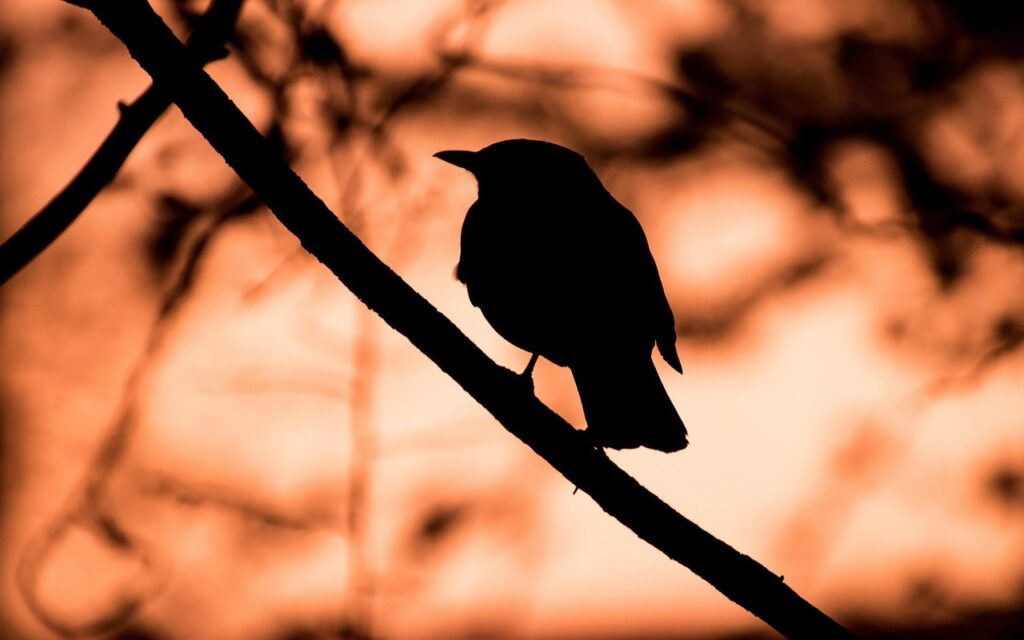
Bird identification by shape is one of the most reliable tools you can use because it is weatherproof, season-proof, and distance-proof. Unlike bright feather colors that quickly fade, change with the seasons, or get hidden by dark shadows, a bird’s basic body shape always stays exactly the same.
Shifting your focus away from tricky colors and training your eyes to look at body outlines instead creates a foolproof bird-watching habit. This makes backyard identification more consistent in everyday conditions, under any lighting, from morning backlight to dark tree branches, all year long.
Quick Answer: Why is bird shape more reliable than feather color?
Bird shape is more reliable than color because a bird’s body bones stay exactly the same size for its entire adult life. This makes a bird’s outline completely immune to seasonal feather shedding or tricky weather changes. Looking at body shapes lets you identify the right bird family even in dark shadows or harsh morning backlighting where feather colors disappear completely.
Bird Shape Basics: Visual Guide to Silhouettes
Before diving into specific bird families, it helps to understand the basics of shape first. This short visual guide shows how body outline, posture, wings, and tail shape can help you identify birds quickly, even without clear color or detail. Watch this first to build a simple shape reference you can use in the field.
Show Transcript:
0:00 Welcome to this explainer. Let’s jump right in because I want to take you back to my early and honestly incredibly frustrating days of backyard bird
0:08 watching. When I first started out, I was completely hopelessly reliant on feather colors. I mean, if a bird landed in perfect golden hour lighting, boom, I
0:16 felt like a total expert. But the second that same bird flew into a deep tree shadow or got backlit by the sky, my entire identification system just
0:25 completely collapsed. I suddenly realized I was spending way more time squinting than actually understanding the ecology right outside my own window.
0:32 So why did morning sunlight always ruin my bird watching? Well, the specific problem literally haunted me. I remember stepping out at dawn, which, you know,
0:40 is the absolute best time to hear territorial songs and to see active foraging. But I’d step out there, coffee in hand, only to find the harsh morning
0:47 glare completely erasing all the plumage colors. I was just left staring at these flat, featureless black silhouettes that I couldn’t identify at all. I would hear
0:55 this incredible symphony of birds, look up into the branches, and log absolutely nothing. The color data was just completely blown out by the sun. Right
1:03 then, I knew I needed a massive paradigm shift in my fieldcraft. I really had to transition from the color dependent me who was constantly getting defeated by
1:11 bad lighting to the silhouette trained me. Basically, I had to stop relying on shifting color fields and start reading structural contours. I discovered that
1:20 shape actually creates this indestructible baseline for my observations. When I stopped looking for pigments and started looking for structural outlines instead, that harsh
1:28 morning backlight suddenly went from being my absolute worst enemy to my greatest tool. And that led to my massive epiphany, skeletal permanence. I
1:38 figured out that while colors were constantly lying to me in those deep tree shadows, a bird’s true structural profile and its skeletal shape never
1:46 actually changed. I mean, think about it. feathers mold, lighting shifts, but bone structure, that is an absolute anatomical constant. Once I locked onto
1:56 the idea that a bird’s skeleton is a fixed biological framework, a whole new world of reliable identification just completely opened up to me. And my new
2:04 method wasn’t just some personal hunch either. When I actually dug into the science, I found this formal research by Zephr and colleagues in the biological
2:13 journal of the Linnean Society. Get this, their data proved that hind limb bone proportions vary by less than 4%
2:20 within passerine families. Just 4%. That figure gave me so much confidence. It basically confirmed that skeletal geometry is tightly limited by
2:29 evolutionary history. It meant the shapes I was seeing were highly reliable, permanent structural baselines that I could totally trust day in and
2:36 day out. So, to turn this science into a practical routine, I developed a very specific three-step mental checklist, I
2:45 now apply this in literally the very first seconds of seeing any new bird in my yard. I call it my 3-second structural scan. First, I check the
2:53 bill geometry. Second, I apply the tail filter. And third, I finish with a posture filter. Instead of wildly scanning for colors like I used to, my
3:01 eyes now move in this highly disciplined systematic path that extracts family level data almost instantly. Okay, so the crucial point is exactly how I
3:09 execute step one. I immediately look at the bill’s length and its thickness and I compare that to the total depth of the head. If a bill’s base depth is massive,
3:17 like over 35% of the head width, I instantly know I’m looking at a seed cracking finch or a grosbeak. If the bill’s length is way longer than the
3:25 head depth, well, it’s an insect probing wren or creeper. And if the length equals the head depth, but has a flat tip, boom, I’ve got a woodpecker. This simple
3:33 ratio instantly tells me the bird’s dietary guild without me needing to see a single feather pigment. Now, when a bird lands on my feeder, I just don’t look for yellow or red feathers anymore.
3:43 Instead, I look for the visual contrast between, say, a massive thick finch cone and a tiny delicate warbler needle.
3:51 Honestly, it’s the absolute fastest family separation I can make. In under 2 seconds, just by glancing at the head, I’ve already filtered out dozens of
3:58 incorrect species possibilities. It’s a real game changer. Moving on to step two, I lock my eyes right onto the tail tip configuration. The cool thing here is
4:07 that even if the bird is so far away that the bill is completely unresolvable, the tail shape still tells me exactly what its flight physics and
4:14 behavioral guild are. deeply forked high-speed aerial insectivore like a barn swallow, square tipped European
4:21 starling, pointed and elongated mourning dove. It’s just an incredible secondary diagnostic tool that basically never
4:27 fails me. Then we hit step three, which is reading the spinal posture angle relative to the perch. I found this
4:35 actually gives me the absolute fastest family level assignment possible. Think about it. A thrush or a flycatcher sits up straight nearly perpendicular to the
4:44 ground. A dove compresses horizontally parallel to the branch. Sparrows, they sit at this intermediate 45 degree angle
4:51 with a compressed neck that makes them look totally spherical. And of course, woodpeckers have that totally unique vertical cling against tree trunks. Once
5:00 I started reading the spine, the bird’s posture basically started announcing its family name to me from all the way across the yard. But I have to admit, my
5:09 transition to structural tracking wasn’t totally perfect. Even with this shiny new system, I hit some pretty major roadblocks. Actually, I consistently
5:18 fell for three specific anatomical illusions that completely corrupted my early log books. Standard field guide illustrations. Yeah, they never prepared
5:26 me for these distortions. So, I want to share exactly how I learned to escape them, just so you don’t end up making the exact same mistakes I did. The very
5:35 first trap was the cold weather inflation illusion. On freezing mornings, sparrows would puff up their contour feathers to trap warm air, which
5:43 increased their volume by up to 50%. No way, right? I was essentially logging tiny little sparrows as massive thrushes
5:51 just because they were wearing their winter coats. I was totally judging size by subjective bulk. So, the fix I use now, I assess against a fixed reference
6:00 object. I started using my sew cage wires or the feeder ports as an objective visual scale. And poof, suddenly the illusion vanished. The
6:08 second big mistake was foreshortening distortion. I used to stand directly under my oak tree looking straight up at a long-tailed northern mockingbird.
6:17 Well, from that exact angle, the tail completely compressed into the torso, disguising it as a short-tailed European starling. The fix for this one was
6:25 incredibly simple. I literally just took a few steps laterally by shifting my observation angle by 20 to 30°. The
6:32 visible tail length immediately restored to its true proportion, entirely fixing that geometric compression. And then my third trap was the tail molt deception.
6:41 In late summer, birds would drop their tail feathers to molt, making these familiar visitors in my yard suddenly look completely alien, truncated, and
6:50 just really irregular. I escaped this trap by falling back on step one of my scan, the beak. I learned to cross
6:57 reference the confusing tail with the fixed bill geometry. I mean, even if a finch had literally no tail feathers left, that massive seed cracking bone
7:05 cone on its face wasn’t going anywhere, it really proved to me that relying on bone over feathers is always, always the safer bet. But, you know, even after
7:15 mastering those traps, I experienced one massive, truly humbling moment. I realized that a European starling in my
7:22 yard literally looked like a structurally different bird from one season to the next. In the fall, its wings looked incredibly long and
7:30 pointed, but by late summer, the exact same bird looked stubby and worn down. I honestly thought my eyes were failing me. I was like, “Wait, how could a fixed
7:38 structural shape suddenly change?” Well, it turns out I wasn’t crazy. I dug into the research and found this fascinating study by Swaddle and Witter from 1997.
7:47 They actually proved that a starling in fresh molt plumage literally has longer, more pointed wings than a worn late summer one. Their shapes actually adapt
7:56 structurally based on seasonal flight demands. This absolutely blew my mind.
8:01 It forced me to realize that silhouette tracking requires seasonal calibration.
8:05 I couldn’t just memorize a single static template anymore. I really had to understand how the bird lived and adapted throughout the entire year. So
8:12 committing to this three zone assessment, the bill, the tail, and the posture has honestly given me an airtight, weatherproof field routine. It
8:20 completely eliminates all those frustrating errors caused by color-based strategies. This new discipline completely transformed how I understand the ecology of my own backyard. It made
8:28 me a faster, more accurate, and frankly a much happier observer. Mostly because I finally felt like I was reading the true biological framework of the birds
8:36 around me. So, as we wrap up, I want to leave you with a personal challenge based on the exact shift I had to make.
8:42 Step out into your yard tomorrow morning. Deliberately ignore the feather colors. Just watch the shapes. Check that bill to head ratio. Look at the tail tip. And read the spinal posture.
8:52 See what those permanent structural shapes tell you. I guarantee that once you start seeing the skeleton beneath the feathers, you will literally never look at your backyard the same way
9:00 again. Thanks so much for joining me on this explainer.
How Bird Shape Helps You Identify Species
Many beginners struggle to read bird shadows (silhouettes) because they just see them as flat, boring outlines. To become a pro at bird watching, you need to realize that a bird’s outline is actually a built-in identification map. Its body shape is designed by nature to show you three important clues all at once:
- What It Eats: The size and shape of the head and beak instantly tell you how the bird finds food.
- How It Moves: The length of its legs and the shape of its wings show you exactly how it flies, hops, or walks.
- Where It Lives: The way a bird holds its body shows you the types of places it likes to hang out, such as high up in tree branches or down on the ground.
A bird’s outline is never just a simple shadow. It is a helpful cheat sheet that shows you the bird’s beak type, flying skills, and daily habits in the very first second you look at it.
Learning to read these outlines connects bird shape to four supporting clues: size, patterns, behavior, and sound:
- Size Class: Comparing how big the bird looks against a familiar object in your yard, like a bird feeder port.
- Shade and Patterns: Looking at the clean lines between light and dark feathers rather than getting confused by bright colors that can fade or change.
- Habits and Movement: Watching how the bird behaves, such as how it walks, climbs, or flicks its tail.
- Bird Songs: Double-checking your visual guess by listening to the bird’s unique call or melody.
This entire four-step strategy is explained in full detail at the Feathered Guru backyard bird identification guide, which serves as the main learning center for every skill in this beginner series.
Why Bird Shape Works Better Than Color
A bird’s shape serves as a steady framework that is completely immune to weather and lighting changes. Shifting sunlight, deep tree shadows, and seasonal feather shedding constantly distort bright colors. However, a bird’s true bone sizes remain entirely unchanged throughout its adult life.
This physical permanence makes shape one of the most reliable tools available. It still delivers accurate family clues in harsh lighting where bright colors disappear completely.
Why Shape Stays Consistent Within Bird Families
Bird shape is incredibly reliable because it stays mostly identical across an entire bird family. Even though birds within the same group can vary wildly in color, age, or sex, their core body structure stays stable. You can break this family pattern down into a few simple features:
- Leg Length: Instantly separates ground-walking birds from tree-perching birds.
- Bill Shape and Size: Provides a direct clue to the bird’s unique feeding style.
- Tail Length: Reveals how the bird balances and steers through the air.
- Body Proportions: Easily separates look-alike species within the same size class.
The 4% Biological Rule
These physical traits are locked tightly into a bird’s family tree. In fact, formal research published by Zeffer et al. in the Biological Journal of the Linnean Society demonstrates that leg bone proportions vary by less than four percent within songbird families.
This tiny margin of variation proves that a bird’s shape is strictly limited by its evolutionary history. This strict anatomical rule provides birdwatchers with an incredibly reliable, rock-solid baseline for identifying species.
How Lighting Affects Bird Identification
Strong backlighting, especially during early morning or late evening, can completely wash out bird colors. In these conditions, birds often appear as dark silhouettes with very little visible detail.
When this happens, your identification approach needs to shift:
- Shape-based observers can still identify birds using outline, posture, bill shape, and tail length
- Color-based observers often lose most identifying details and struggle to make a clear match
This is why lighting is one of the biggest challenges in field identification, especially at sunrise when birds are most active. Even though color can become unreliable in harsh light, shape and structure remain visible in almost all conditions. That’s why experienced birders rely on silhouette first when visibility is poor.
Because color tracking fails when lighting shifts, the Cornell Lab of Ornithology’s core identification guides consistently prioritize size and shape as the first filters applied to any unknown bird. Structural shape data remains completely available under all lighting conditions, while variable color data does not.
For a look at how to expand this workflow into wider population counts across your property, read our step-by-step master checklist overview at the Backyard Birds Checklist.
How to Read a Bird Profile Using Beak Shape, Tail Tips, and Posture?
To judge a bird’s beak shape, compare the length and thickness of the beak against the overall size of its head from the top of the crown down to the throat. This simple trick quickly tells you what the bird eats without needing to see any colors at all.
- Finches and Grosbeaks: A very thick beak base that takes up more than a third of the head width identifies a seed-cracking bird.
- Wrens, Creepers, and Woodcreepers: A long, thin beak that is one and a half times longer than the head identifies an insect-hunting bird.
- Woodpeckers: A straight beak that is the exact same length as the head with a flat, chisel-like tip identifies a woodpecker, even from far away.
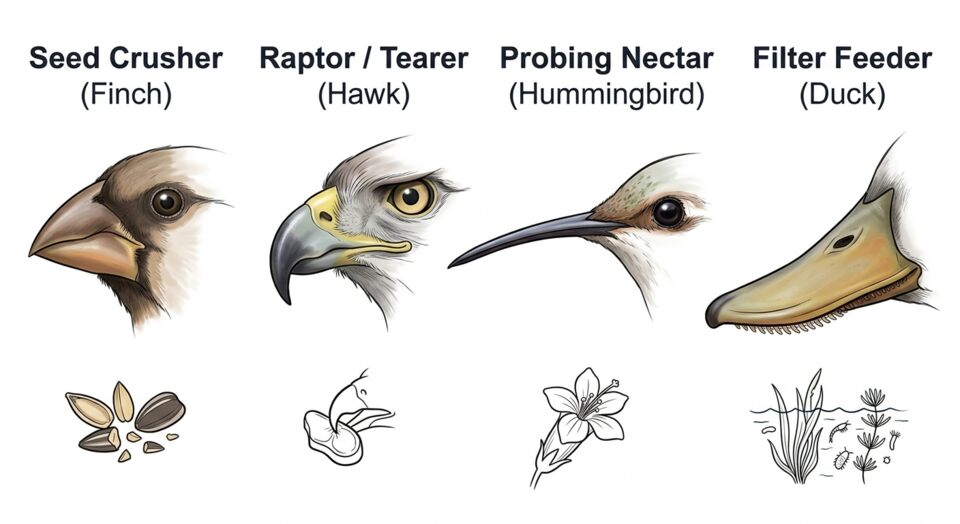
The contrast between a thick finch cone and a thin warbler needle is the fastest trick available to a backyard birdwatcher. It lets you figure out the bird family in under two seconds from any side angle.
For a detailed breakdown of how this head-and-beak comparison separates the most commonly confused look-alike birds in North America, check out the guide at Downy vs. Hairy Woodpecker.
The Tail Filter
Looking at the shape of a bird’s tail tip is your second best tool. It gives you family clues without needing to see the beak at all. Best of all, it works perfectly from far away when a bird’s beak is too small to notice. Each tail shape tells you how the bird flies and lives.
- Deeply Forked: Shaped like a sharp, deep V (like a Barn Swallow). This shape tells you the bird is a high-speed stunt flier that catches flying bugs out of the air.
- Slightly Notched: Features a small, shallow cutout at the tip (like a House Finch).
- Square-Tipped: Perfectly flat across the bottom (like a European Starling).
- Rounded: Curves gently outward like an open hand fan (like a Carolina Wren).
- Pointed and Long: Narrows into a sharp point (like a Mourning Dove). This shape tells you the bird prefers walking on the ground or sitting on branches for long-distance trips, rather than doing quick twists and turns in the air.
Locking your eyes onto the tail shape during the first few seconds stops you from making common mistakes. It prevents you from mixing up look-alike backyard birds that share the same colors but fly and behave completely differently.
To see how the tail length matches up against the rest of a bird’s body size, check out the guide at Identify Birds by Size.
The Posture Filter
The angle of a bird’s back while sitting on a branch provides the fastest family identification in any scenario:
- Trunk Clingers: Woodpeckers sit straight up against vertical bark rather than flat branches. Their bodies stay parallel to the tree trunk, making a unique silhouette you can spot instantly.
- Upright (80 to 90 degrees): Sitting almost straight up and down identifies members of the thrush family or the flycatcher guild.
- Flat (10 to 20 degrees): Sitting nearly flat and parallel to the branch identifies doves and resting flycatchers.
- Angled (45 degrees): Sparrows sit at a medium angle and tuck their necks in. This hides the line between the head and body, creating a round, neckless ball shape that separates them from thrushes, doves, and finches.
What Are the Most Common Silhouette Traps for Beginner Birders?
The three primary structural illusions that trick beginners are the cold-weather inflation illusion, the foreshortening angle distortion, and the tail-molt deception. Each problem causes a unique mistake that standard field guide pictures do not prepare you to handle.
Each issue has a simple visual fix that solves the mistake without needing to see bird colors, buy special gear, or have years of field experience. Use this quick guide to beat these three common traps:
The Cold-Weather Inflation Illusion
Birds fluff up their feathers to trap warm air against their skin on freezing mornings. This action makes their bodies look 30 to 50 percent bigger than they actually are, making small sparrows look almost as large as thrushes.
The Cold-Weather Inflation Correction
- The Trap Fix: Judge the bird’s size against a fixed object rather than guessing based on its fluffed-up body.
- Scaling Clue: A suet cage wire grid or a feeder port opening gives you a steady, unchanging scale that feather fluffing cannot trick.
- Visual Marker: If a bird looks as big as a robin but has a short, tiny sparrow beak compared to its head, it is just a puffed-up sparrow keeping warm.
- Expert Source: The Audubon Society Guide to Birding notes that judging size in the field is tough. They recommend comparing the bird to surrounding objects or other nearby birds to avoid being fooled. This completely eliminates the inflation illusion if a steady reference object is in view.
- Learn More: See how winter birds change their daily habits and shapes in the guide to Winter Bird Identification.
The Foreshortening Angle Distortion
Looking at a bird from directly underneath its perch squishes the look of its tail and beak into its main body. This flat angle makes a long-tailed Northern Mockingbird look just as short and compact as a European Starling.
The Foreshortening Correction
- The Trap Fix: Move your body to change your view by 20 to 30 degrees away from the direct “underneath” spot before guessing tail length.
Visual Marker: Step sideways until the bird is at least at a 45-degree angle from directly overhead. This restores the tail to its true length relative to the body and fixes the squished look that makes long-tailed birds look deceptively short-tailed.
The Tail-Molt Deception
Sudden, uneven feather loss during late-summer molting cycles temporarily strips away a bird’s normal tail shape. This causes species with distinct tails to look short, broken, or uneven, which can make them mimic completely different bird families.
The Tail-Molt Correction
The Trap Fix: Cross-reference the broken tail against the bird’s beak shape, which never drops its feathers or changes size.
Visual Marker: A bird with a short, missing tail that still has a thick, cone-shaped finch beak is definitely a member of the finch family. The beak is a hard bone structure that never changes during a molt cycle.
Expert Source: Research by Jenni and Winkler (1994) confirms tail molt follows a fixed sequence that starts at the center and moves outward. This means key tail outlines are always the last to leave and the first to return. You can access these foundational plumage lifecycle frameworks directly through Oxford Academic’s The Condor database.
Learn More: Read about the weird shapes caused by molting adults and young birds in the guide to Beginner Bird Identification Mistakes.
Case Study: Seasonal Silhouette Shifts
The European Starling is the best example of how seasonal changes can warp a bird’s silhouette. Its body shape shifts throughout the year, which easily confuses birdwatchers who expect it to always look the same.
Research by Swaddle and Witter (1997), published in the Canadian Journal of Zoology, proves that starling wing and tail shapes change to match their flight needs during different seasons. They do not stay perfectly static. This means you must adjust your silhouette expectations based on the time of year rather than relying on a single mental template.
As a practical result, a starling in fresh autumn feathers shows long, pointed wings. The exact same bird in late summer will have worn, broken wingtips that make its silhouette look much less pointed. To learn how its short, square tail and unique walking gait separate it from thrushes, see the full profile at How to Identify European Starlings.
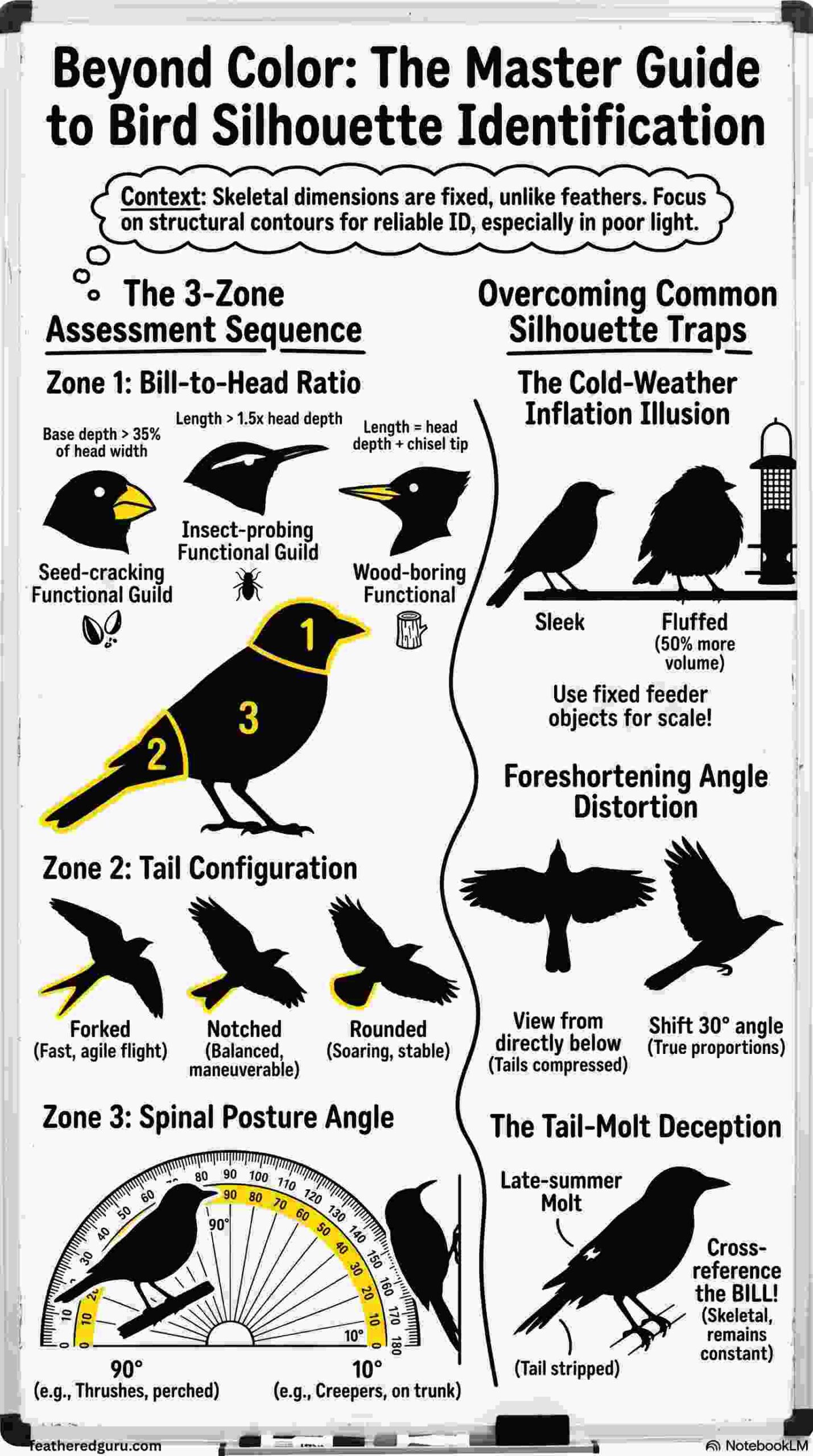
Bird Shape Profile Guide: Quick Bird Silhouette Chart
This simple bird shadow chart shrinks our complete identification guide into a single, easy-to-read picture. Use it to instantly spot body posture changes and sort backyard birds by their true physical shapes. Reviewing these simple outlines helps you turn confusing bird shadows into clear, recognizable patterns before you read our detailed family guides below.
Frequently Asked Questions: Bird Identification by Shape
How Does a Bird’s Posture Help With Identification?
A bird’s perching angle instantly tells you its family. Upright birds sitting at 70 to 90 degrees belong to the thrush or flycatcher families. Flat-sitting birds sitting at 10 to 25 degrees belong to the dove or kingfisher families. You can read this posture clue in one second from any distance where the bird’s full body outline is visible.
Can a Bird Change Its Shape Profile Based on Weather?
Yes. On freezing mornings, birds fluff up their feathers to trap warm air. This trick makes them look up to 50 percent bigger and hides their necks completely. To avoid being fooled, ignore the bird’s overall fluff and focus on the beak shape or tail tip instead. Those hard structures never change size with the weather.
What Is the Most Critical Anatomical Zone to Check in a Silhouette?
The head and beak area is your most important zone. It tells you what a bird eats and its exact family family in under two seconds. A beak deeper than a third of the head width means it cracks seeds. A thin beak longer than the head means it hunts insects. A straight beak equal to the head length with a flat tip means it is a woodpecker.
Conclusion: Mastering Your Silhouette Routine
Integrating a structural scanning discipline into your observations eliminates the errors caused by color-first strategies. Silhouette data remains clear under all lighting conditions, across seasonal plumage states, and at tricky angles that standard field guide illustrations do not prepare you to handle.
Building genuine silhouette fluency requires committing to the three-zone assessment sequence. You must check bill-to-head ratio first, tail tip configuration second, and spinal posture angle third. Through deliberate practice, this sequence quickly compresses into the automatic recognition that distinguishes experienced field observers from beginners.
Keeping this structured silhouette baseline as a permanent reference creates a highly precise identification routine regardless of weather or season. You can easily cross-check these shapes against the acoustic skills documented at How to Identify Birds by Song and the plumage techniques at How to Identify Birds by Color to build an airtight field routine.