
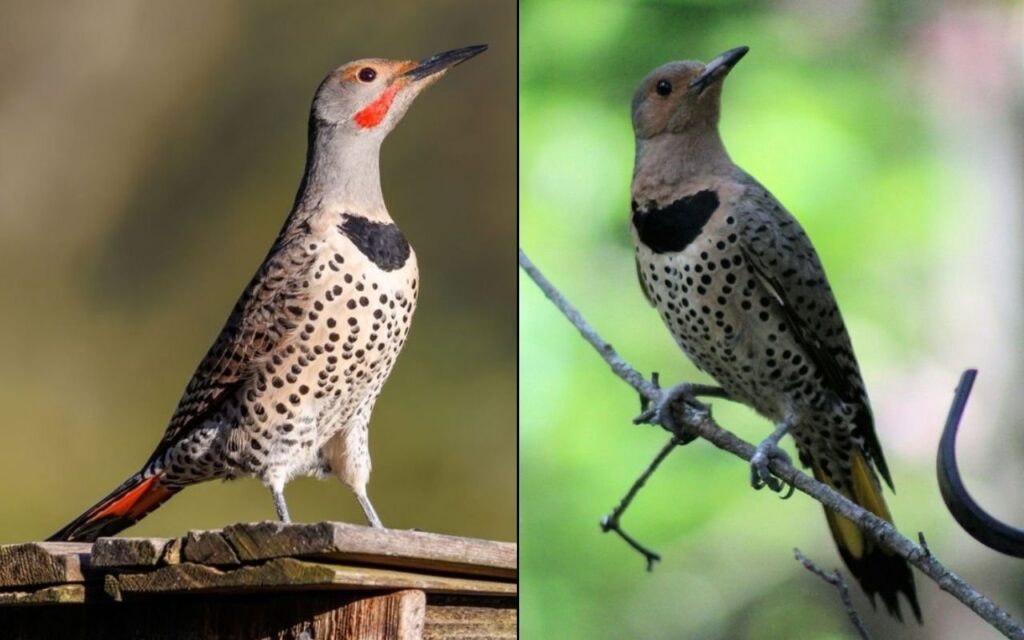
Understanding the distinction between the Northern Flicker vs Yellow-shafted Flicker begins with untangling species rank from regional subspecific variation. The Yellow-shafted Flicker is not an independent species; it represents the eastern and northern subspecies group of the overarching Northern Flicker species (Colaptes auratus).
Birders frequently encounter confusion across field identification groups when trying to separate the broad species designation from its regional forms. In North America, the Northern Flicker splits primarily into the eastern Yellow-shafted form and the western Red-shafted form, alongside an extensive zone of intergradation where both types interbreed freely.
Taxonomic Hierarchy and the Subspecies Classification Breakdown
The Northern Flicker (Colaptes auratus) belongs to the order Piciformes and the woodpecker family Picidae. Historically, taxonomic authorities considered the Yellow-shafted Flicker (Colaptes auratus) and the Red-shafted Flicker (Colaptes cafer) to be two distinct biological species.
In 1973, the American Ornithologists’ Union formally lumped these birds into a single species due to extensive, fertile interbreeding throughout their geographic contact zones.
The Yellow-shafted designation encompasses two major regional subspecies, Colaptes auratus auratus in the southern United States and Colaptes auratus luteus across the northern United States and the Canadian boreal forest.
Conversely, the western Red-shafted group contains Colaptes auratus cafer and the larger interior subspecies Colaptes auratus collaris.
- Northern Flicker represents the complete monophyletic species (Colaptes auratus) across all continental populations.
- Yellow-shafted Flicker designates the eastern and boreal subspecies group possessing bright yellow wing and tail quills.
- Red-shafted Flicker designates the western montane and coastal subspecies group bearing salmon-red underwings.
- The Gilded Flicker (Colaptes chrysoides) of the Sonoran Desert remains a separate, distinct biological species despite superficial plumage similarities.
When field observers refer to a Yellow-shafted Flicker, they are pinpointing the specific eastern morphology of a Northern Flicker. Every Yellow-shafted Flicker is a Northern Flicker, but not every Northern Flicker is Yellow-shafted.
Phenotypic Field Marks and Plumage Carotenoid Differentiation
Identifying a pure Yellow-shafted Flicker relies on distinct plumage criteria concentrated on the head, nape, and flight feather shafts. The primary and tail feather quills show brilliant lemon-yellow coloration on their undersides, caused by dietary carotenoid pigments deposited directly into growing feather keratin.
In flight, the underwings reveal a brilliant golden glow that contrasts sharply against dark dorsal bars. The head patterns offer the most reliable stationary field marks for separating the Yellow-shafted form from western congeners.
Yellow-shafted Flickers exhibit a blue-gray crown that transitions into a warm tan or brown face, bordered by a prominent red crescent across the nape of the neck. Adult males display a clean black malar stripe extending backward from the base of the lower mandible.
- Shaft and flight feather undersides display bright lemon-yellow keratin pigmentation.
- Nuchal patch displays a vivid horizontal red crescent across the gray hindneck.
- Facial coloration features warm tan or light brown cheeks paired with a contrasting slate-gray crown.
- Male malar stripe consists exclusively of solid black feathering with no red edging.
- Female malar area remains entirely plain tan, lacking both red and black pigmentation.
In contrast, western Red-shafted birds possess a brown crown, bluish-gray cheeks, red malar stripes in males, and entirely lack the red nuchal crescent on the nape. Recognizing these exact feather arrangements prevents misidentification during seasonal migration when northern populations push southward.
Hybrid Swarm Dynamics Along the Great Plains Suture Zone
Where the eastern and western populations collide, identification becomes significantly more complex. In field observation communities like r/birdwatching, observers in Nebraska, Kansas, and the Colorado Front Range regularly post images of confusing birds displaying mixed phenotypic markers.
These intermediate birds are the product of a massive hybrid zone running along the western edge of the Great Plains, roughly tracing riparian corridors along the Platte River and extending north into Alberta.
Field ornithologists have tracked this hybrid swarm for decades, noting that paired matings produce fully fertile offspring exhibiting mosaic phenotypes. An individual bird might carry the red nuchal patch of a Yellow-shafted parent while displaying the red malar stripe or salmon-orange flight shafts of a Red-shafted ancestor.
These complex genetic combinations make absolute categorization impossible without examining individual feather tracts.
- Wing and tail quill shafts in hybrids often present an intermediate salmon, apricot, or dull orange hue.
- Male hybrids can display black malar stripes flecked with red feathers, or red stripes edged in black.
- The red nape crescent may present in hybrid birds as a faint, asymmetrical mark or a few scattered red barbs.
- Crown and cheek boundaries frequently blur, showing muddy mixtures of slate-gray and cinnamon-brown.
Birders recording sightings in the Great Plains must carefully document multiple angles of the head and wings. Labeling these individuals simply as Northern Flicker (Yellow-shafted x Red-shafted hybrid) reflects the true biological reality of this suture zone.
Lingual Hyoid Morphology and Ground Foraging Ecology
Unlike typical woodpeckers that drill deeply into rotting wood for wood-boring beetle larvae, the Northern Flicker operates primarily as a specialized terrestrial forager. Yellow-shafted Flickers spend significant portions of the day hopping across open turf, woodland edges, and forest clearings hunting formicine ants. Ants can comprise well over seventy percent of the seasonal diet of Colaptes auratus.
To extract subterranean prey, the flicker relies on a specialized lingual apparatus. Its hyoid apparatus is exceptionally long, featuring cartilage horns that loop backward over the occipital bone of the skull, converge near the forehead, and extend into the right nasal cavity.
Paired with hypertrophied salivary glands that coat the barbed tongue with an extremely viscous mucus, this mechanism acts like a high-tensile dipstick inside underground ant tunnels.
- Hyoid horns wrap entirely around the posterior skull to allow the tongue to extend up to two inches past the bill tip.
- Specialized maxillary salivary glands secrete alkaline mucus capable of neutralizing formic acid defenses.
- Stiff, down-curved bills function as robust chisels to break through soil crusts and ant mounds.
- Heavy reliance on terrestrial prey exposes flickers to direct hazards from turf pesticides and surface ground predators.
Because these birds feed heavily on lawns, urban chemical applications present a recognized environmental hazard. Ground foraging also limits flicker mobility relative to canopy species, making them especially vulnerable to domestic cats and raptors during long feeding bouts.
Backyard Feeder Hardware and Tail Prop Mechanics
Attracting Northern Flickers to backyard stations requires specific hardware dimensions that match their specialized morphology. On community forums like r/backyardbirds, backyard enthusiasts routinely report that flickers struggle on standard small hanging wire cages, often flapping wildly before abandoning the food source.
Because flickers are large woodpeckers measuring eleven to twelve inches in length, they require a solid surface against which they can brace their stiff tail retrices. Standard 5-inch square suet baskets do not provide adequate lower support, forcing the bird into an awkward horizontal hang that stresses their leg joints.
Successful feeding stations incorporate an elongated wooden tail-prop board that extends at least 8 to 12 inches below the bottom of the wire cage. This flat wooden surface mirrors the bark of a tree trunk, allowing the bird to anchor its tail feathers and feed comfortably while conserving energy.
- Feeder body should incorporate an 8-inch to 12-inch untreated cedar tail-prop extension below the wire basket.
- Wire excluder grid spacing should measure standard 1.5-inch gauge to block larger corvids while permitting flicker bill entry.
- Feed stations must be mounted between 5 and 7 feet off the ground near dense shelter to mitigate outdoor cat strikes.
- Food offerings should prioritize raw rendered beef suet free of glycerin, unrendered fats, and chemical fillers.
High-melting-point beef suet blended with peanut flour or insect meal matches the digestive requirements of Colaptes auratus during cold weather periods. Offering stable tail support ensures that local Yellow-shafted Flickers remain steady visitors to your feeding station throughout the winter months.