
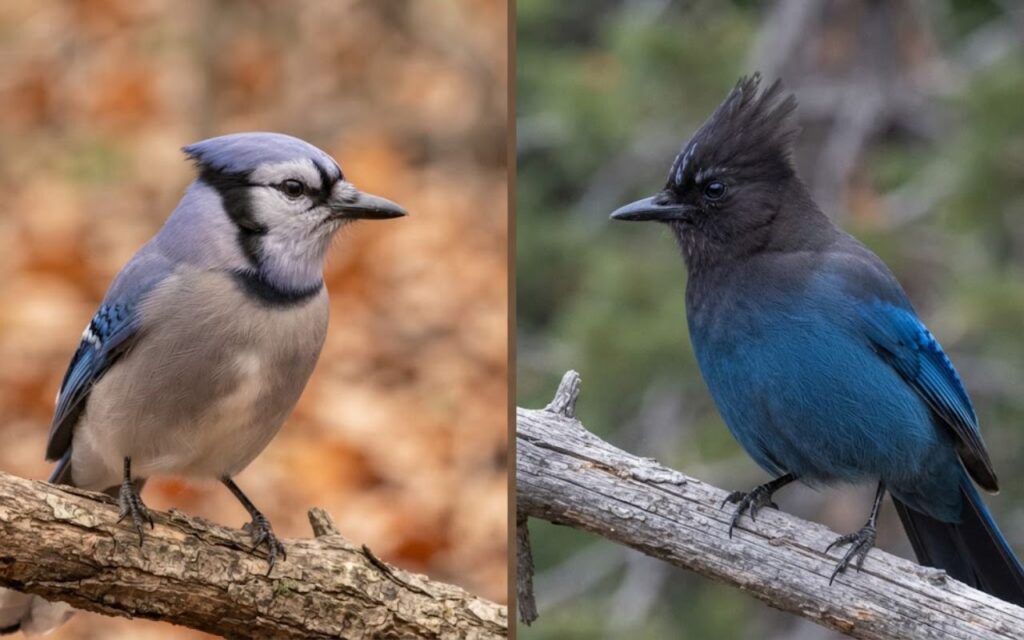
Distinguishing a Blue Jay vs Steller’s Jay in the wild comes down to recognizing key structural markings, geographic distribution, and distinct behavioral signatures. While both corvids share an ancestry within the genus Cyanocitta, their visual patterns and ecological niches diverge significantly across North America.
Birders encountering these energetic birds often struggle during fleeting glimpses or in transitional habitats where territory lines blur. Understanding subtle feather markings, regional vocalizations, and foraging habits will ensure you make an accurate field identification every time.
Quick-Glance Field Summary
Field identification between these two corvids relies on noting underparts coloration and geographic location, as their physical ranges barely overlap outside narrow hybrid zones. Inspect the chest for either clean white feathers or uniform charcoal blue, and check the crest coloration to make an immediate determination.
- Blue Jay range: Central and eastern North America, expanding west into the Rocky Mountain foothills
- Steller’s Jay range: Western montane coniferous forests from Alaska southward through the Rockies and Pacific Coast
- Blue Jay breast plumage: Pure white belly with a pronounced black necklace across the throat
- Steller’s Jay breast plumage: Dark charcoal to soot-brown chest transitioning into deep Prussian blue
- Blue Jay wing markings: Pronounced white barring and prominent white spots on the secondary feathers and tail corners
- Steller’s Jay wing markings: Dark blue bars without white feather patches or white tail tips
- Blue Jay head crest: Powder blue crest edged with fine black lines
- Steller’s Jay head crest: Charcoal-black or dark brownish-gray triangular crest, often with subtle frontal streaks
Morphological Diagnostics Across Plumage and Crest Architecture
Visual assessment begins with the chest and belly plumage, which offers the most foolproof contrast between the two species. The Blue Jay (Cyanocitta cristata) exhibits a stark, pristine white breast and belly framed by a distinctive black necklace extending across the throat and behind its crest. In contrast, the Steller’s Jay (Cyanocitta stelleri) lacks any white plumage on its torso, presenting a dark charcoal or sooty-black upper body that blends gradually into an intense cerulean or Prussian blue on its lower belly.
Crest anatomy provides a second reliable field mark when observing birds at a distance. Blue Jays possess a lighter, soft blue crest that shifts actively according to the bird’s emotional state, dropping flat when calm and raising sharply during territorial defense. The Steller’s Jay features a much taller, more triangular crest that remains soot-black or deep charcoal, giving the bird a hooded, shadowy silhouette.
Wing and tail patterns confirm identification when an individual is in flight. A Blue Jay displays intricate white wing bars along with bold white patches on the tips of its primary secondaries and outer tail feathers. The Steller’s Jay completely lacks white patches on its flight feathers, showing instead dark, subtle black barring directly across a deep blue background.
Blue Jay vs Steller’s Jay
Geographic Boundaries and the Front Range Hybrid Zone
Geographic location simplifies identification across roughly ninety percent of North America. Blue Jays historically dominated deciduous and mixed forests east of the Rocky Mountains, while Steller’s Jays remain tied to western montane coniferous ecosystems dominated by pine, fir, and spruce. If you spot a crested blue corvid along the Pacific Coast or in the Sierra Nevada range, you are looking exclusively at a Steller’s Jay.
Recent community discussions on r/birdwatching frequently highlight identification challenges along the Colorado Front Range, where the two species meet. In suburban corridors between Denver and Boulder, eastern deciduous trees planted in residential developments have drawn Blue Jays directly into historical Steller’s Jay habitat. Wildlife observers often report mixed flocks visiting the same neighborhood yards where ponderosa pines touch suburban greenbelts.
This close contact occasionally produces viable hybrids that confound field observers. Hybrids documented in regional Colorado banding projects often display an intermediate phenotype, showing a faint, broken black necklace alongside a smudgy grayish breast. Such intermediate birds may carry faint white streaks on the crest paired with reduced white spotting on the wings.
Vocalization Discrepancies and Hawk Mimicry Analysis
Both species possess expansive vocal repertoires designed to alert family groups and scare off feeding competition. The classic contact call of the Blue Jay is a piercing, loud “jay-jay” alongside a rhythmic, metallic squeak often compared to an old water pump handle. Steller’s Jays produce a much harsher, rapid-fire “shook-shook-shook” or machine-gun rattle that lacks the musical clarity of eastern jay calls.
Avian mimicry serves as an effective defense mechanism for both birds, yet each targets a different raptor species. Field ornithologists note that Blue Jays reliably mimic the high, two-part whistle of the Red-shouldered Hawk to clear feeding zones. Steller’s Jays habitually mimic the descending, raspy scream of the Red-tailed Hawk, often fooling novice birders into scanning tree canopies for a raptor.
Audio recordings shared in backyard birding groups confirm that Steller’s Jays also mimic mechanical backyard noises. Hobbyists regularly document these western birds imitating squeaky metal gates, dog barks, and irrigation timers. Blue Jays rarely mimic non-avian sounds, concentrating their vocal deceptions almost entirely on predatory birds.
Backyard Foraging Habits and Peanut Feeder Aggression
Feeder interactions reveal distinct behavioral choices between the two corvids. Backyard forum users on r/backyardbirds frequently debate how each bird handles whole, in-shell peanuts. Blue Jays tend to test multiple nuts with their bill to measure weight, often swallowing one small peanut whole into their throat pouch before carrying away a second nut in their bill.
Steller’s Jays operate with a more aggressive, solitary foraging style that can intimidate smaller feeder species. A foraging Steller’s Jay routinely bullies finches, chickadees, and nuthatches away from hopper platforms, caching up to three small sunflower seed clusters or two whole peanuts before flying directly into dense evergreen canopies. Their caching behavior focuses tightly on conifer litter, wedging food under pine bark plates and beneath needle clusters.
Managing feeder traffic requires structural hardware tailored to corvid body mass. If you want to cater to these intelligent birds without losing your seed supplies, consider dedicated platform trays positioned away from standard hopper feeders.
- Install a dedicated open-tray platform feeder constructed from western red cedar to support the heavier physical weight of these large corvids.
- Provide whole, unsalted roasted peanuts in the shell to meet their high winter caloric and lipid requirements.
- Maintain a minimum horizontal clearance of twelve feet from vulnerable tube feeders to reduce territorial displacement of smaller songbirds.
- Position feeding stations within fifteen feet of mature conifer or oak stands so birds have immediate escape cover from aerial predators.
Clean your feeding hardware frequently to prevent the spread of avian diseases. Soaking feeding surfaces in a one-part bleach to nine-parts water solution prevents fungal pathogens like Aspergillus flavus from contaminating damp seed caches.
Low-Light Field Observations and Shadow Camouflage Pitfalls
Subalpine environments create severe lighting distortions that cause frequent misidentifications. In dense western spruce forests, indirect canopy lighting can make the charcoal-black hood of a Steller’s Jay look dull grayish-blue, tricking casual observers into logging a Blue Jay. The lack of direct sunlight hides the iridescent structural color in Steller’s Jay feathers, which depends on light scattering rather than blue pigment.
A common issue raised by community forum members involves birds observed in deep shade against backlit morning skies. When backlighting silhouettes a bird on a pine branch, check the bill shape and body posture rather than plumage tint. The Steller’s Jay displays a slightly longer, flatter bill profile and holds its crest upright in a stiff triangle, whereas a resting Blue Jay holds a rounder crest silhouette.
When evaluating a mystery bird in poor light, rely on process-of-elimination field rules. Search first for white spots on the tail corners, which shine through low light even when belly colors are obscured by shadow. If the bird displays clean white tail margins, it is a Blue Jay regardless of how dark the surrounding forest canopy appears.