
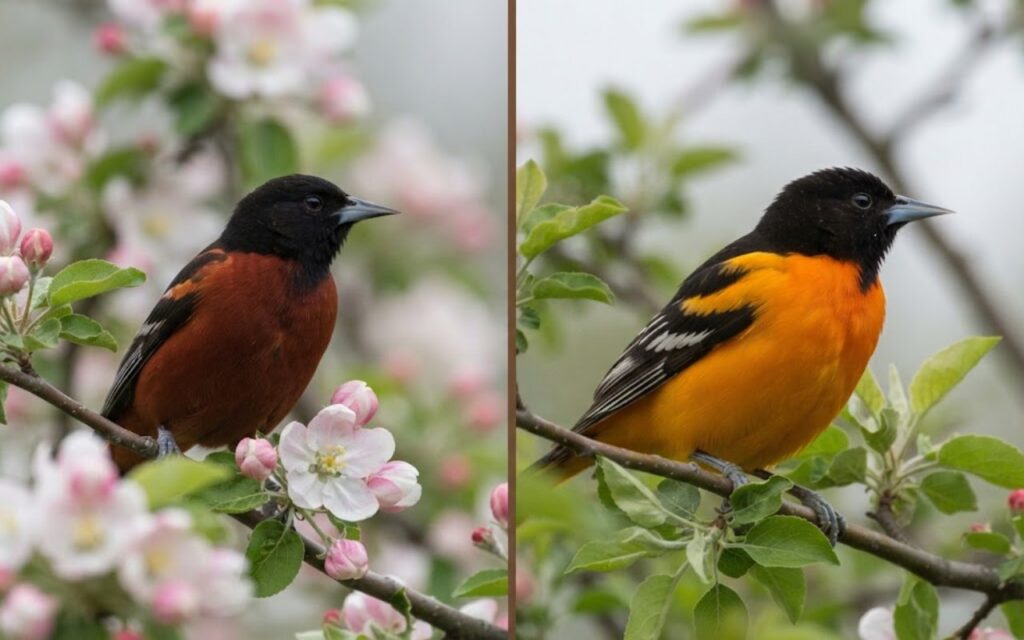
Tackling an Orchard Oriole vs Baltimore Oriole identification challenge requires looking past quick color impressions and focusing on structure, plumage chemistry, and feeding ecology. While vibrant adult males display unmistakable differences in color, backyard birders frequently struggle when separating drab females, molting immatures, and high-canopy silhouettes.
Recent discussions across wild birding communities highlight how often enthusiasts misinterpret these two species during peak spring migration. Learning their subtle morphological markers will immediately elevate your field identification skills.
Quick-Glance Field Summary
Distinguishing these two species relies on assessing body mass, bill curvature, and the distinct contrast between flame-orange and deep brick-chestnut pigments. Pay close attention to throat bib patterning on olive-toned immatures to prevent common second-year identification errors.
- Orchard Oriole length: 5.9 to 7.1 inches (15 to 18 centimeters)
- Baltimore Oriole length: 6.7 to 7.5 inches (17 to 19 centimeters)
- Orchard Oriole average mass: 16 to 28 grams
- Baltimore Oriole average mass: 30 to 42 grams
- Adult male Orchard coloration: Deep chestnut, bay, and solid black
- Adult male Baltimore coloration: Brilliant flame-orange, white wing bars, and solid black
- Female Orchard coloration: Uniform greenish-yellow underside with olive nape
- Female Baltimore coloration: Variable dull yellow-orange breast with brownish-olive mantle
- Standard backyard nectar ratio: 4 parts water to 1 part pure white granulated sucrose
Plumage Carotenoids: Flame Orange Versus Deep Chestnut Tones
Adult male orioles showcase an exceptional divergence in dietary carotenoid metabolism and melanin deposition. Baltimore Orioles process dietary pigments into vibrant lutein and zeaxanthin derivatives, producing a glowing, radiant orange across the breast, rump, and outer tail feathers.
In contrast, male Orchard Orioles deposit dense pheomelanin alongside modified carotenoids, resulting in a rich, dark chestnut or burnt-brick coloration that can appear completely black in poor canopy lighting.
Birders on the r/birdwatching community often note that in overcast conditions, male Orchard Orioles look entirely dark like a cowbird or red-winged blackbird until direct sunlight hits the breast.
The Baltimore Oriole remains visibly bright even on dark, rainy mornings due to the high reflectivity of its orange feathers. Furthermore, the Baltimore features bright orange outer rectrices on the tail, whereas the Orchard Oriole displays a completely black tail.
Wing pattern geometry provides another reliable field checkpoint. Both species show white wing markings, but the adult male Baltimore displays a stark white wing bar combined with broad white edging along the secondary feathers.
The adult male Orchard Oriole exhibits a narrower, cleaner white wing bar across the greater coverts, contrasted against a deep chestnut shoulder patch.
| Oriole Feature | Orchard Oriole (Icterus spurius) | Baltimore Oriole (Icterus galbula) | Field Identification Clue |
|---|---|---|---|
| Underpart Coloration | Deep, dark brick-red or rich burnt-chestnut on the breast and rump. | Brilliant, blazing flame-orange to neon yellow-orange underparts. | Look directly at the chest hue; chestnut always indicates an Orchard male. |
| Physical Size & Build | Small and slender; North America’s smallest oriole species. | Large, robust, and stocky with a heavy, thick-based bill. | Baltimore Orioles are roughly one-third larger and heavier than Orchard Orioles. |
| Female & Immature Plumage | Uniformly greenish-yellow above with a clean, bright yellow-olive breast. | Dull brownish-yellow back with an orange-yellow wash across the chest. | Orchard females show a distinct, bright greenish-yellow wash lacking orange tones. |
Structural Biometrics and Bill Geometry in the Field
Physical dimensions provide immediate identification clues before feather colors even come into view. Orchard Orioles are the smallest breeding icterids in North America, presenting an exceptionally sleek, warbler-like profile. Baltimore Orioles possess a robust, barrel-chested frame with broader shoulders and an overall heavier visual presence on perches.
The bill structure reveals key adaptations for their preferred foraging habits. An Orchard Oriole bill is delicate, slender, sharply pointed, and slightly decurved along the culmen. This sharp instrument allows the bird to probe small blossoms and glean minute caterpillars from the undersides of delicate leaves.
- Orchard Oriole culmen: Slender, sharp, visibly tapered, with a slight downward curve
- Baltimore Oriole culmen: Stout, straight-edged, conical, and thick at the base
- Orchard Oriole silhouette: Compact, narrow-tailed, lightweight, and agile
- Baltimore Oriole silhouette: Heavy-bodied, long-winged, and stout-necked
A Baltimore Oriole carries a noticeably stout, dagger-like beak that tapers evenly from a broad base. This powerful bill allows the species to tear into larger fruits, gap open plant stems, and strip dense bark. When viewing a bird head-on, the base of a Baltimore Oriole bill appears significantly broader between the eyes than that of an Orchard Oriole.
Second-Year Molt Variations and Female Canopy Confusion
The most frequent identification errors documented on forums like r/backyardbirds involve second-year males and dull females. Young male Orchard Orioles in their first spring display an olive-green body combined with an unmistakable, sharply defined black bib over the chin and throat.
Novice observers frequently misidentify these birds as strange warblers, female Baltimore Orioles, or diseased individuals due to this odd patchwork plumage.
Female identification requires evaluating the exact shade of yellow and the uniformity of the underparts. A female Orchard Oriole shows a remarkably clean, uniform greenish-yellow or chartreuse tone spanning continuously from the throat down across the undertail coverts. Her upperparts are a smooth, bright olive-green lacking brown mottling.
Female Baltimore Orioles present far more plumage variability, often showing a warm, dull orange wash on the breast that fades to an off-white or grayish belly. Their upperparts are smudged with mottled brownish tones rather than smooth olive.
The contrast between a yellowish chest and a paler belly is a diagnostic indicator that rules out the uniformly colored female Orchard Oriole.
Feeder Station Geometry and Jelly Feeding Behavior
Backyard feeding stations reveal stark behavioral differences between these two icterids. Forum contributors frequently report that Orchard Orioles are far more timid, routinely being displaced from feeding perches by the heavier, assertive Baltimore Orioles.
If your goal is hosting both species, installing multiple feeding stations separated by at least twenty feet prevents dominant Baltimore males from defending all available resources.
Feeder geometry directly affects which species can comfortably feed. Standard commercial oriole feeders are engineered around the body weight and reach of Baltimore Orioles.
Orchard Orioles readily utilize standard perches, but their lighter weight makes it difficult for them to trip certain mechanical bee-guards or access deep nectar wells designed for larger birds.
- Preferred feeding foods: Fresh orange halves, commercial nectar, and dark grape jelly
- Jelly maintenance rule: Dispense only small portions daily to prevent lethal plumage soiling
- Sanitization protocol: Soak feeders in a 1:9 household bleach solution to eliminate fungal pathogens
- Sugar-water safety: Never use honey, artificial sweeteners, or red dye additives
When feeding grape jelly, always place it in shallow dishes in small quantities. A common backyard hazard reported by rehabilitators occurs when smaller Orchard Orioles accidentally hop directly into deep jelly cups. This covers their flight feathers in sticky sugars, destroying their plumage insulation and causing severe distress.
Acoustic Signatures and Canopy Micro-Habitat Selection
Vocalizations offer instantaneous confirmation when foliage conceals the birds. The song of the Baltimore Oriole consists of a series of rich, flute-like whistles with a pure, clear acoustic resonance that carries across wide open lawns. Their calls include a dry, sharp chatter that sounds like rapid clicks or small stones rattling together.
Orchard Orioles produce an entirely different acoustic performance that is fast, musical, and conversational. Their song is a hurried, sweet warble interspersed with sharp downslurred notes, raspy wheezes, and guttural chatter that mimics the cadence of a house finch. It lacks the hollow, mournful, pure-toned piping of the Baltimore.
Habitat preferences also differ subtly across overlapping breeding ranges. Baltimore Orioles favor high, mature deciduous canopies, showing an affinity for American elms, cottonwoods, and towering maples along suburban streets.
Orchard Orioles prefer lower vertical strata, nesting frequently in riverside willow thickets, old overgrown orchards, and semi-open pastures with scattered young saplings.