
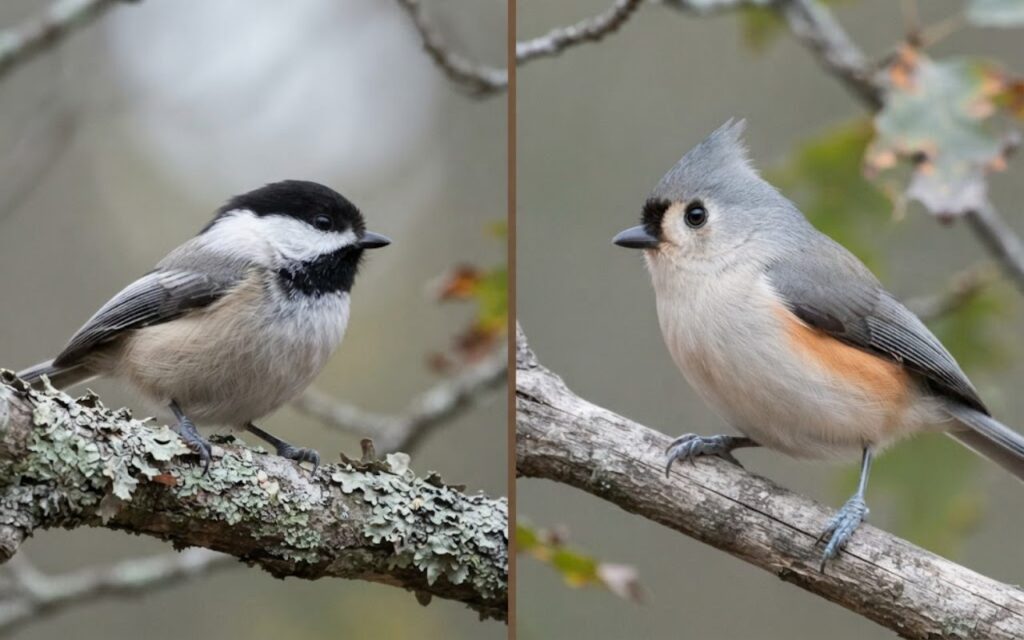
Mastering the visual and auditory differences in a chickadee vs tufted titmouse matchup is one of the most rewarding milestones for any backyard birder. While both species belong to the family Paridae and frequently share feeding stations across eastern North America, their physical geometry and behaviors diverge significantly under close field observation.
Novice birders often confuse them during quick fly-bys because of their shared slate-gray wings, pale underbellies, and lightning-fast foraging habits. Paying attention to distinct morphological markers, vocal dynamics, and feeder etiquette quickly eliminates this common identification confusion.
Quick-Glance Field Summary
Telling these two Paridae relatives apart relies on checking for an active head crest versus a flat black cap, alongside evaluating distinct scolding alarm calls. When quick visual confirmation is impossible through foliage, observing seed-handling mechanics and social hierarchy at feeder perches instantly separates them.
- Head Silhouette: Tufted Titmouse features a distinct pointed gray crest; Chickadee displays a flat, solid black cap with no crest.
- Body Size: Tufted Titmouse measures 5.5 to 6.3 inches; Black-capped Chickadee measures 4.7 to 5.9 inches.
- Throat Markings: Chickadee carries a dark black triangular throat bib; Tufted Titmouse lacks a throat bib entirely, showing pale grayish-white down to the breast.
- Flank Coloration: Tufted Titmouse features warm peach or rusty wash on the lower flanks; Chickadees show buff or pale cream sides.
- Auditory Baseline: Titmouse vocalizes a ringing peter-peter-peter; Chickadee gives a whistled fee-bee or harsh chick-a-dee-dee-dee.
Crest Geometry and Dorsal Plumage Contrast
The most definitive visual separation between these two birds lies in the presence or absence of an erectile feather crest. The Tufted Titmouse (Baeolophus bicolor) possesses a prominent, pointed crest of feathers on the crown that it raises when alert, curious, or defending territory. In contrast, both the Black-capped Chickadee (Poecile atricapillus) and the Carolina Chickadee (Poecile carolinensis) exhibit smooth, flattened crowns dominated by a stark black cap.
Plumage distribution across the face and throat reinforces this distinction immediately. A chickadee features crisp, snow-white cheeks bordered below by a jet-black triangular throat patch. The Tufted Titmouse completely lacks this throat bib, presenting a clean grayish-white chin and an all-white face punctuated by large, dark, round eyes and a narrow black forehead square just above the culmen.
Dorsal coloration also separates the two species under variable winter lighting conditions. Titmice carry an unbroken wash of mouse-gray across the mantle, wings, and tail, accented only by a distinct rust-colored or peachy wash along the lower flanks. Chickadees exhibit more complex mantle patterns, displaying greenish-gray backs, white-edged secondary flight feathers, and softer, buff-washed flanks.
Acoustic Cadence and Scolding Call Frequencies
Backyard birders often hear these active foragers long before spotting them through dense branch work. The primary song of the Tufted Titmouse is a loud, clear, echoing two-note whistle, commonly transcribed as peter-peter-peter or here-here-here. This call possesses substantial vocal volume and carries through deciduous woodlots across long distances during early spring territory establishment.
Chickadee vocalizations operate on entirely different tonal frequencies and intervals. The territorial song of the Black-capped Chickadee consists of a sweet, descending, two-to-three-note whistled fee-bee or hey-sweetie, maintaining a mournful, pure tone. Carolina Chickadees deliver a higher-pitched, four-note variant sounding like fee-bee-fee-bay, which lacks the resonant, percussive volume of the titmouse whistle.
Alarm calls and mobbing notes also diverge in cadence and acoustic rasp. When agitated by predators, chickadees unleash their namesake chick-a-dee-dee-dee, increasing the number of trailing dee syllables as danger levels rise. Members of community forums like r/birdwatching frequently note that titmouse scolds sound much scratchier, nasal, and mechanical, resembling a harsh zh-zh-zh or a raspy scolding trill rather than a structured syllabic phrase.
Backyard Feeder Dominance and Foraging Posture
Aggression levels and perching habits at feeding stations provide immediate behavioral cues for identification. A recurring observation discussed on community birding threads involves feeder displacement hierarchies. The Tufted Titmouse almost always dominates chickadees at shared hopper feeders, utilizing its larger body mass to actively displace chickadees from preferred perches.
- Tufted Titmouse Feeder Mechanics: Grabs one large seed, flies to an elevated hardwood perch, pins the hull firmly between both feet, and hammers it open using downward strikes of its stout bill.
- Chickadee Feeder Mechanics: Snatches a single sunflower seed, darts instantly into nearby dense brush, wedges the shell into rough bark crevices, and uses rapid, light pecks to extract the kernel.
- Posture Differences: Chickadees routinely feed upside down on branch tips and suet cages with complete agility; Titmice rarely invert themselves, preferring upright perches.
While both birds practice grab-and-go foraging rather than sitting idly on open trays, their flight paths differ noticeably. Chickadees display an undulating, bouncy flight style, frequently darting across open yard spaces in erratic bursts. Titmice fly along direct, level trajectories, shooting straight from tree trunks directly to perches without erratic vertical bouncing.
Winter Hoarding Habits and Nutritional Cache Selection
Both birds are prolific seed hoarders, caching hundreds of food items throughout autumn to survive severe winter cold snaps. However, their physical anatomy dictates what size and type of nutritional items they target. The Tufted Titmouse possesses a robust, deep bill capable of cracking tough, heavy-hulled seeds like striped sunflower, intact peanuts, and even small tree nuts like acorns or beech mast.
Chickadees feature smaller, more delicate conical bills that struggle against heavy, uncracked shells. They strongly favor smaller seeds with higher lipid-to-hull ratios, preferentially taking black oil sunflower, hulled sunflower chips, and safflower seeds. Community hobbyists on r/backyardbirds report that offering whole unshelled peanuts almost exclusively attracts titmice, while chickadees ignore them in favor of crushed peanut pieces.
Caching strategy also varies between the two species across local territories. Chickadees hide single food items across hundreds of widely scattered sites, tucking them under lichen, inside furrows of tree bark, or beneath clustered conifer needles. Titmice often cache food closer to central woodlot cores, selecting larger tree cavities or deep bark splits that can securely store larger nut fragments.
Mixed-Species Winter Flocks and Range Overlap Hazards
Winter birding in eastern North America often presents birders with moving, mixed-species foraging flocks that travel together through the canopy. Chickadees and titmice regularly join these foraging bands alongside white-breasted nuthatches, downy woodpeckers, and kinglets. The nuclear core of these flocks is typically formed by chickadees, whose acute alarm calls alert all participating species to incoming raptor threats.
Range overlap introduces distinct regional identification puzzles depending on your geographic location. The northern limit of the Tufted Titmouse extends through southern New England and the Great Lakes, where it overlaps heavily with the Black-capped Chickadee. In the Mid-Atlantic and southeastern states, the titmouse shares forest canopy with the Carolina Chickadee, where the size contrast becomes even more striking due to the Carolina Chickadee’s smaller body frame.
- Northern Range Zone: Tufted Titmouse overlaps with Black-capped Chickadee; focus on the stark white cheek patches and pure whistle of the chickadee versus the peach flanks of the titmouse.
- Southern Range Zone: Tufted Titmouse overlaps with Carolina Chickadee; look for the titmouse’s distinct black forehead patch and heavy bill structure.
- Southwestern Range Transition: In central Texas, the Tufted Titmouse hybridizes with the Black-crested Titmouse (Baeolophus atricristatus), creating intermediate crest patterns that should not be mistaken for chickadees.
By combining structural cues like crest geometry and throat bibs with behavioral indicators like seed hammering, you can instantly distinguish these lively woodland companions. Watching their posture and listening for their signature calls will turn confusing feeder flashes into confident, split-second backyard identifications.