
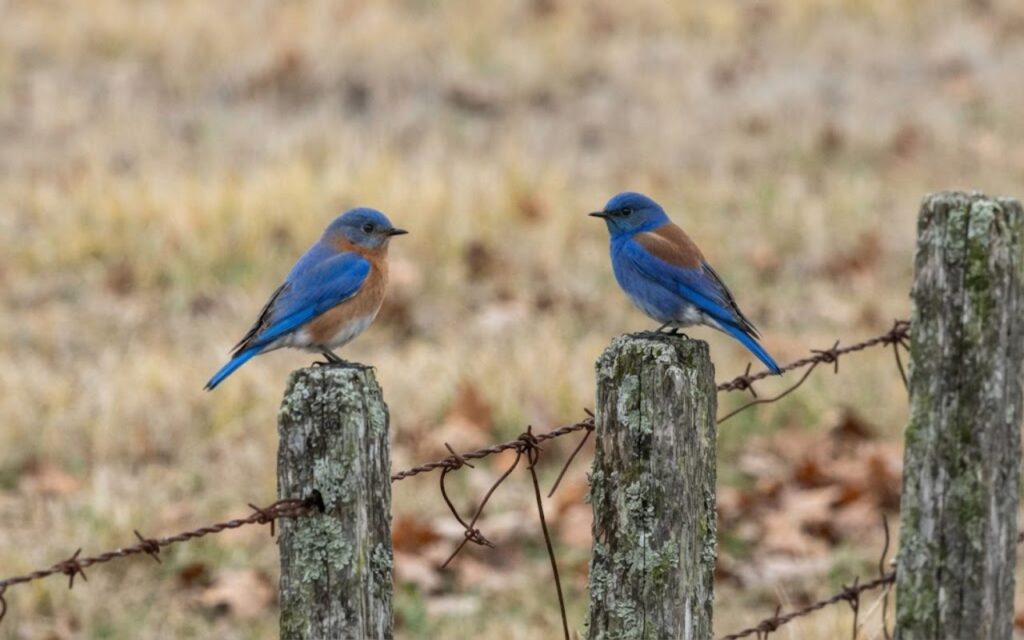
Mastering Eastern Bluebird vs Western Bluebird identification in overlapping zones requires looking beyond broad color washes to evaluate specific plumage boundaries and vocal cadence. While both species share vibrant blue structural coloration and rust-toned breasts, subtle differences in throat color, scapular markings, and belly plumage separate them definitively in the field.
Field observers frequently encounter identification challenges in transition corridors such as the Rocky Mountain foothills, West Texas, and the Great Plains. Understanding these physical demarcations and behavioral nuances prevents common misidentifications during breeding surveys and backyard nest box monitoring.
Quick-Glance Field Summary
Accurate separation of Eastern and Western Bluebirds relies on checking throat color before examining whether the chestnut breast plumage wraps across the upper back. In hand or through spotting scopes, noting the exact break between lower belly white and chestnut wash provides an immediate diagnostic marker.
- Eastern Bluebird male: Solid chestnut-cinnamon throat, clear white belly and undertail coverts, fully blue upper back.
- Western Bluebird male: Solid cobalt or grayish-blue throat, chestnut upper back patch or saddle, smoky gray-to-blue belly.
- Eastern Bluebird female: Warm buffy-orange throat and breast, clean white lower abdomen, distinct white eye-ring.
- Western Bluebird female: Pale grayish throat, muted rust breast wash, charcoal-gray belly, subtle whitish eye-ring.
- Nest box entrance hole diameter: 1.5 inches for Eastern Bluebird; 1.56 inches (1 9/16 inches) for Western Bluebird.
- Primary overlap zone: High Plains of eastern Colorado, western Kansas, central Texas, and the Edwards Plateau.
Throat Plumage Demarcation and Chin Contrast
The most reliable visual field mark between adult males of both species centers entirely on the chin and throat plumage. In male Eastern Bluebirds (Sialia sialis), the rich chestnut coloration of the breast extends uninterrupted up across the chin, framing the lower cheeks in warm red tones.
Conversely, the male Western Bluebird (Sialia mexicana) exhibits a deep cobalt-blue throat that matches its crown, sharply isolating the chestnut coloration to the chest.
Birders on wildlife forums regularly note that poor lighting or shadowed angles can obscure this distinction. On Reddit’s r/birding community, observers tracking winter flocks in central Texas frequently caution against evaluating throat color in harsh midday glare, where structural blue feathering appears almost black.
Viewing the bird at eye level against a neutral background reveals whether the chin reflects blue structural light or absorbs light through warm melanin-based chestnut pigments.
Female bluebirds present a parallel throat marker that requires closer glassing. A female Eastern Bluebird exhibits a clean, pale buff or warm cinnamon throat that neatly matches her breast wash. Female Western Bluebirds display a pale, dull grayish-ash throat that creates an obvious tonal break against the muted reddish tones on the breast.
- Male Eastern: Chestnut throat completely connects the upper chest to the lower bill base.
- Male Western: Cobalt-blue bib completely covers the throat, severing the chest rust from the face.
- Female Eastern: Warm buff throat that blends smoothly into an orange-buff breast.
- Female Western: Cool, muted gray throat that contrasts with a soft grayish-chestnut breast.
Lighting conditions dictate plumage evaluation accuracy across both sexes. Backlit perches flatten these subtle contrasts, turning the blue throat of a Western Bluebird into a silhouette that mimics the darker tones of an Eastern Bluebird. Always reposition to keep the sun directly behind your shoulder when glassing the bird’s upper breast.
Dorsal Saddle Patterns and Scapular Bleed
When viewing perched birds from behind or above, the mantle and scapular regions offer an immediate secondary diagnostic trait. Male Western Bluebirds typically display a distinct chestnut crescent or saddle extending across the upper back between the shoulder blades. This rust-colored mantle patch varies from a complete band across the back to broken patches of chestnut mixed with deep blue.
Male Eastern Bluebirds show a clean, uninterrupted expanse of vibrant blue extending from the nape down to the rump. Their scapulars and dorsal feathers lack any trace of chestnut pigment. If a male bird displays even a faint wash of rufous feathers across the center of its upper back, observers are looking at a Western Bluebird.
Recent troubleshooting threads on backyard bird forums highlight how feather wear impacts this dorsal saddle during late spring. As Western Bluebird feathers wear down before the post-breeding molt, the chestnut margins on the scapulars can fray, exposing darker feather bases that mimic a solid blue mantle. Careful observation with high-magnification optics is required to confirm the absence of rufous feathering.
- Eastern dorsal profile: Solid, uninterrupted sky-blue or cerulean from crown to uppertail coverts.
- Western dorsal profile: Chestnut or rust-toned mantle saddle interrupting the dorsal blue field.
- Eastern scapulars: Monotypic blue without brown, rust, or charcoal mottling.
- Western scapulars: Variably marked with rufous feather margins, often forming a complete shoulder mantle.
Female dorsal patterns follow a similar tonal distribution with lower color saturation. Female Eastern Bluebirds display a warm, grayish-brown back that contrasts with clear blue tints in the primaries, secondaries, and outer rectrices. Female Western Bluebirds lean toward a cooler, uniform charcoal-slate back with significantly less contrast against their duller blue wing edges.
Abdominal Break and Ventral Color Boundaries
The transition between the lower breast and the lower belly separates these two thrush species with absolute clarity. Eastern Bluebirds feature a stark, high-contrast dividing line between the lower breast and the abdomen. The rich cinnamon-orange abruptly stops, giving way to an expansive, crisp white belly, vent, and undertail covert region.
Western Bluebirds lack this crisp white abdominal patch. Instead, the chestnut chest gives way to a smoky, dull grayish-blue or slate-toned lower abdomen. The undertail coverts may show pale gray or off-white edges, but the ventral region never displays the clean, snowy white characteristic of an Eastern Bluebird.
Field workers contributing to regional bird banding databases point out that this abdominal division is the best feature for identifying young fledglings and molting immatures. Even before juvenile bluebirds fully develop their adult throat feathers, the underlying white versus smoky-gray down on the lower belly indicates species identity.
- Eastern ventral pattern: Abrupt transition from orange breast to snow-white lower belly and vent.
- Western ventral pattern: Muted transition from chestnut breast to slate-gray or grayish-blue belly.
- Eastern undertail coverts: Immaculate white without dusky centers or dark fringing.
- Western undertail coverts: Dirty gray or grayish-white, often with diffuse dusky centers.
Backyard feeding stations frequently reveal this ventral contrast during seed or mealworm consumption. When a bird perches vertically on a hanging suet cage or flat tray, its abdomen is exposed directly to the viewer. Look specifically for the sudden horizontal line where bright orange meets clean white to confirm an Eastern Bluebird.
Nest Box Aperture Dimensions and Territory Overlap
Backyard conservationists managing trails in sympatric ranges must account for structural nesting requirements and subtle size variances. While Eastern and Western Bluebirds share identical body lengths of roughly 6.3 to 8.3 inches, Western Bluebirds possess a marginally stockier build and slightly wider shoulders. This subtle anatomical difference affects optimal nest box entrance hole dimensions.
Standard North American Bluebird Society (NABS) recommendations specify an exact 1.5-inch circular entrance hole for Eastern Bluebirds to exclude invasive European Starlings (Sturnus vulgaris). However, trail monitors in Colorado and New Mexico frequently report that Western Bluebirds struggle to pass through a rigid 1.5-inch opening.
For Western Bluebirds, trail managers must utilize an entrance hole measured precisely at 1.56 inches (1 9/16 inches) to allow easy passage while still barring starlings.
In geographic overlap zones along the Front Range of Colorado and the Trans-Pecos region of Texas, both species occasionally compete for the same nest boxes. Forum contributors on trail monitoring networks note that Eastern Bluebirds typically dominate lower-elevation riparian cottonwood corridors and suburban open lawns. Western Bluebirds preferentially seek out semi-open ponderosa pine savannas, pinyon-juniper woodlands, and rangelands above 5,000 feet.
- Standard Eastern aperture: Exactly 1.50 inches (38 mm) circular diameter.
- Standard Western aperture: Exactly 1.56 inches (40 mm / 1 9/16 inches) circular diameter.
- Oval aperture note: The 1.375-inch by 2.25-inch vertical oval aperture is a specialized alternative intended exclusively for Eastern Bluebirds and should be avoided on trails targeting Western Bluebirds.
- Floor interior footprint: 5 inches by 5 inches standard depth (or 5.5 inches by 5.5 inches) to safely accommodate larger Western Bluebird clutch sizes, placed 5 feet above the ground.
- Baffle installation: 8-inch diameter stovepipe predator baffle mounted immediately below the floor.
Providing the correct hole size directly affects nesting success and prevents wing feather abrasion. Using a 1.5-inch hole in an area dominated by Western Bluebirds forces adults to wedge their shoulders through the wood, wearing down flight feather margins. In transition zones, installing boxes with a standard 1 9/16-inch opening equipped with a thick wood reinforcement block provides the safest universal utility.
Vocalization Acoustics and Hybrid Overlap Zones
Acoustic separation serves as an indispensable tool when foliage, distance, or lighting limits visual inspection. Eastern Bluebird vocalizations carry a melodic, liquid quality characterized by a soft, rolling, three-to-four-note musical chatter often transcribed as tu-a-wee or cheer, cheerful, charmer. The flight call is a clear, rising whistle that sounds gentle and fluid.
Western Bluebird vocalizations are distinctly lower-pitched, dry, and mechanical by comparison. Their primary call is a short, clipped, hard pew or kew, lacking the rolling cadence of their eastern counterpart. When agitated, Western Bluebirds emit an abrupt, chattering che-check-check that sounds abrasive rather than musical.
- Eastern flight call: Liquid, rolling whistle (tu-a-wee) with rising inflections.
- Western flight call: Hard, single-syllable, dry drop call (pew or few).
- Eastern song: Sweet, rich musical warble lasting two to three seconds.
- Western song: Paired, stuttering chips and dry chirps without melodic flow.
In areas of true sympatry, such as the Davis Mountains of Texas or the Black Forest of Colorado, interspecific hybridization occurs rarely but consistently. Observers on regional listservs have documented male hybrids displaying intermediate phenotypes, such as a mottled throat containing both blue and chestnut feathers alongside a partial chestnut back saddle. These individuals often produce mixed songs, combining the liquid whistles of the Eastern Bluebird with the dry call notes of the Western Bluebird.
When documenting suspected hybrid individuals, visual assessment alone is insufficient. Field ornithologists record the vocal frequency range, note the precise feather transitions on the throat and mantle, and photograph the undertail coverts. Relying on this structured evaluation prevents misidentification and ensures reliable distribution records across dynamic boundary zones.