
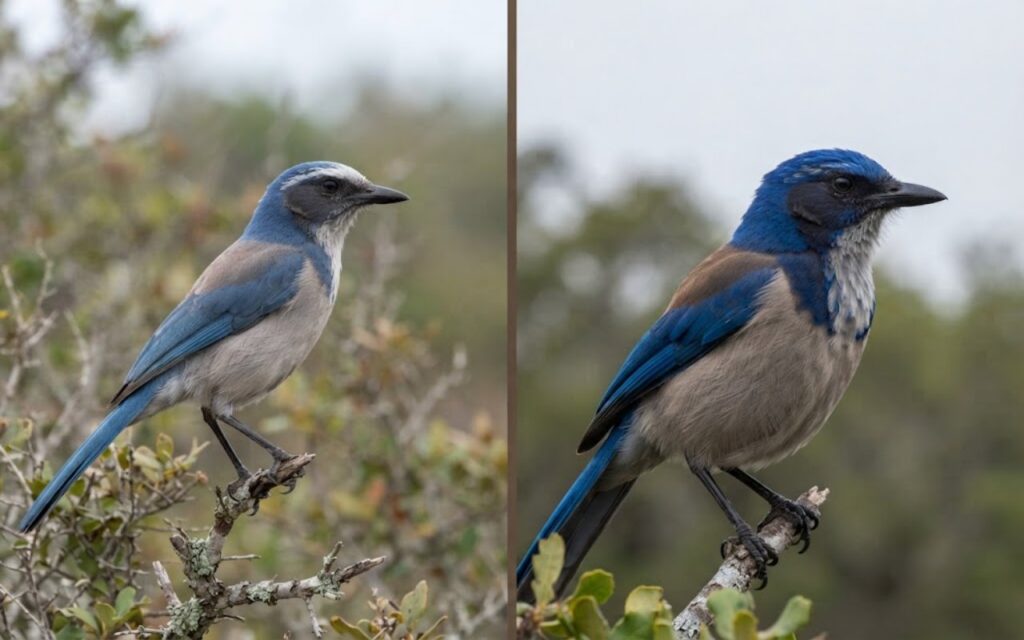
Navigating the comparison between a generic Scrub Jay vs Florida Jay requires unpacking both taxonomic history and precise geographic morphology. The term “Florida Jay” is the historical, colloquial name for the Florida Scrub-Jay (Aphelocoma coerulescens), a federally threatened species restricted exclusively to relict sand pine scrub in peninsular Florida.
Birders frequently confuse this distinct bird with western species like the California Scrub-Jay (Aphelocoma californica) or Woodhouse’s Scrub-Jay (Aphelocoma woodhouseii), which separated taxonomically decades ago. Distinguishing these corvids relies on crown pigmentation, neck collar definition, vocal structure, and rigid habitat boundaries.
Quick-Glance Field Summary
Identifying these birds centers on geography, forehead plumage, and tail proportions; the Florida bird exhibits a pale, frosted forehead and muted blue-gray tones within pyrogenic scrub oak ecosystems. Western counterparts display sharp white superciliary lines, richer cobalt hues, and occupy varied western chaparral or suburban oak savannas.
- Geographic Isolation: Peninsular Florida scrub habitat only (A. coerulescens) versus western North America (A. californica, A. woodhouseii).
- Forehead Marking: Pale gray-white frosted forehead on Florida birds versus deep blue crown with white eyebrow streak on western species.
- Breast Band: Soft, indistinct gray-blue bib on Florida birds versus dark, sharply defined chest collar on California Scrub-Jays.
- Tail-to-Wing Ratio: Noticeably longer tail relative to wing chord in Florida scrub-jays to facilitate low-brush maneuvering.
- Legal Status: Federally Threatened under the Endangered Species Act with strict zero-contact feeding restrictions.
Taxonomic Clarification: Untangling Historical Vernacular and Geographic Distribution
The debate over naming conventions regularly surfaces in digital identification groups. On Reddit r/whatsthisbird, novice observers often ask if the Florida Jay is an entirely separate biological entity from the scrub-jays found across the continent. Historically, William Bartram and early naturalists recorded Aphelocoma coerulescens simply as the Florida Jay.
In 1996, the American Ornithologists’ Union formally split the ancestral Scrub Jay into distinct regional species in its 40th Checklist Supplement, officially separating the Florida Scrub-Jay, Island Scrub-Jay, and Western Scrub-Jay.
The Western Scrub-Jay was subsequently split again in 2016 into the California Scrub-Jay and Woodhouse’s Scrub-Jay. Consequently, any wild scrub-jay encountered outside of peninsular Florida belongs to a western taxon, as their ranges do not overlap by more than a thousand miles.
This geographic separation eliminates overlapping range identification challenges in the field. When observing birds in California, Oregon, or Nevada, any scrub-jay observed is either a California or Woodhouse’s species. If an observer spots a crestless blue-and-gray corvid in a sandy Florida nature preserve, it is unequivocally the Florida Scrub-Jay.
| Avian Attribute | Florida Scrub-Jay (A. coerulescens) | Western / California Scrub-Jay | Field Identification Clue |
|---|---|---|---|
| Geographic Location | Strictly restricted to localized oak scrub sand ridges in peninsular Florida. | Widespread across western oak woodlands and Pacific coastal scrub. | Location is definitive; these species live thousands of miles apart. |
| Forehead Plumage | Displays a prominent, frost-white or pale silvery forehead patch. | Solid, deep cobalt-blue crown with a stark white eyebrow stripe. | A clear white forehead patch instantly indicates a Florida endemic. |
| Breeding Behavior | Cooperative breeders; family helpers assist in raising young. | Isolated pairs; nest and forage in independent parental units. | Florida birds stay in tight, multi-generational family groups. |
Morphological Distinctions: Collar Boundaries, Forehead Frosting, and Bill Curvature
Visual separation between these species is subtle in low light but unmistakable under direct sun. The Florida Scrub-Jay displays a washed-out, frosted gray-white patch spanning its forehead and crown. California Scrub-Jays present an unbroken cap of rich cobalt, accented by a stark white supercilium stripe running directly above the eye.
Collar margins provide another reliable field mark when viewing birds in heavy brush. The chest markings of the Florida Scrub-Jay diffuse into a hazy, indistinct bluish-gray wash across the upper breast. In contrast, the California Scrub-Jay displays a crisp, dark blue-to-black pectoral band that frames a clean white throat patch.
- Forehead Pigmentation: Frosted white wash on Florida species; solid cobalt blue on California species; dull slate-blue on Woodhouse’s species.
- Supercilium: Inconspicuous or pale gray in Florida; bright white and sharply defined in California scrub-jays.
- Dorsal Saddle: Pale smokey-gray mantle on Florida birds; deeper brown-gray mantle on California birds; washed-out grayish saddle on Woodhouse’s birds.
- Bill Anatomy: Heavier, blunt tip suited for scrub oak acorns in Florida; hooked, sharply tapered tip in western varieties for pinyon nuts and varied seeds.
These physical traits directly reflect adaptation to regional food sources. The heavy bill of the Florida bird handles tough scrub oak species like Quercus inopina and Quercus geminata. Western scrub-jays carry narrower, slightly chisel-shaped bills adapted for stripping coniferous pinyon pine cones and foraging broader agricultural seeds.
Scrub Oak Dependence and Microhabitat Indicators across Regional Biomes
Habitat choice represents the single most decisive factor when assessing these corvids in the field. Florida Scrub-Jays are true habitat obligates, surviving exclusively in pyrogenic scrub dominated by scrub oak, sand live oak, and myrtle oak. They require low canopy heights under ten feet and exposed patches of bare white quartz sand to store caches.
Western scrub-jays demonstrate vastly superior ecological plasticity. Observers in western states routinely document California Scrub-Jays nesting in dense suburban hedgerows, eucalyptus groves, and commercial walnut orchards.
Woodhouse’s Scrub-Jay thrives across montane pinyon-juniper woodlands and arid sagebrush plateaus where bare sand substrates are entirely absent.
- Canopy Height Preference: One to three meters in Florida scrub oak; three to ten meters in western oak woodland and suburban canopies.
- Soil Composition: Well-drained, sterile marine quartz sand deposits in Florida; gravelly loam, clay, or rocky talus in western ranges.
- Fire Regimes: Strict five-to-twenty-year fire cycles required to suppress pine overstories in Florida habitats.
Without frequent low-intensity fire, scrub habitat becomes overgrown and unlivable for Florida birds. When sand pine canopies close overhead, predatory raptors gain hunting perches, driving the Florida Scrub-Jay to abandon the territory. Western scrub-jays, conversely, thrive in overgrown brush and dense suburban cover without relying on wildfire cycles.
Behavioral Sentinel Systems versus Solitary Foraging Strategies
Social architecture reveals massive divergence between Florida birds and their western relatives. In threads on r/ornithology, field researchers often highlight the complex cooperative breeding strategy unique to Florida Scrub-Jays.
They form permanent multigenerational family clans where non-breeding offspring act as territory helpers, defending borders and provisioning young.
While foraging, Florida family groups rotate duty with a dedicated sentinel positioned high on an exposed branch. This sentinel scans constantly for Cooper’s hawks or coachwhip snakes, vocalizing with specific alarm rattles that cause ground foragers to freeze.
Western scrub-jays maintain strictly pair-based territories during nesting and do not utilize extended helper family units.
Vocal cues also differ distinctly once heard in the field. The Florida species produces a dry, raspy scolding sound that lacks the sharp rising inflection heard in California birds. Female Florida scrub-jays also produce a unique rattling call termed the “hiccup”, which male birds never utter.
Foraging Hazards, Aflatoxin Risks, and Federal Protection Protocols
Backyard feeding and trail interactions present serious biological consequences for the Florida Scrub-Jay. State park forums frequently detail visitors attempting to lure Florida birds with store-bought peanuts along nature trails in preserves like Oscar Scherer or Lyonia Preserve.
Unlike widespread western species, the Florida Scrub-Jay is protected as a threatened species under both state and federal wildlife statutes.
Offering supplemental human food severely degrades the social dynamics of Florida scrub-jay families. Ingesting raw peanuts exposes birds to Aspergillus flavus, an environmental fungus that produces lethal aflatoxins in humid subtropical climates.
Furthermore, high-protein handouts cause females to initiate nesting prematurely before wild caterpillars hatch, resulting in devastating nestling starvation.
- Legal Protection: Federal status under Section 9 of the Endangered Species Act prohibits feeding, harassing, or capturing Florida birds.
- Feed Mold Hazards: Humid conditions rapidly generate aflatoxins on damp nuts, causing acute hepatic necrosis in corvids.
- Acorn Cache Longevity: Wild Florida jays bury between 6,000 and 8,000 acorns annually in sand without human intervention.
- Chick Nutrition Deficits: Fast-food scraps or peanuts lack essential amino acids, inducing metabolic bone deformities in growing fledglings.
Habituating these birds to trail feeding also increases roadside mortality from vehicle strikes. Western scrub-jays can adapt to backyard peanut feeders without legal issue, but feeding Florida jays carries substantial civil penalties.
Maintaining wild foraging habits ensures that Florida’s relict scrub-jays preserve their evolutionary caching behavior across protected sandhill corridors.