
That sickening thud against your living room window is something you never forget. If you’re trying to figure out how to prevent birds hitting windows, you’re definitely not alone. One minute you’re enjoying your morning, and the next you’re rushing outside to check on a stunned cardinal or a small pile of feathers. Most people have no idea how widespread this problem really is.
Researchers estimate that between 365 million and 988 million birds die every year from building collisions in the United States. Nearly a billion birds, gone, and residential homes account for a huge share of it. The hardest part is knowing that most of these strikes can be prevented with simple, inexpensive fixes.
I’ve dealt with this at my own place. I’ve found warblers, finches, and even a cedar waxwing lying stunned on my deck. It’s upsetting, it’s frustrating, and it pushed me to start testing everything I could to figure out what actually works instead of just hoping the problem goes away. 🙂
- Use decals, dots, or stripes placed close together so birds see the glass.
- Add exterior screens or netting a few inches in front of the window.
- Apply bird-safe window film to reduce mirror-like reflections.
- Keep feeders and baths within 3 feet of windows or over 30 feet away.
- Close blinds or curtains during early morning and late evening.
- Turn off indoor lights at night during migration seasons.
- Move houseplants away from windows so birds don’t aim for them.
- Use awnings or exterior shades to cut down bright reflections.
- Treat your most dangerous windows first, like big glass panels.
- If a strike happens, protect the bird and call a rehabber if needed.
How to Prevent Birds Hitting Windows (video guide)
Below is a short explainer video showing practical, real-world solutions to prevent birds from hitting windows, especially in homes with large or reflective glass.
Show Transcript:
0:00
Let’s talk about a sound you never forget: the sickening thud of a bird hitting a window. It’s heartbreaking, but here’s the good news: it’s almost entirely preventable. Today, we’ll break down a comprehensive guide from Feathered Guru on making your home safer for birds.
0:25
That thud can stop you in your tracks and leave you feeling helpless. Sadly, it’s not unique. Up to 988 million birds die from window collisions each year in the U.S., and a huge portion happens right at our homes. But we have the power to change that.
1:10
Here’s the plan: first, understand why birds don’t see glass. Then, we’ll cover solutions that actually work, smarter backyard setups, and finally, a bird-safe action plan you can implement immediately.
1:29
Birds aren’t clumsy; their incredible vision is adapted for trees and fields. Glass is alien to them. They see either a perfect reflection of trees and sky or a transparent tunnel to the garden beyond—both deadly illusions.
2:11
Collision risk spikes during spring and fall migration, when millions of birds move through unfamiliar areas and are drawn to city lights, making windows especially dangerous.
2:32
Now, let’s tackle solutions backed by science. One common myth: that single hawk sticker on your window. Does it prevent collisions? Not really. Birds see it as a tiny obstacle but still fly into the rest of the invisible glass.
3:19
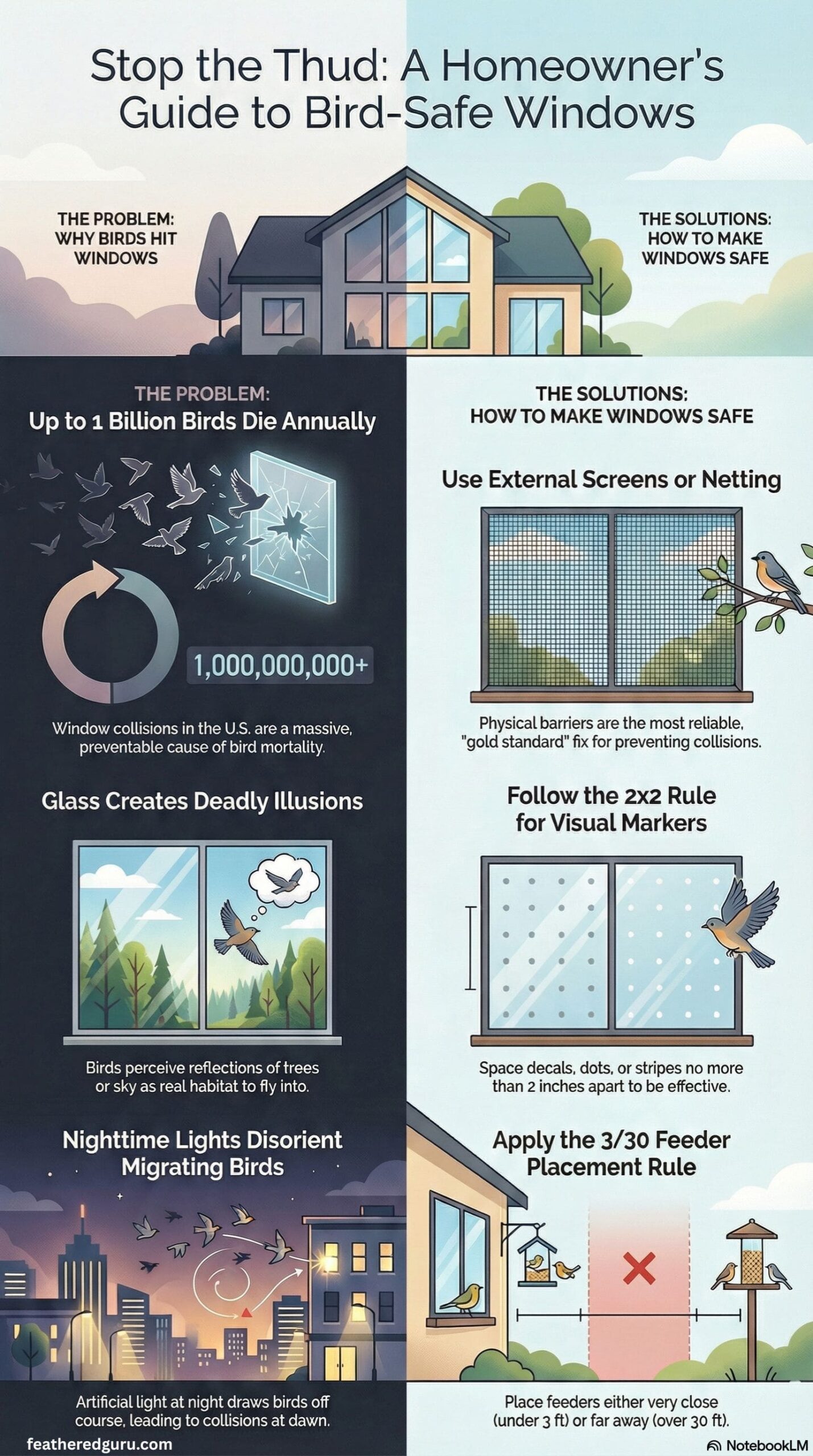
The golden rule: the 2×2 rule. Place visual markers no more than 2 inches apart, both vertically and horizontally. Research shows small songbirds avoid flying through gaps that size, breaking the illusion of open space.
3:45
Options include:
- Low-cost DIY: tape or window markers following the 2×2 rule.
- Patterned window films: visually appealing and effective.
- Gold standard: external screens or netting, which eliminate reflections and act as a safety net if a bird still flies toward it.
4:42
Check your yard too. The 3-30 rule for feeders and bird baths: place them within 3 feet of windows or more than 30 feet away. Birds close to the window can’t gain enough speed to get seriously hurt.
5:13
Other simple tips: move plants away from windows, partially close blinds, and turn off unnecessary lights at night—especially during migration.
5:38
If a strike happens, stay calm. Place the bird in a safe, dark, quiet box for up to 2 hours. If it’s still injured, contact a local wildlife rehabilitator.
6:11
Your bird collision prevention checklist:
- Immediate: move plants, turn off lights.
- Short-term: apply tape to problem windows.
- Long-term: invest in films or screens.
6:31
You don’t need to treat every window. Fixing the one or two most dangerous windows can reduce collisions by 80% or more.
6:53
Homework: step back and view your windows from a bird’s perspective. See the sky or trees reflected? That’s exactly what they see. Start there.
7:22
For photos of these solutions, detailed guides, and product recommendations, check out the full guide at featheredguru.com. Thanks for watching!
Why Birds Hit Windows in the First Place
Understanding the problem is the first step to fixing it. Birds don’t hit windows because they’re stupid or careless. They hit windows because glass is essentially invisible to them, and what they see reflected in or through the glass looks exactly like somewhere they want to go.
Reflection is the biggest culprit. Your windows act like mirrors, reflecting sky, trees, and vegetation. To a bird, that reflection looks like open flight space or habitat. They don’t perceive the glass as a solid barrier because in nature, there’s no such thing as an invisible wall. They see blue sky or leafy branches and fly straight toward it at full speed.
Transparency creates the same problem. When birds can see through windows to vegetation or open space on the other side, like seeing through your living room to the backyard beyond, they think they can fly straight through. This is especially dangerous with corner windows, glass walkways, or aligned windows that create a “fly-through” illusion.
Certain times make it worse. Research shows that collision peaks occur during overnight and early morning hours, particularly during spring and fall migration when millions of birds are on the move. Nocturnal migrants often set down into stopover habitats during early morning and are especially vulnerable to strikes during these crucial periods.
Artificial lighting disorients birds. Light pollution during nighttime attracts migrating birds off their course. They become confused and exhausted circling lit buildings, dramatically increasing their collision risk when dawn arrives.
The problem is worst during spring migration (March through June) and fall migration (August through November), but window strikes happen year-round. Understanding your specific risk factors helps you prioritize which solutions to implement first. Looking for fall-specific collision risks? Check out my guide on preventing window strikes in fall.
Want to understand more about bird behavior during migration? Check out warbler migration patterns.
How to Identify if Birds Are Hitting Your Windows
Sometimes window strikes are obvious. Sometimes they’re not. Here’s what to look for.
Obvious signs: Dead birds on the ground below windows, stunned birds sitting motionless nearby, or piles of feathers indicating a fatal impact. If you find any of these, you’ve definitely got a window strike problem.
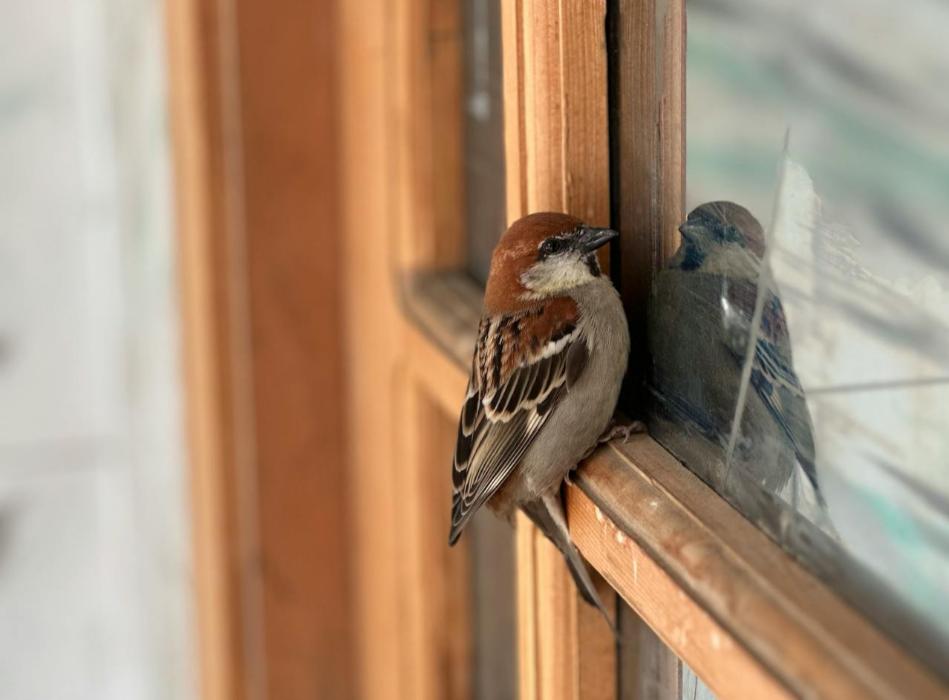
Subtle clues: Smudges or dust outlines on the glass where a bird’s body made contact. These ghostly impressions show exactly where impacts occur. Small feathers stuck to windows or lying on the ground nearby. Window sills with scratch marks or tiny bits of down.
Check your windows daily during migration seasons, especially in early morning before scavengers (cats, crows, raccoons) remove evidence. The areas most likely to have strikes are large picture windows, glass doors, corner windows, and windows near feeders or bird baths.
Early detection matters because knowing which windows cause problems helps you prioritize where to apply deterrents. Some windows might never cause issues while others might be deadly collision zones.
The Top Causes of Window Strikes You Must Fix First
Not all windows pose equal risk. Certain situations dramatically increase collision danger.
Reflection of vegetation is the deadliest factor. Windows that reflect trees, shrubs, or sky are collision magnets. Stand outside at different times of day and look at your windows from a bird’s perspective. If you see reflected greenery or blue sky, birds see it too.
Indoor plants create false signals. Large houseplants positioned near windows attract birds who see them as real habitat. They fly toward the plants and hit the glass barrier they can’t perceive.
Aligned windows create fly-through paths. Windows on opposite sides of a room or hallway make birds think they can fly straight through the building. This is incredibly dangerous because birds approach at full flight speed.
Glass angle matters. Windows angled to reflect sky or trees at certain times of day become temporary hazards. South and west-facing windows often reflect afternoon sun and vegetation most strongly.
Nighttime lighting is a migration killer. Interior lights visible through windows at night attract and disorient migrating birds. This combination of attraction plus invisible barriers creates perfect conditions for deadly collisions.
Window Decals: Do They Work? (Spoiler: Mostly No)
Let’s talk about those little hawk silhouette stickers everyone seems to have. Here’s the harsh reality: they don’t work worth a damn.
Most decals fail because of spacing. That single hawk decal in the center of your window? Birds will just fly around it. They don’t think “oh, a predator, better avoid this entire area.” They think “I’ll fly three feet to the left of that thing.”
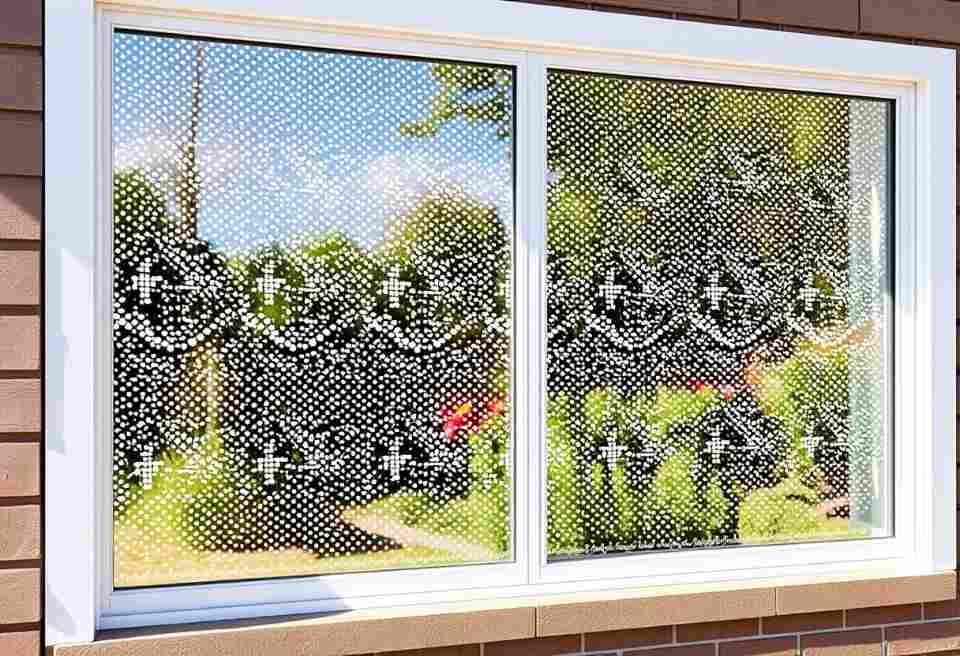
The 2×2 rule is non-negotiable. For window treatments to actually prevent collisions, visual markers must be spaced no more than 2 inches apart horizontally and 2 inches apart vertically. This is based on the physical profile of a bird in flight. Most birds cannot fit through a 2-inch gap, so properly spaced markers force them to perceive glass as a barrier.
What actually works: Decals or dots applied in a complete grid pattern covering the entire window at 2-inch spacing. This means dozens or hundreds of small markers, not just a few random stickers. UV-reflective decals work best because birds can see ultraviolet light that’s invisible to humans, maintaining your view while warning birds away.
Stripe patterns work too. Vertical stripes at least 1/4 inch wide with maximum 4-inch spacing, or horizontal stripes at least 1/4 inch wide with maximum 2-inch spacing have proven effective. Closer spacing works better.
If you’re going to use decals, commit to proper coverage. Half-measures waste money and don’t save birds.
External Screens and Netting (The Most Reliable Fix)
Want the absolute most effective solution? Physical barriers win every time.
Why screens work: They create an actual, visible obstacle that birds can see and avoid. Even if a bird does hit, it bounces off the soft mesh instead of slamming into hard glass. Studies show that external screens and netting provide shock absorption and visual cues that dramatically reduce both collision frequency and injury severity.
Types that work best: Standard insect screens work surprisingly well, especially the darker colored ones that provide better visual contrast. Tensioned bird netting (1/2-inch or smaller mesh) mounted 3-4 inches from the window surface creates a cushioned buffer zone. Framed screen systems that attach with suction cups or brackets offer the most professional appearance.
Installation tips: Mount screens or netting at least 3 inches from the glass surface. This distance allows birds to perceive the barrier and prevents them from hitting glass if they contact the screen. Secure all edges properly so wind doesn’t create gaps. Check regularly for tears or sagging.
The downside: Aesthetics. Some people hate the look of screens on their windows. But if you’re serious about preventing bird deaths, external screens are the gold standard solution. You can always use them seasonally during migration periods and remove them in winter.
Window Films and Tinting Options
Films offer a middle-ground solution between effectiveness and aesthetics.
Patterned films work well. Films with visible dots, lines, or patterns applied to the exterior glass surface break up reflections and make windows visible to birds. Look for films specifically rated for bird collision prevention with patterns following the 2×2 spacing rule.
One-way films help some. Mirror-effect films that reflect outward can reduce strikes by making windows less transparent, though they can increase reflection of surroundings. These work best on windows where transparency (seeing through to the other side) is the main problem.
UV-reflective films are clever. These films reflect ultraviolet light that birds can see but humans cannot, preserving your view while warning birds away. According to American Bird Conservancy, UV films show promising results though effectiveness varies with UV light availability (less effective on overcast days or early morning).
Application matters: Films must be applied to the exterior surface of windows to be effective. Interior application gets obscured by exterior reflections and doesn’t work. Professional installation ensures no bubbles or gaps that reduce effectiveness.
Films cost roughly $4-6 per square foot for DIY options. Professional installation adds labor costs but ensures proper coverage.
Feather Friendly Tape and DIY Grid Patterns
If you’re willing to put in some effort, adhesive markers offer an effective, affordable solution.
Feather Friendly products use small dots or lines applied directly to exterior glass in precise grid patterns. These markers are nearly invisible from inside but highly visible to birds. The adhesive is durable and weather-resistant, lasting several years.
DIY alternatives work too. You can create your own grid pattern using narrow tape (1/4 inch wide), paint pens, or even tempera paint. The key is consistent 2-inch spacing both horizontally and vertically covering the entire window surface.
How to apply correctly: Clean windows thoroughly first so adhesive sticks properly. Use a measuring tape or ruler to mark your grid. Work in moderate temperatures (not extreme heat or cold) for best adhesion. Start at the top and work down methodically to maintain straight lines.
Maintenance: Check adhesive markers annually and replace any that have peeled or faded. UV exposure gradually breaks down some materials, though quality products last 3-5 years.
The biggest advantage of tape/marker systems is customization. You can treat only the most dangerous windows instead of every window in your house, saving money while still protecting birds.
Learn more about protecting birds around your home in our guide on bird-friendly garden design.
Exterior Shades, Awnings, and Strategic Plantings
Sometimes the best solution is preventing reflections from forming in the first place.
Awnings and overhangs shade windows and reduce reflection of sky and vegetation. Even a 2-foot overhang dramatically decreases how much sky glass reflects during midday hours. Retractable awnings let you deploy shade during migration seasons and retract them in winter.
Exterior roller shades (like solar screens) diffuse reflections while still allowing light through. These work especially well on south and west-facing windows that catch afternoon sun and create the strongest reflections.
Strategic plantings can help or hurt depending on placement. Shrubs planted very close to windows (within 3 feet) make birds slow down as they approach, reducing impact severity if strikes occur. However, trees and shrubs planted 10-30 feet away that get reflected in windows actually increase collision risk by creating attractive habitat illusions.
The goal is breaking up large expanses of reflective glass. Architectural elements that cast shadows or partially obstruct windows reduce the “mirror effect” that fools birds.
Indoor Fixes That Actually Help
Don’t ignore solutions you can implement from inside your home.
Move houseplants away from windows. Large plants positioned right at windows attract birds who see them as real vegetation. Move plants at least 6 feet back from glass or to windows you’ve already treated with external deterrents.
Use blinds and curtains strategically. Partially closing interior blinds or curtains (especially during migration seasons) breaks up the “fly-through” illusion. However, fully closed blinds can sometimes create more reflection on the exterior surface. Experiment with what works for your specific windows.
Turn off unnecessary lights at night. This is huge during migration seasons. Interior lighting visible through windows disorients nocturnal migrants and draws them toward buildings. Use motion sensors, timers, or simply develop the habit of turning off lights in unused rooms at night during spring and fall.
Rearrange furniture to block sight lines. Positioning bookcases or other furniture near windows creates visual clutter that makes the “fly-through” path less apparent to birds.
The combination of exterior and interior modifications provides the most comprehensive protection.
Bird Feeder Placement and Window Safety
Feeders and bird baths need thoughtful positioning relative to your windows.
The 3/30 rule is crucial. Place feeders either within 3 feet of windows or beyond 30 feet away. Here’s why: feeders within 3 feet mean birds approaching windows haven’t built up dangerous speed yet. If they do hit, impacts occur at low velocity, rarely causing serious injury. Feeders beyond 30 feet keep birds away from window collision zones entirely.
The danger zone is 10-20 feet. This distance gives birds enough space to build up full flight speed but keeps them close enough that windows appear reachable in a single flight. This combination creates the highest risk for fatal impacts.
Water features follow the same rule. Bird baths positioned correctly provide birds with needed resources without creating collision hazards.
Feeder types matter. Platform feeders and suet feeders create perching stations where birds sit facing toward or away from windows. Position these thoughtfully so birds fly parallel to windows rather than toward them when leaving.
If you’re feeding birds, you have an ethical responsibility to protect them from window strikes. Don’t create an attractive bird habitat right next to deadly glass barriers.
High-Risk Window Types and Custom Solutions
Certain architectural features create elevated collision danger requiring targeted approaches.
Large picture windows provide expansive reflections of sky and surroundings. These need comprehensive coverage with films, screens, or dense marker patterns. Don’t skimp on coverage, treat the entire surface.
Corner windows create particularly deadly situations because birds see “through” the corner to open space beyond. These require treatment on both window surfaces meeting at the corner.
Glass walkways and breezeways with windows on opposite ends create obvious fly-through paths. These are collision magnets during migration. Treat both ends heavily or install barriers that force birds to recognize the enclosed space.
Sliding glass doors kill huge numbers of birds, especially when they open onto decks or patios with vegetation. Treat the entire door surface, not just the upper portion. Consider decorative decals, films, or external screens designed specifically for doors.
Sunrooms with extensive glass need comprehensive solutions. The large surface area and 270-degree glass exposure create multiple reflection angles. Consider professional installation of external screens or bird-safe films rated for full-room applications.
Identify your highest-risk windows first. Even treating just the most dangerous 20% of your windows can reduce bird mortality by 80% or more.
Species Most Likely to Hit Windows
Some birds are disproportionately vulnerable to window collisions.
Warblers top the list. These small, fast-flying migrants travel at night and are especially susceptible to light-disoriented collisions during spring and fall migration. Species like Yellow-rumped Warblers, American Redstarts, and Common Yellowthroats frequently show up in collision mortality studies.
Sparrows are another high-risk group. House Sparrows, White-throated Sparrows, and Song Sparrows commonly collide with residential windows, partly because they frequently forage near buildings and fly at window height.
Finches, especially goldfinches and Purple Finches, collide frequently. Their erratic, bouncing flight pattern may contribute to collision risk.
Mourning Doves are surprisingly vulnerable despite being relatively large birds. Their burst-and-glide flight style and tendency to flush suddenly when startled leads to window impacts.
Ruby-throated Hummingbirds collide with windows more than you’d expect. Their territorial aggression during breeding season causes them to chase rivals directly into reflective glass.
Woodpeckers sometimes strike windows, especially during territorial disputes or when attracted to insects visible through glass. Learn more about preventing woodpecker damage to your house and avoiding conflicts.
If you notice specific species repeatedly hitting your windows, tailor your deterrents accordingly. Smaller birds require denser marker spacing than larger species.
What to Do if a Bird Hits Your Window
Despite your best efforts, collisions sometimes happen. Knowing how to help improves survival chances.
Assess the situation carefully. Approach slowly and quietly. If the bird is conscious but stunned, it needs time to recover without additional stress. Never assume a bird that flies away immediately is fine. Many birds die hours later from internal injuries even though they initially appeared okay.
Provide safe recovery space. Gently place a cardboard box or laundry basket over the stunned bird to protect it from predators and weather. Darken the container by covering it with a towel. This reduces stress and gives the bird time to recover neurological function. Don’t handle the bird unless absolutely necessary.
Wait patiently. Most stunned birds recover within 15 minutes to 2 hours if they’re going to survive. Check periodically by quietly lifting the container edge. If the bird is alert and attempting to escape, it’s ready for release.
Release properly. Carry the container to a safe location away from windows, open it, and step back. The bird should fly away immediately if fully recovered. Release during daylight hours when birds can orient properly.
When to get help: If the bird shows obvious injury (broken wing, bleeding, unable to stand after 2 hours), contact a licensed wildlife rehabilitator immediately. According to US Fish & Wildlife Service guidelines, only licensed rehabilitators can legally provide medical treatment to wild birds.
Don’t give food or water. Stunned birds can aspirate liquids or choke on food. Let professionals handle feeding if the bird needs rehabilitation.
Never keep a wild bird longer than necessary. The goal is temporary protection during recovery, not captivity.
Science Behind Bird Vision and Why Glass Fools Them
Understanding avian visual perception explains why window collisions happen.
Birds have exceptional eyesight, far better than humans in many ways. Most songbirds have tetrachromatic vision, meaning they see four color channels including ultraviolet light. They can detect subtle color variations and movement we miss entirely.
However, glass doesn’t exist in nature. Birds evolved for millions of years without encountering transparent barriers. Their visual systems never developed the ability to recognize glass as solid matter. When they see reflected habitat or transparent passage, their brains interpret this as actual flight space because nothing in their evolutionary history prepared them for invisible walls.
Reflection appears identical to reality. A bird’s eye cannot distinguish between an actual tree and the reflection of that tree in glass. The reflection includes all the visual cues (color, texture, depth, movement from wind) that signal safe, accessible habitat.
UV patterns work because birds see them. Many bird-safe glass products incorporate ultraviolet patterns invisible to humans but clearly visible to birds. This exploits birds’ superior visual range to create warning signals we don’t perceive. However, UV patterns are less effective in low-light conditions or heavy cloud cover when UV availability drops.
The fundamental problem isn’t that birds are careless, it’s that glass presents a visual illusion their brains cannot process as dangerous.
Tested and Approved Bird-Safe Solutions
Don’t waste money on untested products. Stick with solutions verified by conservation organizations.
American Bird Conservancy maintains a comprehensive database of tested products with “threat factor” ratings. Products scoring 30 or below (indicating at least 50% collision reduction) earn ABC’s recommendation. Look for their “Bird-Safe” certification when purchasing commercial products.
Tested products include: Feather Friendly markers, CollidEscape tape, various patterned films, and specific UV-reflective glass products. ABC conducts tunnel testing where birds choose between clear glass and treated glass, measuring avoidance rates.
FLAP Canada (Fatal Light Awareness Program) provides additional research and product ratings specifically for Canadian conditions and bird species.
US Green Building Council’s LEED certification includes bird-friendly design credits for new construction. Buildings can earn points by incorporating bird-safe glass and reducing light pollution.
Before purchasing any window treatment product, verify it has been independently tested. Marketing claims mean nothing without data backing them up.
Your Complete Window Safety Checklist
Ready to make your windows bird-safe? Follow this action plan.
Immediate actions (do today):
- Turn off unnecessary lights at night, especially during migration seasons
- Move houseplants away from windows
- Identify which windows show strong reflections or fly-through paths
- Check feeder and bird bath placement relative to windows
Short-term solutions (this week):
- Apply temporary deterrents like painter’s tape in 2×2 grid patterns to test effectiveness
- Close blinds or curtains on high-risk windows during migration seasons
- Install external screens on the most dangerous 1-2 windows as a trial
Long-term investments (this month):
- Purchase tested, rated bird-safe window films or markers
- Install permanent external screens or netting on highest-risk windows
- Consider architectural modifications like awnings or exterior shades
- Plant shrubs very close to problem windows (within 3 feet)
Seasonal reminders:
- March through June: Heighten deterrents for spring migration
- August through November: Maintain deterrents for fall migration
- December through February: Assess and repair deterrents damaged by winter weather
- Year-round: Monitor for strikes and adjust strategies as needed
Maintenance schedule:
- Weekly: Check for collision evidence and adjust as needed
- Monthly: Inspect deterrents for wear or damage
- Annually: Replace worn markers, repaint DIY patterns, repair screens
Start with your highest-risk windows and expand coverage as budget allows. Even partial protection dramatically reduces bird mortality.
Window Collision Prevention Methods at a Glance
Conclusion: Making Your Home a Safe Space for Birds Year-Round
Window collisions kill hundreds of millions of birds annually, but unlike many conservation challenges, this one has straightforward, affordable solutions that individual homeowners can implement immediately.
The most effective approach combines multiple strategies. External screens or properly spaced visual markers on glass, combined with responsible lighting practices and thoughtful feeder placement, can reduce collisions by 90% or more. You don’t need to treat every window in your house, focus on the highest-risk glass and you’ll save the vast majority of birds at risk.
Yes, some solutions require upfront investment. But we’re talking about $20-50 for DIY options that save dozens of bird lives per year at a single home. Commercial products run $100-300 for comprehensive window treatment. Compared to the ecological value of those birds (insect control, pollination, seed dispersal), it’s an incredibly cost-effective conservation action.
I treated my highest-risk windows two years ago with external screens and Feather Friendly markers. I went from finding dead or stunned birds monthly to maybe one or two incidents per year. The difference is dramatic and immediately obvious. Birds still visit my feeders and bird baths, but now they safely navigate around my house instead of flying into it.
Your windows don’t have to be bird killers. Take action today, even if it’s just turning off lights at night or applying temporary tape in a grid pattern. Every window you treat potentially saves dozens of birds over its lifetime.
For more ways to create a bird-friendly backyard, check out our complete backyard birding guide and learn about spring birdwatching tips for beginners.
Now go look at your windows from outside. Really look at them. What do birds see? That’s where you start.