
Mastering bird identification by habitat allows you to narrow down mysterious backyard sightings by analyzing the physical layers of your environment. Wild birds rarely move at random; their feeding habits, nesting choices, and survival instincts link them directly to specific environmental zones.
By observing whether a bird clings to high tree canopies, hides in low shrubs, or forages across open lawns, you can instantly eliminate hundreds of lookalike species. This comprehensive field guide breaks down the precise landscape zones in your yard so you can identify visiting species with total confidence.
Quick Answer: Why is bird habitat more reliable than feather markings?
You identify birds by habitat by filtering every observation through three universal properties: terrestrial levels, canopy strata, and yard substrates. Breaking a property layout into structural tree layers and predictable feeding zones allows you to instantly isolate look-alike species inside dense foliage without getting tricked by fading colors or deep shadows.
Why Tracking Yard Zones Beats Tricky Feather Colors
Many beginners struggle with field guides because they expect birds to appear randomly across open spaces. To become an elite tracker, realize that a backyard is a multi-layered biological grid. A bird’s preferred habitat zone reveals three immediate clues:
- Family Blueprint: Evolutionary adaptations lock specific families into distinct feeding heights.
- Dietary Target: Location choice tells you whether a bird is targeting underground grubs, bark insects, or canopy seeds.
- Niche Preference: Micro-habitat selections showcase how different species co-exist without competing.
Observing exact bird locations completes your foundational four-step strategy. This connects physical profiles from our Bird Identification by Shape guide and active gaits from our Bird Identification by Behavior guide with environmental boundaries to stop identification errors.
Yard Zone Habitat Comparison Chart
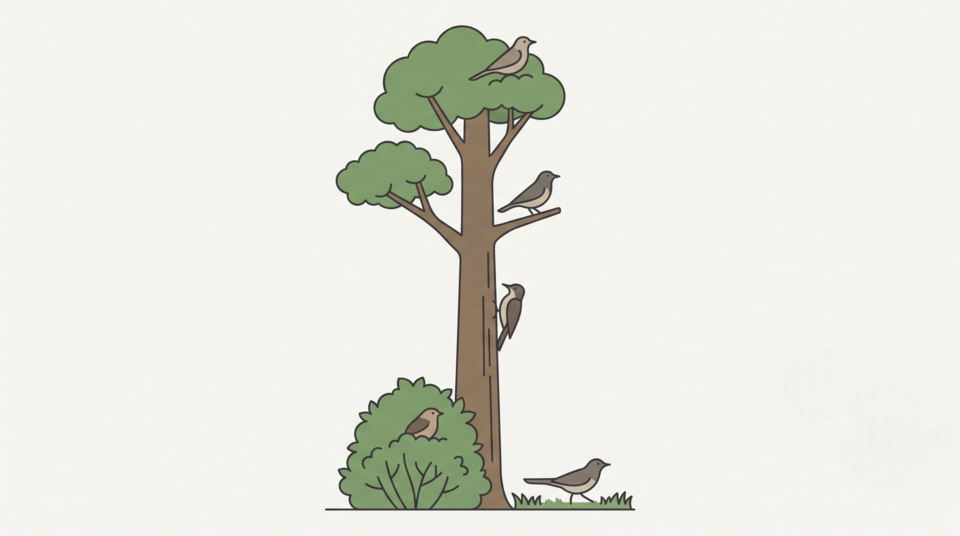
This habitat mapping guide shrinks our complete yard layout strategy into a single scannable cheat sheet. Use it to instantly differentiate overlapping silhouettes by tracking exactly where they choose to sit, feed, or perch:
| Environmental Zone | Common Family Examples | Core Biological Purpose |
|---|---|---|
| Open Turf / Lawn | Doves, Robins, Flickers | Probing for soil invertebrates and fallen seeds |
| Understory / Dense Shrub | Towhees, Catbirds, Wrens | Foraging in leaf litter near protective escape cover |
| Vertical Tree Trunk | Woodpeckers, Creepers, Nuthatches | Drilling and scaling bark for sub-surface insects |
| Mid-Canopy Branch | Vireos, Tanagers, Orioles | Gleaning foliage insects and slow fruit targeting |
| High Canopy / Sky | Swallows, Flycatchers, Swifts | Launching aerial hunting loops or long-range hawking |
Decoding the Three Primary Habitat Filters
1. Terrestrial Feeding Level: Open Lawn vs. Shrub Understory
How a ground-foraging bird utilizes open space instantly cuts your list of potential bird families in half.
- The Open Lawn: Doves, American Robins, and European Starlings feed out in the wide open on flat turf. Their bodies are built for long-distance vigilance, allowing them to spot predators from far away while pacing across grass.
- The Shrub Understory: Towhees, native sparrows, and thrushes scratch beneath heavy brush, hedge lines, or low leaf litter. They rely on dense, low-hanging foliage for instant escape cover, rarely venturing more than a few feet into open lawns.
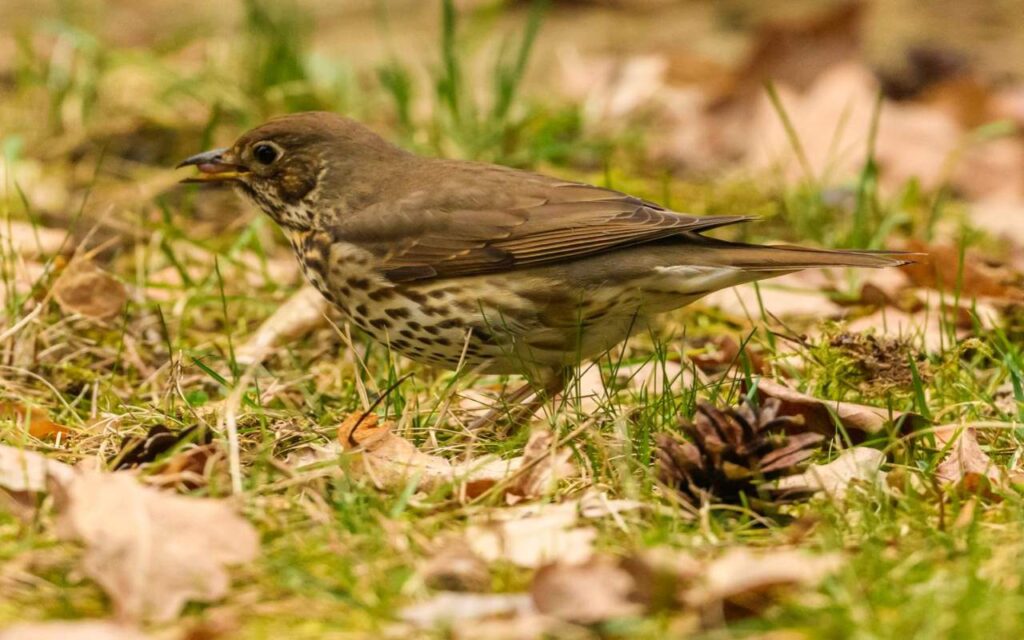
If you spot a brown, streaky bird scratching at the edge of your property line, ignore the colors. If it is hopping confidently across short grass far from trees, it is likely a juvenile thrush. If it stays glued to the dark soil under a thick bush, it is a native sparrow or towhee.
2. Vertical Tree Stratum: Trunk vs. Canopy Foliage
When a bird feeds inside a tree, its specific choice of wood layer rules out identical families.
- The Hardwood Bark (Trunk Specialists): Woodpeckers, Nuthatches, and Brown Creepers hunt strictly on vertical trunks and major structural limbs. They are anatomically locked onto bark surfaces to find food.
- The Outer Leaf Canopy: Warblers, vireos, and goldfinches operate out at the tips of flexible twigs, dancing through leaves to glean bugs or buds. You will rarely see these species sit against heavy, bare vertical tree trunks.
3. Structural Yard Substrate: Man-Made vs. Natural Perches
The specific platform a bird chooses for territorial singing or resting reveals deep behavioral constraints.
- Man-Made Linear Strata: Mockingbirds, flycatchers, and starlings actively seek out telephone wires, roof peaks, and chain-link fence lines. These hard, clear perches give them an unobstructed 360-degree view to defend territory or watch for flying insects.
- Natural Concealed Perches: Thrushes, grosbeaks, and cardinals prefer singing from deep inside tree branches or split-rail fences shrouded in climbing vines, choosing camouflage over open exposure.
What Are the Most Common Habitat Illusions for Beginners?
Missing sudden environmental shifts will completely corrupt your backyard counts. Getting tricked by temporary bird locations is one of the most widespread causes of Beginner Bird Identification Mistakes. Use these three rules to spot when a bird is acting outside its normal territory:
The Weather-Induced Downward Squeeze
Sudden spring frosts or heavy rain storms kill or freeze high-canopy insects. This environmental shift forces strict canopy-dwelling warblers down onto the lawn or low flowerbeds to hunt for low-dwelling bugs.
- The Correction: Never assume a bird on the grass is a ground-dwelling species during severe or freezing weather. Look past the floor location and evaluate its physical profile and wing-flicking movements instead.
The Nesting Material Illusion
During late spring, strict ground-feeding birds must gather nesting materials or find secure high perches to sing. A towhee that normally stays hidden under leaf litter will climb to the absolute top of a 30-foot oak tree to sing its breeding song.
- The Correction: Ignore the unusual height during spring singing bouts. Rely on the bird’s structural silhouette features, like bill shape and tail length, to verify its identity rather than relying on its temporary tree-top spot.
The Migratory Drop-In Anomaly
Exhausted nocturnal migrants land in whatever habitat patch is available at sunrise. This can cause forest-dwelling ovenbirds or thrushes to drop directly into open city parks or open yard flowerbeds where you would never see them in summer.
- The Correction: During peak migration months, do not immediately cross off a rare forest bird just because it is sitting in your vegetable patch. Rely on hard anatomical measurements and movement styles.
Case Study: The Scarlet Tanager Canopy Trap
The most instructive case study in habitat-based identification involves locating the Scarlet Tanager. This bird’s brilliant red body and black wings make it look unmistakable in field guides, yet birdwatchers go entire seasons without ever spotting one in their yard.
Field data published by The Cornell Lab of Ornithology on All About Birds proves that learning specific micro-habitat preferences solves this puzzle without requiring clear visual views:
- The Overstory Niche: Scarlet Tanagers are extreme canopy specialists. They spend their time high up in the dense leaves of mature oak trees, completely invisible to people standing directly beneath them.
- The Tracking Strategy: Instead of scanning open grass or feeders, observers must look strictly at the highest forest layers. They use backlighting to track movement in the leaf canopy, ignoring lower shrub layers completely.
Understanding this strict canopy rule stops you from wasting time searching the wrong yard levels.
The Science Behind Avian Micro-Habitats
Modern field tracking relies heavily on spatial ecology data. Field testing confirms that environmental boundaries are locked tightly into a species’ survival needs:
- Micro-Habitat Partitioning: A foundational ecological study published by the Ecological Society of America demonstrates that competing songbird species actively divide structural tree habitats down to the exact branch level to avoid fighting over identical food sources. This evolutionary constraint proves that a bird’s choice of tree height, branch thickness, or leaf layer is a highly predictable, hardwired biological marker you can rely on for field identification.
- Foraging Niche Choice: Urban wildlife research published in Landscape and Urban Planning through ScienceDirect reveals that migratory and backyard bird species select specific seasonal feeding spots based on canopy volume, tree sizes, and local vertical leaf structure. These strict vegetation layer preferences stay consistent even inside busy suburban yards, giving birdwatchers a highly predictable zone template for separating species.
- Canopy Structure Adaptation: Three-dimensional bio-structural research hosted by PMC Functional Ecology shows that physical tree density and leaf canopy layout directly control how birds move, hide, and find shelter based on their specific body traits. This functional mapping underscores why different bird groups choose specific tree layers based on their exact body sizes, tail shapes, and wing mechanics.
Frequently Asked Questions: Bird Identification by Habitat
Why Do Some Birds Only Visit Ground Feeders?
Native sparrows, juncos, and doves are anatomically designed to scratch and walk on flat dirt. They lack the leg mechanics or balance to cling to swinging tube feeders, which is why they stay on the floor to eat fallen seeds. The official Audubon Field Guide notes that these ground-gleaning profiles stay completely consistent across semi-open winter environments, where they spend the vast majority of their foraging time running, hopping, or scratching through leaf litter under feeding trays.
Can Tree Types Help Me Identify Mystery Birds?
Yes. Many bird families are locked onto specific tree species. For example, Pine Warblers are rarely found outside mature pine stands or evergreen blocks, while Wood Thrushes require damp, shady hardwood deciduous forests with thick leaf litter.
Why Are Swallows Always Flying Near Lakes or Lawns?
Swallows are aerial insectivores that catch flying bugs out of mid-air. Open water surfaces and freshly mowed grass create natural thermal currents that push bugs into the sky, creating a perfect open hunting habitat for high-speed fliers.
Conclusion: Mastering Your Habitat Routine
Mapping yard layers gives you an unbreakable visual baseline that completely bypasses the confusion of changing colors. Location data stays clear and useful through driving rain, dark tree shadows, and winter storms.
Building habitat fluency requires practicing your tracking order. Check the terrestrial feeding level first, look for tree trunk vs. canopy placement second, and examine structural perch platforms third. With steady practice, this routine helps you recognize bird families instantly.
Pairing these tracking habits with our Backyard Birds Checklist creates a strong foundation for your yard counts. You can easily cross-check these locations against our universal Backyard Bird Identification Guide and combine them with your acoustic skills at How to Identify Birds by Song, structural profiles at Bird Identification by Shape, visual rules at How to Identify Birds by Color, and Identify Birds by Size to build an airtight field routine.