
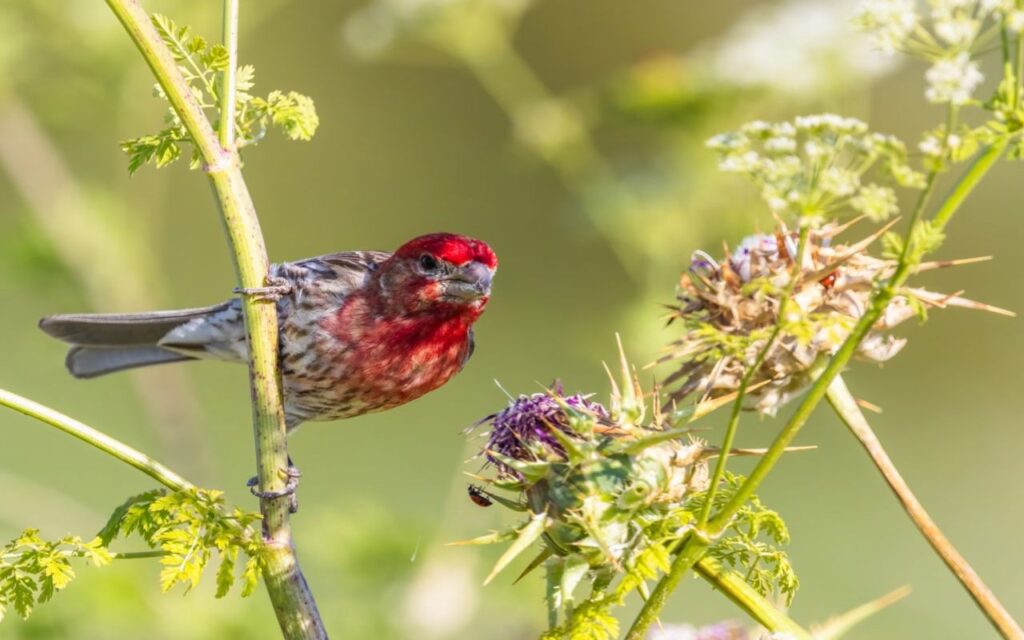
Learning to recognize backyard wildlife is an incredibly rewarding pursuit, but falling into common beginner bird identification mistakes frequently leads to highly inaccurate backyard species logs. Novice observers often walk away from their very first season of yard observation with a diary full of confident species counts that simply do not survive a second look.
These tracking errors are almost always systematic rather than random events occurring at your feeding stations. They are deeply rooted in a handful of repeatable cognitive traps that no standard commercial field guide warns you about before you begin your hobby.
Relying too heavily on unstable field marks creates cascading data errors across your entire seasonal tracking database. This initial confusion happens because new birders tend to process visual information backward, focusing on superficial markings instead of analyzing stable anatomical foundations.
Fortunately, mastering a few basic structural checks completely transforms your morning property auditing routine. Shifting your focus away from variable feather tones and toward fixed physical dimensions will instantly build your field-craft confidence across all changing seasons.
Quick Answer: What Is Color-First Tracking in Bird Watching?
Color-first tracking is an observation trap where beginners focus strictly on highly variable feather plumage tones before analyzing stable physical silhouettes or bill dimensions. Shifting sunlight and canopy shadows constantly distort these colors, making it the most unreliable field mark available and a primary cause of critical beginner bird identification mistakes.
Visual Identification Breakdown: Common Birding Traps Video Tutorial
Watching these common identification traps broken down on a screen provides immediate visual clarity before you dive into our long-form chapters below. This quick explainer style video tutorial maps out exactly how shifting sunlight and trick plumage stages look in real time to help you completely eliminate data logging errors from your morning property counts.
Show Transcript:
0:00
Welcome to this explainer. You know, today I’m going to walk you through my personal journey from being a deeply frustrated beginner with a completely
0:08
inaccurate backyard bird log to becoming a confident rapid fire observer. If you’ve ever felt like the birds at your feeders are practically conspiring to
0:16
confuse you, believe me, you are exactly where I used to be. So, why was my very first season of yard observation just a total disaster? Well, I got to confess.
0:27
I walked away with a diary full of confident species counts that looking back simply did not survive a second look. I was falling into highly
0:35
repeatable cognitive traps that absolutely no standard field guide warned me about before I began my daily tracking. Chapter 1, the color first
0:44
trap. I quickly realized my absolute biggest mistake. I was processing visual information entirely backward. Like so
0:53
many of us, I used to immediately scan for bright hues the second a bird landed. I was completely ignoring the fact that shifting sunlight and deep
1:00
canopy shadows aggressively distorts feather pigments. Because feather color is the most visually obvious feature, it’s a deeply intuitive starting point.
1:08
Sure, but it’s also the least stable field mark available. And man, it was just ruining my species logs. It’s
1:15
honestly amazing how powerfully lighting dictates what we think we see. I was routinely tricked into logging entirely
1:22
new species just because a male house finch sat in the blinding midday sun and looked totally bleached out. Or on the
1:29
flip side, a purple finch hiding in the dappled shade absorbed so much blue green light that it looked dull brownish gray, completely stripping away the
1:38
signature raspberry red tones I was desperately looking for. Chapter 2.
1:43
Lumping little brown jobs. My next major hurdle was figuring out what on earth to do with all those small streaked brown birds constantly flooding my feeders.
1:53
And I am completely guilty of this trap.
1:55
Because my novice eyes couldn’t instantly detect subtle structural boundaries, I was lazily dumping incredibly diverse species under one
2:03
single name on my tracking sheets. By defaulting to just calling everything a sparrow, I was systematically erasing vibrant, diverse local wildlife from my
2:12
daily counts. The solution to this problem actually blew my mind. I used to mix up female house finches and song
2:20
sparrows constantly, right? Because their streak backs look practically identical during a passing glance. It wasn’t until I learned to stop staring
2:28
at their backs and start looking directly at their bill profiles that everything changed. The finch’s deep conical seed cracking bill is a dead
2:37
giveaway compared to the sparrow’s fine, slender profile. To force myself out of this rut, I trained my eyes to execute a deliberate face first scanning routine.
2:46
I started spending exactly 3 seconds, literally just 3 seconds, checking these specific facial micro zones the moment a
2:54
compact brown bird arrived. Instantly, I could spot a chipping sparrow’s crisp rufous chestnut crown cap or a white-throated sparrow’s bold white
3:01
eyebrow. It provided a foolproof tracking anchor without needing any complex color assessment at all. Chapter 3. Tricked by seasonal molts.
3:11
Just when I thought my new facial scanning routine had everything figured out, the changing seasons threw me a massive curveball across the calendar
3:18
year. I was completely fooled by the fall plumage transition trap. Since I originally learned my species from those colorful summer guide books, my mental
3:26
templates were incredibly rigid. So, when November rolled around, I confidently logged the dull olive brown winter American goldfinch as a total
3:34
stranger. I completely failed to recognize the bright yellow resident I had happily watched all summer long. So the crucial point here is that color
3:42
isn’t just about seasons. It’s about food. When I read Joffrey Hill’s 1991 research, it totally clicked for me. The
3:50
intensity of carotenoid based yellow and red plumage is directly dependent on dietary access during the molt. This
3:57
meant even two male house finches sitting right next to each other at my feeder could show noticeably different red intensities simply based on what
4:04
they ate that summer. Color is truly the least stable metric we have. And midsummer brought its own chaos. I kept
4:13
spotting these weird, heavily spotted robins and these odd brown cardinals with dark bills, genuinely wondering if I was discovering rare exotics in my own
4:22
backyard. The breakthrough for me was learning to look for the fleshy pale yellow or pink gape flange at the corner of their mouths. Spotting that flange meant they weren’t mystery migrants.
4:32
They were just awkward, freshly fledged juveniles still growing into their adult looks. Chapter 4. My four-step structural blueprint. To finally stop
4:41
making all these visual mistakes, I had to completely abandon color matching and adopt a strict, disciplined diagnostic
4:48
routine. This breakthrough research from Grant and Grant was my major light bulb moment. It proved to me that a bird’s
4:55
structural anatomy, specifically its bill geometry, is an evolutionary constant. Unlike its feathers, which change with the seasons, the lighting,
5:03
and the diet, the core anatomical shape of the bird is completely fixed. So, I developed and now strictly use this
5:10
exact four-step observational sequence the absolute moment a bird arrives. I start with a baseline size check, then assess the bill shape, do my 3-second face first pass, and finally I note its movement style. I can complete this entire checklist in under 8 seconds, permanently bypassing my old
5:28
impulse to just guess a color. Applying this structural filter feels like unlocking a superpower, honestly. For example, if I assign a small size class
5:36
and note the bird is working headfirst downward on the vertical side of my seed cage, I can instantly filter out every single sparrow and finch candidate. I
5:44
can confidently log a nuthatch before I even see a single feather color clearly just based on that behavioral and spatial anatomy alone. This structural
5:52
blueprint completely saved me with persistent lookalike pairs, too. I used to tear my hair out over Downy versus Hairy woodpeckers until I learned to track this one specific facial ratio.
6:04
Judging the bill length against the overall head depth is a physical measurement that is totally lighting proof. It works perfectly at normal feeder distances, no matter if the bird
6:13
is in the blinding bright sun or deep shade. Chapter 5, fixing my daily bird log. Ultimately, I realized that
6:21
changing how I observed wasn’t quite enough. I also had to fundamentally change how I recorded those sightings.
6:27
This 2009 study heavily validated my new habits. It turns out that formal data entry actively forces you to commit to a decision. When I started logging
6:36
systematically, it created a line of accountability that stopped me from casually lazily guessing. It trained my brain to treat every single observation
6:43
window as a precision audit rather than just a quick glance. I also had to change my relationship with technology.
6:50
I absolutely love using AI apps like Merlin for their incredible spectrogram analysis, but I realized that opening them before I tried my own four-step structural assessment was a huge trap.
7:00
It was making me dependent on my phone and actively blocking my own visual fluency. I had to learn to use them strictly as secondary verification
7:06
instruments, not crutches. The payoff for all this discipline is massive. It’s incredibly rewarding to know that by
7:14
fixing my own daily records, I am actually doing something larger. By shifting to a structure first routine and utilizing structured checklists, I’m
7:22
contributing highly accurate, verified data to global citizen science platforms that track continentwide population and migration patterns. My backyard is
7:31
literally feeding global science. How cool is that? Once I abandoned my color first habits and truly embraced the structural blueprint, my backyard
7:40
completely transformed. It went from a confusing blur of random feathers into a predictable, highly readable biological
7:47
document. The birds haven’t changed, but my ability to actually see them has. So, the only question I have left for you
7:54
is, are you ready to look out your own window differently?
What Is the Most Common Bird Identification Mistake Beginners Make?
The single most common bird identification mistake beginners make is color-first tracking, which is the habit of scanning for bright hues before assessing structural features. Novice observers routinely look for distinctive plumage tones instead of analyzing vital baseline indicators like body shape, bill geometry, and tail proportions.
Feather color stands out as the most visually obvious feature on an active bird, making it a deeply intuitive starting point for new backyard hobbyists. The critical problem is that this visual element also represents the least stable field mark available across changing outdoor environments.
Shifting light conditions and deep canopy shadows constantly distort how feather pigments look from your window observation post. Relying entirely on these variable surface markings before establishing structural benchmarks will inevitably corrupt your daily species logs.
The Danger of Color-First Tracking
Direct midday sunlight bleaches red and orange plumage tones exceptionally thoroughly. A male House Finch sitting in full sun can appear pale and washed out enough to be logged as an entirely separate species.
Conversely, a Purple Finch sitting in dappled tree canopy shadows absorbs an immense amount of blue-green wavelength light. This lighting shift makes the bird appear dull brownish-gray, stripping away the signature raspberry-red tones that help distinguish it from local sparrows.
The primary identification training resources managed by the Cornell Lab of Ornithology emphasize that experienced field observers must evaluate overall structural properties first. They analyze silhouette sizing, body shape, and tail proportions before using color as a minor final confirmation marker.
This reliable approach reflects a heavily documented principle in field ornithology where core structural traits are fixed anatomical constants. Physical dimensions like bill depth, tail-to-torso ratios, and natural body postures do not shift with changing light conditions, feather wear, or mobile camera exposure settings.
The Structural Blueprint Fix
The structural blueprint fix to eliminate this common tracking error is exceptionally straightforward. When a new bird arrives near your feeding stations, resist the immediate impulse to name the color you see and ask two foundational shape questions.
You must first evaluate how large the unknown visitor sits relative to a common House Sparrow. Right after that, look directly at the profile of its face to determine the exact shape and curvature of its bill.
The comprehensive field identification guides published by the Audubon Society reinforce this structural-first approach by training bird watch enthusiasts to build a shape reference ladder. Learning to rank these raw dimensions completely eliminates guesswork before you ever consult detailed plumage descriptions.
Furthermore, classic breakthrough research on bill morphology published in Science by Grant and Grant (2006) demonstrated that bill depth and curvature are the primary evolutionary predictors of dietary ranges. Their field data proves that bill geometry carries far more reliable taxonomic information per observation second than any unstable plumage color mark available to a backyard observer.
Why Do Novice Birdwatchers Frequently Misidentify Common Sparrows?
Differentiating small, streaked brown yard birds ranks among the most frustrating field challenges for beginning backyard bird observers. Because multiple native species share identical compact profiles, learning to spot subtle physical boundaries is the only way to avoid critical data logging errors.
Anatomical Indicators of the Sparrow Family
Novice birdwatchers frequently misidentify sparrows because the family is exceptionally large, geographically overlapping, and superficially identical at a passing glance. Differentiating look-alike members of this compact group requires tracking crisp anatomical indicators inside specific facial zones rather than scanning broad back plumage patterns.
The “Little Brown Job” Over-Simplification
Sparrows routinely generate more intense identification confusion per square inch of residential yard space than any other bird family in North America. This localized tracking frustration stems from a pervasive cognitive shortcut known among field observers as the “Little Brown Job” over-simplification.
This mental trap causes beginning birdwatchers to lump every small, brown, streaked bird visiting their property into a single undifferentiated mental category. Because novice eyes fail to immediately detect subtle structural boundaries, distinct species like Song Sparrows, Chipping Sparrows, and female House Finches end up mixed up interchangeably down their daily tracking sheets.
Falling into this tracking trap is particularly costly for amateur bird watch enthusiasts. Lazily dumping every streaked bird under a singular name creates severe cascading errors across your entire seasonal species log.
A beginner who defaults to tracking every small streaked visitor as a standard sparrow is systematically erasing diverse local wildlife from their final counts. This mental shortcut effectively collapses Song Sparrows, Chipping Sparrows, White-throated Sparrows, Field Sparrows, and Lincoln’s Sparrows into one single duplicate record.
The exact same cognitive blind spot commonly causes observers to misidentify female House Finches as native Song Sparrows. This specific mistake happens because both birds present a nearly identical brown-streaked appearance during a brief passing glance.
However, a female House Finch carries a gently curved, moderately deep conical seed-cracking bill designed for hard hulls. Conversely, a Song Sparrow displays a much finer, more slender conical bill profile that can be instantly verified in a brief head examination at any standard feeder distance.
The structural blueprint fix requires training your eyes to scan three highly specific facial zones the moment a compact streaked bird arrives on your property columns. You must analyze the supercilium eyebrow stripe, check the lower throat region for distinct bib markings, and inspect the central crown for colored caps.
A clean, plain gray breast completely free of dark streaking combined with a crisp rufous-chestnut crown cap identifies a Chipping Sparrow immediately. Spotting this specific physical combination eliminates every other candidate from consideration before any other plumage feature is even examined.
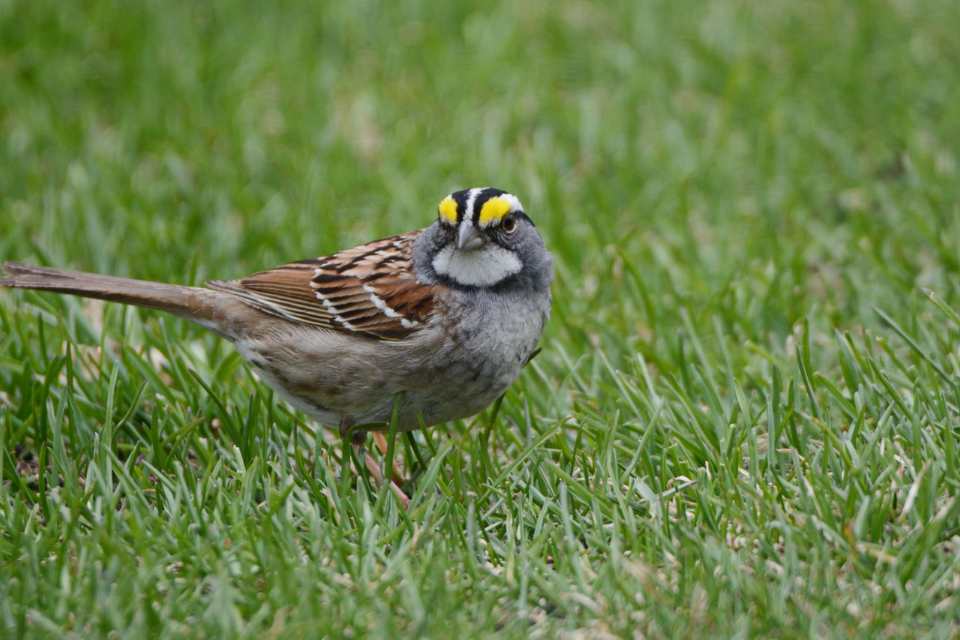
Similarly, a bold black bib situated on the throat profile next to a chestnut-brown nape points directly to a male House Sparrow. If you instead spot a clean, unstreaked breast anchored by a distinct white eyebrow accent line, your candidate narrows to a White-throated Sparrow.
Learning to confidently separate these complex look-alike plumage stages across changing seasonal variations is detailed extensively inside our House Sparrow Juvenile vs. Adult Identification Guide. Reviewing these specific age milestones prevents record crowding and locks in maximum diagnostic data integrity.
To further support backyard community auditing networks, tracking programs like Project FeederWatch at the Cornell Lab of Ornithology document the sparrow family’s vast behavioral diversity across their public species indices. Utilizing these structured diagnostic pathways inside the comprehensive Winter Feeder Sparrow Guide provides the exact training frame needed to permanently break the “Little Brown Job” cognitive shortcut.
The Face-First Scanning Method
Practicing a deliberate face-first scanning routine on every small brown bird that arrives at a feeder eliminates this categorical error within a single season of regular observation. This disciplined sequence requires a focused examination of specific facial micro-zones before your eyes ever look down at the bird’s back plumage pattern.
The routine takes approximately three seconds to execute and checks four distinct zones: bill shape, supercilium presence, throat markings, and breast streaking. Committing to this systematic top-to-tail sequence ensures you catch critical diagnostic indicators that casual spotters miss completely.
Any small brown bird that shows zero eyebrow stripe, zero throat marking, and uniform fine breast streaking is a female House Finch or a House Sparrow. Observing this specific combination immediately proves the visitor is not a native Song Sparrow or a Lincoln’s Sparrow.
Conversely, any small brown bird that shows a bold white eyebrow stripe and a clean, unstreaked pale gray breast is a Chipping Sparrow or a White-throated Sparrow. This crisp visual combination confirms the family lineage and means the visitor can never be a House Finch or a House Sparrow.
This four-point face-first check resolves the single most misidentified category of birds in the North American backyard without requiring any complex color assessment at all. It provides an immediate, foolproof tracking anchor that keeps your morning log sheets incredibly accurate across all changing seasons.
For a broader context on the complete range of sparrow and finch species that commonly appear in residential yards, review our organized overview inside the master Common Backyard Birds Guide. This core foundational resource provides a structured family-by-family breakdown sorted carefully by size class and seasonal occurrence.
How Does Seasonal Molting Cause Bird Identification Errors?
Seasonal molting is the biological process by which birds systematically replace their entire feather coat on an annual or biannual schedule. This necessary renewal cycle produces some of the most spectacular and consistently misinterpreted visual changes in the backyard bird community.
Differentiating these changing plumage stages across the calendar year ranks among the most frustrating challenges for beginning backyard bird observers. Because multiple native species undergo radical color changes, learning to spot subtle physical boundaries is the only way to avoid critical data logging errors.
The Fall Plumage Transition Trap
The core problem is that most beginner observers learn bird species from colorful summer guidebook illustrations that depict birds in their full breeding plumage. This limited training creates a rigid mental template that simply does not match what those same species look like for five or six months of every year.
Seasonal molting causes identification errors by transforming the bright, high-contrast breeding plumage that guidebooks illustrate into dull, muted winter coloration. This radical transition means many beginners do not recognize the bird as the same species from their previous records.
Species like the American Goldfinch complete this transformation so thoroughly that a bird the observer confidently identifies as a bright yellow finch in July looks like a completely unfamiliar olive-brown visitor by November. This seasonal camouflage shift routinely tricks backyard spotters into entering entirely new, incorrect species names down their property tracking logs.
The trap operates in both directions across the calendar year as birds adapt to their environments. In autumn, bright summer residents complete their post-nuptial complete molt, replacing worn breeding feathers with a fresh set of duller, denser winter plumage that provides insulation rather than visual signaling.
Classic breakthrough research on avian pigmentation published in Nature by Hill (1991) established that the intensity of carotenoid-based yellow and red plumage coloration in finches is directly dependent on dietary access to carotenoid pigments during the active molt period. Their field data proves that the exact same individual bird can show highly variable color intensity between summer and winter molt cycles depending purely on food availability.
This means that even within a single season, two male House Finches at the same feeder can show noticeably different red intensities because one had better nutritional access during its molt period. The fall plumage trap catches beginners most dramatically with the American Goldfinch, because the transition from brilliant lemon-yellow summer plumage to dull olive-brown winter plumage is nearly complete by late October.
A beginner who has never seen this transition will arrive at the feeder in November, see a dull olive-brown bird with faint wing markings perched exactly where the yellow finches were in August, and log it as an unknown visitor rather than recognizing the same resident population in its winter dress.
The structural blueprint fix is to learn two plumage states for every species rather than one, specifically noting the wing pattern and bill shape, which remain consistent between breeding and non-breeding plumage states even when body color shifts dramatically.
The American Goldfinch’s black-and-white wing pattern, small conical bill, and characteristic undulating flight trajectory are identical in summer and winter, providing reliable structural anchors that survive the carotenoid pigment shift completely intact.
A full explanation of why goldfinches and other finch species change color is available inside our comprehensive Why Do Goldfinches Change Color Guide, which documents the hormonal and nutritional mechanisms driving each seasonal plumage transition.
The Mid-Summer Juvenile Trap
The molting confusion problem is compounded in mid-summer by the simultaneous presence of freshly fledged juvenile birds displaying plumage that bears no resemblance to either the summer or winter adult patterns. This sudden population explosion introduces highly confusing visual variables directly into your morning property counts.
Juvenile American Robins present heavy dark spotting across the entire breast, a pattern so unlike the clean orange-red breast of the adult that beginners frequently report them as spotted mystery birds or exotic migrants. Similarly, juvenile Northern Cardinals lack the bold red plumage of either adult sex, instead showing a warm brown overall coloration with only faint reddish tinges on the wings and tail.
They also present a noticeably dark bill that has not yet developed the adult’s characteristic bright orange-red coloration. The structural field marks that resolve juvenile identification are the same ones used for adults, ensuring your size, body proportions, and behavioral association with adult birds remain consistently reliable even when plumage is transitional and patchy.
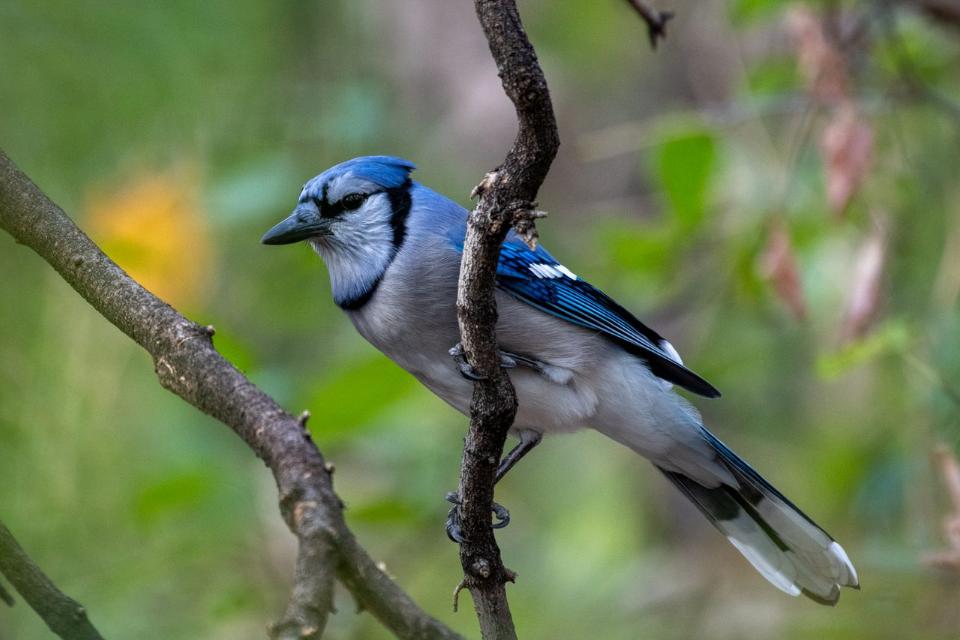
Fledgling birds are also identifiable by a highly visible gape flange, which is the fleshy pale yellow or pink commissure visible at the corner of the bill where the upper and lower mandibles meet. This prominent physical trait persists for approximately 2 to 4 weeks after the bird permanently leaves the nest.
Any small bird showing this gape flange is unambiguously a recent fledgling rather than a rare or unusual visitor navigating your neighborhood tracking log. Its species identity should be resolved by associating it with the adult birds delivering food during that same observation window.
The Spring Return Confusion
Spring creates a second molting confusion event running in the opposite direction from the fall transition. Between February and April, resident finches and warblers complete their pre-nuptial partial molt, regenerating the bright carotenoid-saturated feathers of breeding plumage.
This biological shift causes the same olive-brown winter birds that have been visiting all season to suddenly appear transformed into brilliantly colored strangers at the familiar feeder.
Beginners who have never observed this transition sometimes interpret the arrival of breeding-plumage males as new migrants displacing the winter birds, when in reality they are watching the same individual birds that have occupied the yard for the previous four months undergoing their spring coat change.
Pairing the seasonal plumage knowledge documented in this guide with the broader migration and seasonal activity context provided inside our master Spring Birdwatching Tips for Beginners Guide creates a complete year-round framework for interpreting what you see at the feeder in every month. This synchronized data mapping ensures your backyard logs remain completely accurate across all weather variations.
What Is the Best Way to Avoid Misidentifying Birds in Your Yard?
The most reliable prevention strategy for bird identification errors is not acquiring more field guides or better optics. It requires implementing a structured diagnostic routine that evaluates size, bill shape, and behavioral signature in a fixed sequence before any color assessment is attempted.
Avoiding misidentification requires replacing the natural impulse toward color-first pattern matching with a deliberate, repeatable four-step observation sequence. This specific discipline targets structural field marks first and uses color only as a final confirmation down your daily logs.
Combining this observational discipline with an active species-tracking database eliminates guesswork from yard counts. It creates an accurate, replicable record that easily survives secondary verification against reference sources over time.
The Four-Step Structural Diagnostic Routine
Implementing a structured observation routine allows you to systematically filter out look-alike species within a few seconds of arrival. Checking specific physical milestones in a disciplined top-to-tail sequence ensures your data collection remains perfectly accurate across changing seasons.
- Step 1 (Size Class Assignment): Takes approximately one second to assign the unknown visitor to a specific baseline size class. Observers compare the bird against familiar benchmarks like being smaller than a sparrow, matching a sparrow, matching a robin, or crow-sized and above.
- Target Filtering Impact: This single physical comparison successfully eliminates the majority of incorrect candidate species before any detailed plumage examination begins.
- Step 2 (Bill Archetype Tracking): Takes one to two seconds to identify the bird’s precise facial bill archetype. You check for a deep conical seed-cracker, a slender needle-like insect probe, a heavy chisel hammer, or a hooked predatory bill.
- Target Filtering Impact: These physical shapes are completely independent of variable lighting conditions and seasonal plumage states. This anatomical stability makes bill geometry the single most lighting-proof field mark available to any observer.
- Step 3 (Face-First Pass): Scans the head profile in a rapid three-second window to map out fine facial markings. Your eyes check specifically for supercilium presence, distinct throat bib markings, crown stripes, or clean plain eye rings.
- Target Filtering Impact: Executing this swift facial scan instantly resolves the large majority of sparrow and warbler confusions that easily defeat standard color-first tracking strategies.
- Step 4 (Behavioral Signature): Notes one immediate behavioral trait to track how the bird moves across your feeding stations. Document whether the bird is hopping or walking on the ground, whether it utilizes a snatch-and-retreat perch strategy, and what flight trajectory it produces when departing.
- Target Filtering Impact: Completing all four checks before committing to a name takes between five and eight seconds for a perched bird. It consistently produces accurate identifications that easily survive secondary verification.
The complete forensic framework behind this four-step routine is documented in detail inside our master Backyard Bird Identification Guide. This core foundational resource expands each diagnostic step into a comprehensive visual blueprint applicable to every species on the North American residential checklist.
Why Systematic Logging Prevents Repeated Errors
Systematic species logging does far more than create a tidy historical record for your property columns. It actively forces the observer to commit to a specific identification decision rather than allowing uncertain sightings to remain completely unresolved in short-term memory.
This formal data entry creates an immediate line of accountability that significantly accelerates the development of genuine diagnostic skill. It stops you from lazily guessing and trains your brain to treat every birding session as a precision audit.
Classic breakthrough research on citizen science platforms published in Biological Conservation by Sullivan et al. (2017) demonstrated that structured observation platform data carries measurably higher accuracy than casual logs. Their field data proves that the formal act of data entry prompts observers to apply strict verification criteria they routinely bypass during informal watching.
This psychological principle applies directly to your neighborhood tracking log. Observers who log their sightings using a structured checklist consistently outperform casual watchers in terms of identification accuracy on follow-up verification audits.
Once you learn to recognize these common plumage traps, utilize our comprehensive backyard bird checklist to systematically document your daily counts. Referring back to this structured tracking baseline creates an airtight diagnostic routine to master your morning property counts flawlessly.
The Look-Alike Species Pair Problem
A specific category of data logging error deserves its own systematic tracking attention. This common frustration involves look-alike species pairs, which are closely related birds that share a matching geographic range, similar body sizing, and superficially overlapping plumage traits.
These specific pairs generate persistent, chronic errors in backyard logs because casual window observation produces a genuine visual ambiguity. This confusion cannot be resolved without deliberately training your eyes to examine the single diagnostic feature that separates them.
The House Finch and Purple Finch remain the most commonly confused pair at eastern feeding stations. The physical separation hinges entirely on checking for the presence of parallel brown flank streaks on a white background versus a diffuse raspberry wash, alongside analyzing the curved versus straight culmen bill lines.
The complete separation protocol for this pair, including the female-plumage distinctions that many observers find even more challenging than the male comparison, is documented at our House Finch vs. Purple Finch Guide. Reviewing these precise lines prevents record crowding and locks in maximum data integrity.
The Crow and Raven pair creates comparable confusion for backyard observers in geographic areas where both species occur simultaneously. The wedge-shaped versus fan-shaped tail profile remains the single most reliable in-flight separator at distances where bill size differences are difficult to judge.
Similarly, the Downy and Hairy Woodpecker pair resolves entirely on one single physical facial measurement. Reviewing our comprehensive Downy vs Hairy Woodpecker Guide confirms that the Downy’s bill is noticeably shorter than 40 percent of its overall head depth, while the Hairy’s bill matches or completely exceeds its total head depth across all lighting conditions.
Why Binocular Quality Matters Less Than Observation Discipline
Beginning observers frequently attribute common identification errors to inadequate optics rather than inadequate observation habits. However, the available field evidence does not support premium equipment as the primary cause of backyard misidentification.
The structural field marks that resolve the most common identification confusions are easily resolvable at typical feeder distances with any standard binocular of modest quality. You do not need expensive glass to track basic bill shapes, reference size benchmarks, gape flange presence, tail-to-torso ratios, and ground locomotion gaits.

The beginner birdwatcher resources published by the Audubon Society consistently note that observational discipline and methodological consistency heavily outweigh optical quality. True accuracy comes from training your eyes to execute a fixed sequence, not from upgrading your lenses.
The most productive investment for a beginning observer is not a premium binocular upgrade but rather 15 dedicated minutes per day of structured feeder observation. Applying the four-step diagnostic routine to every bird that arrives, regardless of whether the species is already known, builds permanent field-craft confidence.
How Distance and Habitat Context Filter Candidates
One frequently overlooked identification tool requires zero optical equipment and zero detailed field mark knowledge. Utilizing habitat context filtering allows you to eliminate large numbers of candidate species before any structural assessment even begins.
Every species on the North American backyard checklist maintains a highly characteristic microhabitat preference within your property layout. Paying close attention to where an unknown bird sits instantly compresses your candidate choices down your daily tracking sheets.
For example, a small bird working headfirst downward on the vertical side of a suet cage is a Nuthatch or a Chickadee. No member of the sparrow or finch families possesses the physical anatomy to execute headfirst downward locomotion on vertical surfaces.
Similarly, a medium-sized bird running across open lawn turf in stop-and-start bursts is an American Robin or a European Starling. Both Mourning Doves and Cardinals strongly avoid open lawn foraging in favor of ground-level cover near protective shrubs or feeder stations.
A small brown bird scratching through leaf litter directly under a platform station is almost certainly a sparrow species, a Dark-eyed Junco, or a Towhee. Warblers, vireos, and most finches do not habitually scratch through ground debris during winter foraging sessions.
A comprehensive introduction to applying this spatial method alongside seasonal timing data is available inside our master Spring Birdwatching Tips for Beginners Guide. This core resource documents exactly how microhabitat preferences and active arrival calendars intersect to ensure your backyard logs remain completely accurate across all weather variations.
Digital Tools as Verification Instruments
The rapid development of AI-assisted bird identification applications has created a powerful secondary verification layer for backyard observers. Beginning birdwatchers can utilize these mobile programs to instantly confirm or challenge their own tentative field assessments.
The free Merlin Bird ID App developed by the Cornell Lab of Ornithology provides real-time sound identification through advanced spectrogram analysis. This technology allows you to confirm a tricky visual identification by matching a vocalization to a verified audio profile, or to identify a species heard but not seen during low-light morning observation sessions.
However, it remains critical to use these automated programs strictly as confirmation instruments rather than primary identification replacements. Building genuine visual recognition skills requires you to commit to your own field identification decisions before consulting electronic verification.
An observer who opens an application before attempting a basic four-step structural assessment quickly trains themselves to be entirely dependent on technology. This bad habit actively blocks you from developing the observational fluency that makes identification rapid and automatic during brief, fast-moving sightings.
Public citizen science networks extend the value of your systematic property records by providing instant access to massive historical databases. Utilizing the global eBird Platform allows you to review local species frequency data filtered precisely by geographic location and calendar date.
Checking these localized data distributions helps you quickly determine whether an unusual-looking yard visitor is genuinely anomalous for your neighborhood. It helps you verify if you are looking at a rare regional migrant or simply a common resident species passing through an unfamiliar seasonal plumage state.
Furthermore, classic breakthrough research on citizen science data accuracy published in PLOS ONE by Hurlbert and Liang (2012) demonstrated that structured public observation platforms accurately capture massive regional migration phenology patterns. Their landscape-scale analysis confirms that formal backyard data logging contributes directly to continent-wide population monitoring programs.
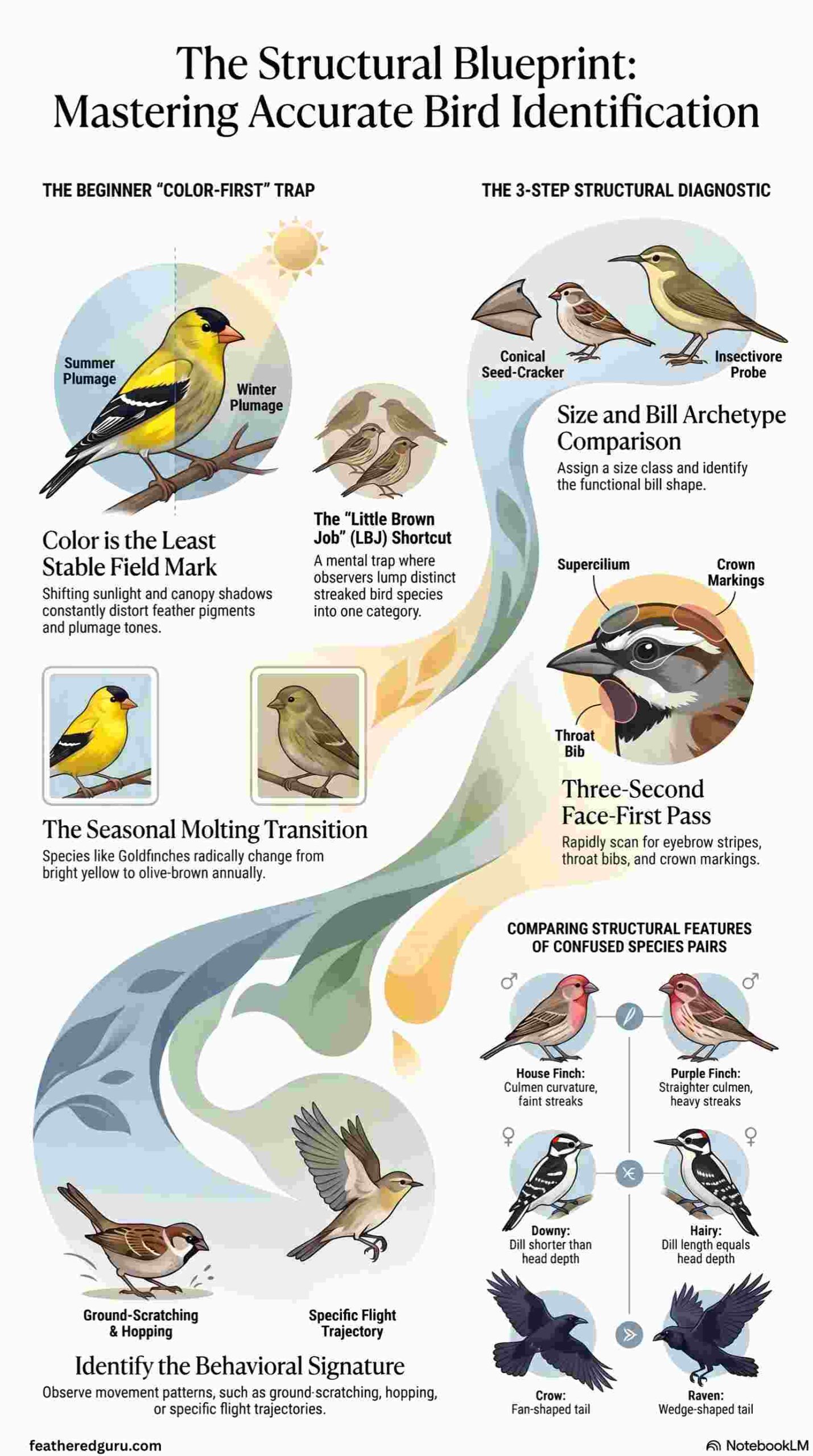
Visual Summary Matrix: Quick Reference Tracking Chart
This quick reference tracking chart condenses our full 6,000-word field guide into a single scannable panel to completely eliminate data logging errors before your next property count.
Conclusion: Building an Error-Resistant Identification Practice
The beginner identification mistakes documented throughout this guide share a single underlying cause. Whether you struggle with color-first tracking, Little Brown Job lumping, seasonal plumage transitions, or look-alike pair confusion, each error results from applying the wrong observational sequence to a structural anatomy challenge.
Shifting to a structure-first diagnostic routine that evaluates size, bill shape, and behavior before color permanently eliminates the most common error categories in a single change of approach. The look-alike pair separations and seasonal plumage context provided alongside them build the specific knowledge base needed to resolve your remaining identification challenges.
Pairing this structural observational framework with systematic daily logging through a verified tracking checklist transforms a casual hobby into a rigorous, continuously improving citizen science practice. This disciplined approach ensures you generate incredibly accurate data at your feeding stations every single morning.
The birds in your yard belong to the same predictable species, appearing in the same repeatable behavioral patterns week after week and season after season. What changes as your identification discipline develops is not the birds themselves, but the precision and confidence with which you read the biological document every visitor presents the moment it lands on your property.