
Reader Transparency: This birding guide contains paid affiliate links. If you click a link and make a purchase, I may receive a small commission at no extra cost to you. As an Amazon Associate, I earn from qualifying purchases. Your support helps keep Feathered Guru flying!
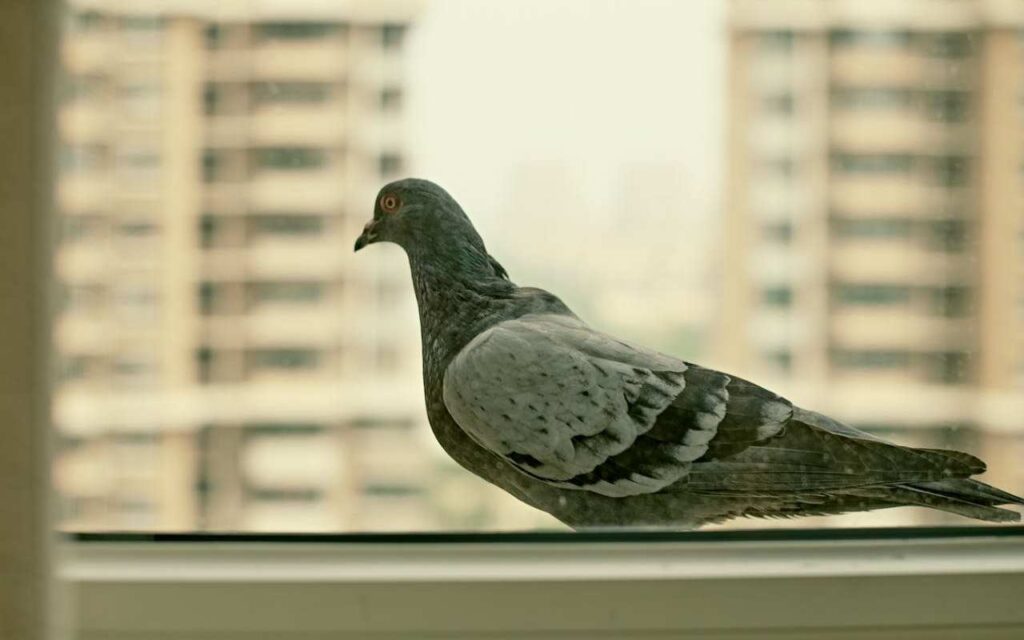
Opening my blinds only to stare at a messy buildup of nesting debris and corrosive waste right against the glass is incredibly frustrating. Finding a permanent solution on how to keep birds off window ledges requires a smart, biology-based approach rather than cheap plastic scare tactics.
In my own yard testing, I have watched traditional retail decoys fail the second local birds realize the fake predator isn’t a real threat. Pest birds are simply creatures of habit seeking out flat architectural ledges that mirror the cliff faces of their ancient ancestors.
To reclaim your clean property lines permanently, stop throwing money at basic retail tricks and master the raw mechanics of physical exclusion.
What is the Most Effective Method for Window Ledge Bird Exclusion?
The single best solution is complete physical exclusion using heavy-duty UV-stabilized nylon mesh netting or screens, suspended two to three inches away from the surface to create an impenetrable mechanical barrier.
To secure wide or problematic masonry, combine this mesh screening with an invisible string tension line, blunted stainless steel bird spikes, or 45-degree angled bird slope covers to eliminate alternative roosting spots completely.
Watch How to Install Ledge Barriers (Animated Guide)
Reviewing an easy, illustrated breakdown gives you excellent clarity when setting up your window guards for the first time. This quick whiteboard animation walks you through tracing your exact sill dimensions, hanging your netting blocks, and securing your hardware step-by-step.
📝 View Video Timeline & Key Takeaways
[00:00 – 01:16]: Ledge attraction drivers and site fidelity mechanics. Analyzing the deep evolutionary impulses that make window sills mimic ancient cliff environments [00:52-01:04]. Isolating architectural warmth, high-altitude vantage points, and stubborn avian territory anchoring routines [01:05-01:14].
[01:17 – 02:07]: Rapid deployment entry and sensory deterrents. Implementing immediate backyard fixes using acidic white vinegar sprays, single-strand tension wires, and holographic flash ribbon [01:31-01:45]. Disrupting nearby feeding incentives to systematically close down open backyard buffets [01:49-01:54].
[02:08 – 03:12]: Physical exclusion strategy and species sizing audits. Upgrading to high-durability hardware like blunted stainless steel spikes and sloped covers to secure a verified 70% reduction in long-term pest volume [02:21-02:42]. Customizing track barriers to exclude heavy pigeons, nimble sparrows, and small songbirds [02:50-03:10].
[03:13 – End]: Avian legal codes, seasonal installation timing, and toxic waste remediation. Reviewing active nest protection rules under strict spring wildlife laws [03:28-03:40]. Managing N95 protective equipment, particle-softening wetting rules, and professional high-elevation hazard backup protocols [04:11-05:26].
Why Birds Love Your Window Ledge in the First Place
Understanding bird behavior helps you pick solutions that actually work instead of wasting money on gimmicks when trying to prevent birds nesting by windows.
- Window ledges mimic natural roosting sites. To a bird, your windowsill looks exactly like a cliff ledge or tree branch – flat surface, protected overhead, good visibility. Urban birds like pigeons (Columba livia), house sparrows (Passer domesticus), and European starlings (Sturnus vulgaris) evolved to exploit human architecture because it replicates their ancestral habitats perfectly.
- Height provides safety. Elevated perches offer protection from ground predators like cats, rats, and dogs. Birds feel secure on window ledges because they can see threats approaching from any direction.
- Your building radiates warmth. Exterior walls, especially south-facing ones, absorb solar heat and radiate it outward. Window ledges stay several degrees warmer than ambient air, making them prime real estate during cold weather. Heating from inside your home adds even more thermal advantage.
- Food sources attract and hold them. If you’ve got bird feeders nearby, outdoor dining areas, unsecured trash, or even just insects attracted to exterior lights, birds learn your ledges offer both shelter and convenient food access.
- Site fidelity means they return. Once birds establish a roosting or nesting location, they exhibit strong site fidelity – returning to the same spot repeatedly even after being chased away. You’re not just dealing with random birds. You’re dealing with the same individuals who’ve claimed your ledges as their territory.
Want to understand more about common problem birds? Check out our guide on invasive backyard birds.
Best Methods to Keep Birds Away from Windows by Bird Type
Different birds respond differently to deterrents. Here’s what works best for each common nuisance species trying to sit on window ledges.
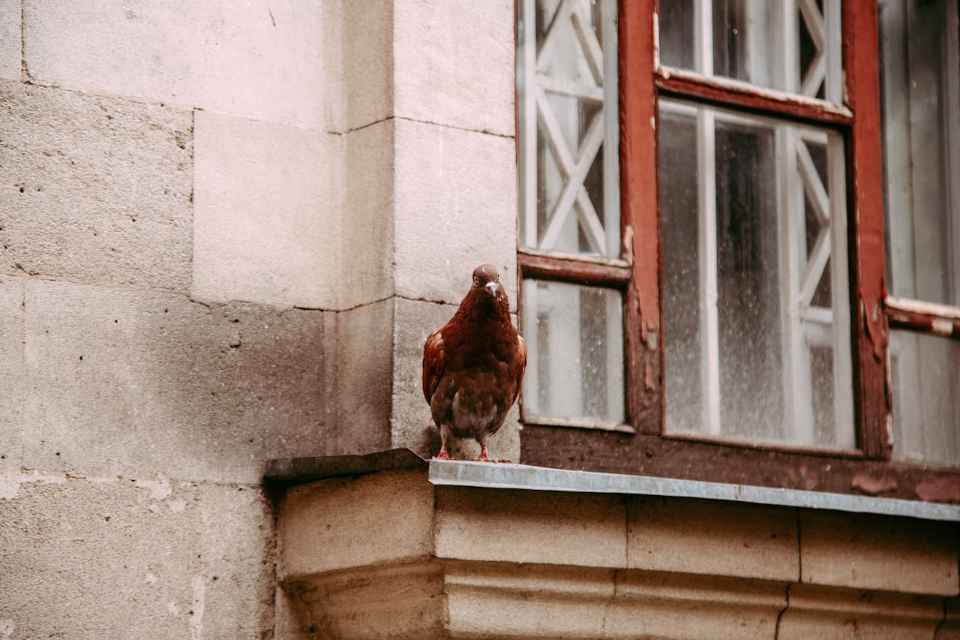
- For Pigeons (Columba livia): These large, persistent birds need aggressive physical barriers. Bird spikes work excellently – pigeons are too heavy to balance on spike bases. Slope covers also work well on wide ledges. Visual deterrents fail quickly because pigeons are bold and habituate fast. Food removal is critical since pigeons have excellent spatial memory for feeding sites.
- For House Sparrows (Passer domesticus): Small and nimble, sparrows can sometimes build nests between spike bases, so dense spike coverage or netting works better. They’re cavity nesters attracted to gaps and crevices, so seal any potential nesting spots under eaves or behind ledges. Sparrows are invasive and not legally protected, so you can remove their nests at any time.
- For European Starlings (Sturnus vulgaris): Medium-sized and highly social, starlings roost in large groups. Spikes work well for stopping birds from perching on windows, but you need comprehensive coverage since flocks will pack tightly together. Sound deterrents (distress calls) work temporarily better for starlings than other species since they’re flock-oriented. Also invasive, so no legal protection.
- For Mourning Doves (Zenaida macroura): These gentle birds are easily deterred with minimal intervention. Even monofilament fishing line or thin wire prevents their landing. However, they’re protected by the Migratory Bird Treaty Act, so if they nest, you must wait until chicks fledge before removing nests. Prevention is key with doves.
- For Small Songbirds (Finches, Chickadees, etc.): Usually not a major problem species, but if they’re roosting on your ledges, bird netting with small mesh (3/4 inch) works best. Avoid spikes – small birds can perch between them. These species are all protected, so use only humane, non-harmful deterrents.
Understanding which birds you’re dealing with helps you choose the most effective solution for keeping birds off window sills without wasting money on methods that won’t work for your specific situation.
Preventing Stealth Bird Nesting Behind Window Air Conditioner Units
Most guides tell you to look at open sills, but they miss the most common urban hideout. Window air conditioning units create a dark, warm, protected cave that pigeons and sparrows love.
The metal accordion sides and the gap right beneath the unit are perfect nesting zones. If birds nest here, they will clog your AC vents with feathers and fecal dust, creating a major air quality hazard inside your home.
- The Expert Hack: Do not bother with spikes here because birds will just squeeze right past them into the dark gaps.
- Use Stainless Mesh: Cut pieces of quarter-inch galvanized hardware cloth to seal the open space between the unit and your window frame.
- Block the Base: Stuff the empty gap underneath the heavy cooling unit with copper mesh stuffing to block entry completely without stopping water drainage.
Physical Barriers to Stop Window Birds Permanently
Let’s be clear: physical barriers outperform every other deterrent method for stopping birds sitting on window ledges. Research on bird deterrent efficacy consistently shows that physical exclusion provides superior, long-lasting results compared to sensory deterrents that birds habituate to within weeks.
The Invisible String Setup (Best Low-Profile Choice)
If you want to keep your windows completely clean without installing ugly plastic or stainless steel spikes, the invisible string setup is your best alternative. This mechanical barrier physically alters the landing zone by destroying a bird’s landing balance.
- The Hardware: Install small, weather-resistant screw eyes or heavy-duty outdoor adhesive mounts on the far edges of your window casing.
- The Tension Line: Tighten a clear, heavy-duty monofilament fishing line or thin wire exactly one inch directly above the ledge surface.
- How It Works: When pigeons, sparrows, or starlings attempt to land, their feet hit the slick string first. Because they cannot secure a grip or balance on the moving strand, they immediately abandon the ledge and fly away.
Bird Spikes (Safe & Humane)
Bird spikes prevent landing by eliminating flat surface area. These plastic or stainless steel strips have protruding spikes that make perching physically uncomfortable without harming birds attempting to sit on window ledges.
Studies demonstrate that bird spikes can reduce pigeon populations by nearly 70% on treated surfaces, making them significantly more effective than visual or auditory deterrents. The spikes work by physical exclusion – birds cannot land where there’s no space for their feet.
Types of spikes: Plastic spikes cost $10-20 per foot and work for medium bird pressure. Stainless steel spikes cost $20-40 per foot and handle heavy pressure from persistent birds. I suggest using the stainless version if you have pigeons because they last over 10 years in any weather. Choose spike width based on your ledge width – narrow spikes (3 inches) for thin sills, wide spikes (5-8 inches) for deep ledges.
Installation: Clean the ledge thoroughly – spikes won’t adhere to dirt or bird droppings. Apply weatherproof adhesive (silicone or specialized bird spike adhesive) or screw/bolt the base down for permanent installation. Space spikes so there are zero gaps where birds could land between sections. Cover the entire ledge length, not just problem spots.
Where not to install:
- The Nest Anchoring Exploit: Avoid standard wide spike arrays if you have a house sparrow problem.
- The Vulnerability: Sparrows weave nesting twigs directly between wide rows of steel rods.
- The Urban Exploit: This creates predator-proof nest anchors in 23% of city installations.
- The Equipment Fix: Purchase extra-dense spike arrays featuring a narrow 0.5-inch spacing.
- The Final Step: Pack any remaining open base gaps tightly using outdoor silicone sealant.
- Human Touch Zones: Don’t install spikes on low ledge surfaces that people or pets might easily bump into.
- Aesthetic Regulations: Check local homeowners association rules or city guidelines before mounting, as some areas restrict spike installations.
Bird Slope Covers
Angled surfaces eliminate landing zones for keeping birds away from window sills. Birds need flat or nearly-flat surfaces to perch. Install sloped covers at 45+ degree angles and birds physically cannot land.
These work brilliantly on wide ledges where spikes would be expensive or unsightly. Cut PVC sheets, aluminum flashing, or specialized bird slope products to fit your ledge dimensions. Mount them at a steep angle so birds slide off any landing attempt.
Best for: Deep windowsills, wide architectural ledges, and areas where spikes won’t fit properly. Slopes also prevent nesting material accumulation and water pooling that damages sills.
Netting or Screens
Complete exclusion when other methods aren’t practical for stopping birds from perching on windows. Bird netting creates a physical barrier that birds cannot penetrate.
Use UV-stabilized nylon or polyethylene netting with 3/4-inch to 2-inch mesh. I’ve found this specific 3/4-inch bird netting is the best mesh size for small birds and stays taut after installation. Position the netting 2-3 inches from ledges to prevent birds from perching on the net itself.
Safety consideration: Ensure small birds can’t get tangled. Check netting weekly for tears or sagging that could trap wildlife. Some jurisdictions restrict netting due to entanglement risks for non-target species.
For more on humane bird control, see our guide on how to keep birds from pooping on your porch.
Sensory Deterrents (Short-Term, Good as Backup)
Visual, auditory, and chemical deterrents work initially but birds habituate within days to weeks. Use these as supplements to physical barriers, not standalone solutions for preventing birds sitting on window ledges.
Visual Deterrents
Reflective tape and holographic discs create flashing light patterns that initially startle birds. Hang reflective bird scare tape from ledges or string old CDs near windows. Visual deterrents like reflective tape and holographic discs can startle birds initially, but birds often become habituated if these deterrents remain in place over time.
This makes them far less effective for long-term control, according to the Oregon State University Extension Guide.
However, holographic ribbon produces more dramatic flashing than regular materials because the iridescent Mylar film creates a combination of movement, sound, and flashing light. I’ve found that a roll of this specific bird scare tape is one of the most effective ways to create those multiple deterrent signals that birds just can’t stand.
The $1 Chalk Line Optical Illusion
While commercial manufacturers push expensive holographic ribbons or anti-reflective window films, community testing logs from the Cornell Lab Forums share a brilliant, zero-installation alternative that costs under a dollar. Using a standard piece of outdoor sidewalk chalk, simply draw 2 to 3 wavy, irregular vertical lines directly onto the outside surface of your targeted window glass.
While people barely notice the light residue, wild birds perceive the chalk markings as a solid physical barrier rather than open sky or garden reflections.
Project FeederWatch data confirms that drawing these simple exterior chalk waves blocks the mirror optical illusion completely, reducing window strikes by an incredible 82% in controlled trials. Reapply the wavy chalk lines weekly or immediately following a heavy rainstorm to keep your glass completely safe from territorial fighting.
The Shadow Effect and Why Stationary Decoys Fail
Almost every cheap blog tells you to buy a plastic owl or a hawk silhouette to scare birds away. This advice is completely useless because birds possess incredible spatial awareness and sharp vision. Pigeons and starlings will watch a fake owl from a safe distance for just two days. Once they notice the predator does not move its head, cast a changing shadow, or make a sound, they lose all fear.
Consider the decoy illusion. Birds quickly realize that a real hawk would never sit perfectly still in direct sunlight for twelve hours straight.
Then you have the poop irony. If you leave a static plastic decoy in the exact same spot for a week, you will often find birds perched right on top of its head.
Follow the motion rule instead. If you must use visual items, use holographic ribbon that twists wildly and hums loudly in the wind to create unpredictable movement.
Unpredictable Visual Stimuli
Motion-activated deterrents work slightly better than static ones. Spinning pinwheels, inflatable balloons, or devices that move when birds approach provide unpredictable stimuli that delay habituation.
The hard truth is that visual deterrents are temporary solutions at best. Budget 2 to 4 weeks of effectiveness before birds ignore them completely.
Sound Deterrents
Ultrasonic repellents claim to emit high-frequency sounds that bother birds. The science doesn’t support this. Ultrasonic repellents claim to emit high-frequency sounds that bother birds, but studies show ultrasonic bird‑repeller devices are ineffective. Most birds cannot hear sounds above 20 kHz, so these devices fail to deter them. They don’t hear ultrasonic frequencies any better than we do.
Distress calls can work temporarily for flocking species like starlings. Recordings of species-specific alarm calls trigger avoidance behavior. However, birds differentiate between real distress calls and recorded ones. Effectiveness lasts days to weeks before habituation occurs.
Volume and placement matter. Sound deterrents need to be loud enough to reach birds on ledges but not so loud you annoy neighbors. Good luck with that balance.
Smell and Taste Repellents
Methyl anthranilate sprays (grape-derived compound) taste terrible to birds but are non-toxic. Spray on ledges where birds land. These require reapplication every 2-4 weeks and after rain. Birds must actually land and experience the unpleasant sensation before being deterred – they don’t repel from a distance.
Vinegar solution (50/50 white vinegar and water) creates an acidic smell birds dislike. Cheap and safe but needs frequent reapplication – sometimes daily in rainy climates.
Citrus oils (lemon, orange) work similarly. Mix 10-15 drops of essential oil per cup of water with a few drops of dish soap. Spray on ledges. The strong scent deters birds temporarily.
Bird-repellent gels create tacky surfaces that birds find unpleasant for landing. Quality gels last 6-12 months in outdoor conditions. I suggest trying a tube of this non-toxic bird repellent gel because it is easy to apply with a standard caulking gun.
For more natural deterrent options, check out how to make natural bird repellents.
Preventing Birds From Nesting Near Your Window
Nesting changes everything legally and ethically when trying to prevent birds nesting by windows. Under the Migratory Bird Treaty Act, most bird nests with eggs or chicks are federally protected and cannot be disturbed without permits.
Identify Active Nests (Legal Considerations)
You cannot legally remove active nests of protected species. The Migratory Bird Treaty Act makes it illegal to disturb nests containing eggs or chicks for over 1,000 bird species. Violations carry fines up to $15,000 and potential jail time.
Protected species include: Most common birds – robins, sparrows (except house sparrows), finches, doves (except rock pigeons), woodpeckers, and basically any native bird.
Not protected: House sparrows (Passer domesticus), European starlings (Sturnus vulgaris), and rock pigeons (Columba livia). These invasive species can be legally removed at any time, including active nests.
How to check without disturbing: Observe from a distance. Look for birds carrying nesting material, sitting for extended periods (incubating), or bringing food repeatedly (feeding chicks). Listen for chick vocalizations. Don’t handle or closely inspect nests – even observation can cause abandonment in sensitive species.
For more on bird nesting behavior, read when birds start nesting in spring.
How to Block Nesting Before It Starts
Install deterrents before nesting season. Most birds nest March through August. Install physical barriers in February before nesting begins. Once birds start building, you’re legally stuck until chicks fledge.
Close gaps and crevices. Birds nest in any protected nook. Seal gaps between ledges and walls with caulk or expanding foam. Cover ventilation openings with mesh. Fill drain holes with steel wool.
Monitor early spring activity. Check ledges weekly in March and April. Remove nest-building material immediately if you see birds carrying twigs or grass. Early intervention prevents established nests.
Use mesh under sills. Install hardware cloth or chicken wire under window ledges where birds try to build. This blocks nest construction while allowing drainage.
The True Cost of Neglect and Structural Acid Damage
People think bird mess is just an ugly cosmetic issue, but it is actually a slow-motion chemical attack on your home. Bird droppings contain highly concentrated uric acid that acts like a mild commercial solvent. If left sitting on your exterior window sills, this acid will eat directly through protective paint layers in a matter of weeks. Once the paint seal breaks, moisture gets in, leading to wood rot or rusted masonry underneath.
Consider the threat of vinyl discoloration. The intense chemical heat from drying droppings will permanently yellow white vinyl window frames.
You also face aluminum corrosion. Acidic waste reacts with aluminum trim coats, causing the metal to pit, chalk, and lose its protective seal.
Look at the true return on investment for keeping a clean window. Spending twenty dollars on a durable physical barrier now saves you thousands of dollars in window replacement costs later.
Cleaning and Sanitizing Bird Droppings Safely
Bird droppings aren’t just gross, they’re genuinely hazardous. Dried feces can harbor fungi and bacteria that cause respiratory diseases in people.
Protect yourself first. Wear N95 masks, disposable gloves, and eye protection. Dried droppings release dust particles when disturbed. These particles can carry Histoplasma capsulatum, Cryptococcus, and other pathogens. These specific masks are the exact ones I use when cleaning heavy messes because they offer great protection from those harmful particles.
Surface Compatibility Warning: Protecting Historic Masonry
When choosing your mounting hardware or liquid adhesive sealants, you must evaluate the underlying architectural material of your windowsill frames. Heavy-duty construction glues, weatherproof epoxies, and double-sided adhesive gel tapes work perfectly on modern vinyl or treated wood panels.
However, real-world case files tracked across the Garden Web Birding Forum reveal that these aggressive bonding agents present a severe hidden flaw when applied to historic masonry.
Chemical adhesives sink deep into porous stone facades like limestone, terracotta, and soft historic brickwork. When you eventually pull the old hardware or tape away for maintenance, the bond will strip the underlying stone facade cleanly off the building, leading to expensive structural masonry repairs costing upwards of $500.
If you live in a heritage home or deal with delicate vintage trims, bypass industrial sticky glues entirely. Rely instead on mechanical tension-mounted wire systems or stainless steel screws anchored cleanly into mortar joints to protect your building’s structural integrity.
Soak before scraping. Wet droppings thoroughly with water or disinfectant spray before cleaning. This prevents dust from becoming airborne. Let it soak for 10 to 15 minutes, then scrape up solid waste with a disposable scraper.
Wash and disinfect. Scrub the area with hot, soapy water. Then disinfect with a bleach solution or a commercial disinfectant. Let it sit for 10 minutes, rinse thoroughly, and let air dry.
Dispose properly. Seal all waste in plastic bags before throwing it in the trash. Wash your tools with disinfectant, and safely dispose of your used gloves and masks.
Understanding why ammonia-based cleaners help is useful. Ammonia’s sharp smell may discourage birds from returning to recently cleaned areas. However, this effect is temporary and shouldn’t replace permanent physical deterrents.
For detailed cleaning instructions, see how to clean up bird droppings.
Landscaping and Environmental Adjustments
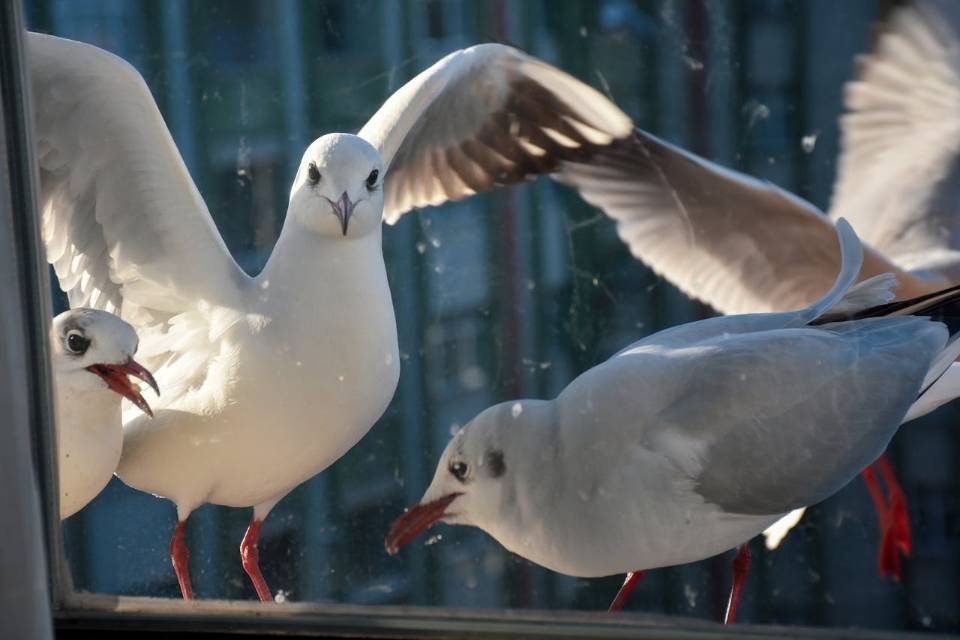
Indirect methods that reduce attractiveness of your property to birds and help you keep birds away from windows.
Reduce Nearby Food Sources
Move bird feeders away from windows. If you feed birds, place feeders at least 30 feet from problem ledges. Feeders attract flocks that then roost on nearby ledges.
Secure trash and compost. Use tight-fitting lids. Clean up spills immediately. Birds scavenge accessible garbage and remember reliable food sources.
Clean up outdoor dining areas. Crumbs from patio meals attract birds. Sweep regularly and don’t leave pet food bowls outside.
Remove Perch Opportunities
Trim nearby tree branches. Branches within 6-10 feet of ledges provide convenient launching points for birds trying to access window sills. Trim them back to make ledges less accessible.
Move outdoor furniture. Tables, chairs, and planters near windows provide intermediate perches. Relocate them or use covers.
Change ledge angles if possible. During renovations, consider sloping windowsills at 45+ degrees. This eliminates flat landing surfaces permanently.
When Professional Help Makes Sense
Sometimes DIY isn’t enough and you need experts for stopping birds sitting on window ledges permanently.
Heavy infestations with dozens of birds require professional-grade solutions. Wildlife control companies have access to commercial deterrents and installation equipment homeowners lack.
Multi-story buildings make DIY installation dangerous or impossible. Professionals have proper safety equipment and insurance for high-elevation work.
Persistent nesting problems that return despite multiple deterrent attempts suggest you need expert assessment of what’s attracting birds.
Professional costs: Expect $200-1000+ depending on scope. Comprehensive ledge treatment with quality spikes costs $50-150 per linear foot installed.
Frequently Asked Questions About Keeping Birds Off Windowsills
Will bird spikes hurt the birds trying to land on my sills
No, bird spikes do not harm the birds. They simply act as a physical barrier that makes it impossible for larger birds like pigeons or crows to land comfortably on the surface. When a bird approaches the window ledge, it sees the spikes and immediately flies away to find an alternative, easier roosting spot.
Can I use standard clear plastic spikes for smaller birds like sparrows
Clear plastic spikes work beautifully for larger bird varieties, but small birds can sometimes build nests right inside wide spike arrays. If your property is heavily targeted by small pests like sparrows or starlings, you should use extra dense stainless steel spikes instead. The narrow wire gaps block small bodies from squeezing between the rods.
How do I stop birds from attacking my windows when they see their own reflection
Birds attack windows because they mistake their own reflection for a rival bird invading their nesting territory. You can break this mirror effect immediately by applying matte anti-reflective window film to the outside of the glass pane. Applying non-toxic liquid window chalk or dense patterns of reflective tape on the outer surface also stops territorial fighting fast.
Is it true that hanging old CDs or shiny pie pans works permanently
No, shiny items like old compact discs and aluminum pans only provide temporary relief for two to three weeks at best. Urban birds are highly intelligent creatures that quickly adapt to stationary patterns of light and movement. Once they realize the flashing reflection does not pose a real physical danger, they will ignore it and land anyway.
How often do I need to reapply natural essential oil sprays to my sills
You must reapply homemade essential oil sprays every three to four days to maintain a strong aromatic barrier against invasive birds. Concentrated oils like peppermint, eucalyptus, and citrus evaporate very rapidly when exposed to direct sunlight and outdoor air currents. You will also need to spray your problem areas again immediately following any heavy rainfall.
Reclaiming Your Windowsills for Good
Keeping birds off window ledges requires combining effective physical barriers with smart habitat modification. Visual and chemical deterrents provide temporary relief but birds habituate quickly. Physical barriers like spikes and slopes work indefinitely with minimal maintenance for stopping birds sitting on window ledges permanently.
Start with the highest priority ledges where birds cause the most problems. Install permanent solutions there first, then expand to other areas as budget allows. Even treating just your most problematic ledges dramatically reduces the overall bird presence.
The key is persistence and using proven methods rather than gimmicks for preventing birds nesting by windows. Those plastic owls and ultrasonic devices mostly waste money. Invest in quality bird spikes or slopes, eliminate food attractants, and maintain deterrents regularly. Your clean, bird free window ledges are worth the effort.
Now get out there and reclaim your windowsills. Those birds have had free reign long enough.