
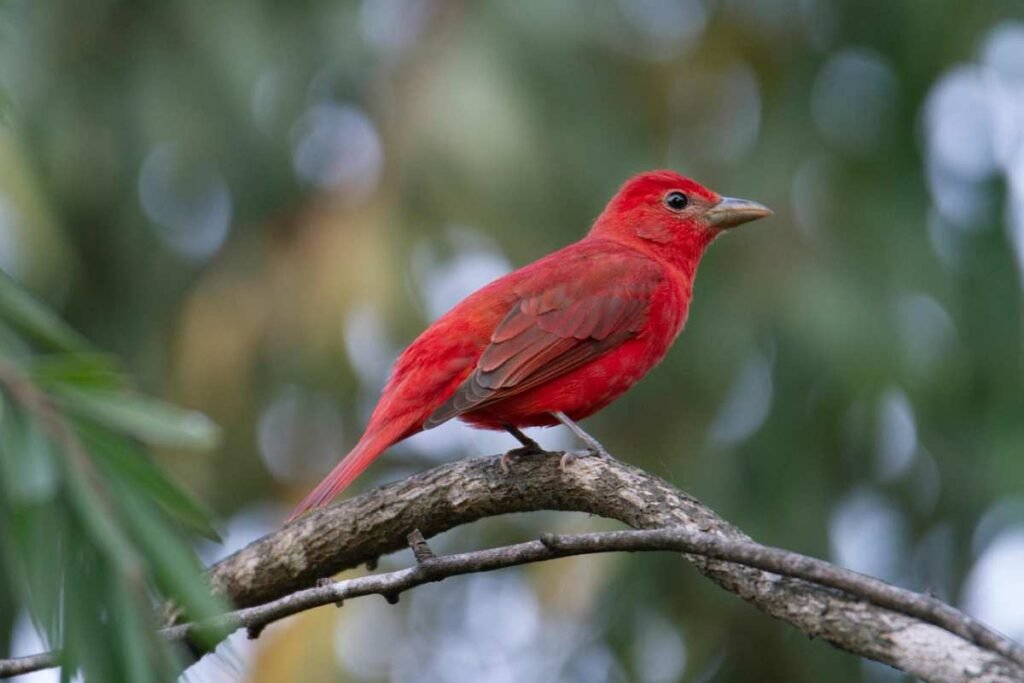
Learning how to identify common backyard birds turns my daily outdoor space into a fascinating natural classroom. In my years of tracking local wildlife, I have found that you do not need expensive optical gear or advanced training to confidently separate subtle migratory visitors from permanent neighborhood residents.
The entire secret relies on looking past basic plumage colors to isolate deep structural silhouettes, specific foraging behaviors, and seasonal vocalization calendars. Making a few small upgrades to our property lines will bring an endless variety of unique wildlife directly to our windowsills.
This comprehensive diagnostic field guide breaks down the precise anatomical markings, seasonal molting patterns, and territorial traits of common urban species. Mastering these expert checkpoints ensures you can document local flocks with absolute technical accuracy throughout the entire year.
What is the Easiest Way to Identify Common Backyard Birds?
The easiest method is isolating structural field marks like thick seed-cracking beak shapes, distinctive head crests, and unique body silhouettes.
To verify tricky species, check their real-world foraging habits, because nuthatches walk headfirst down tree bark, while juncos perform double-footed scratch dances on open soil.
Watch How to Identify Common Birds (Animated Guide)
Reviewing an illustrated breakdown provides excellent clarity when learning these subtle avian markers for the first time. This animated explainer video maps out the distinct visual checkpoints and physical boundaries directly on a digital canvas.
Why Backyard Bird Identification Matters
Recognizing individual avian visitors moves far beyond a basic backyard hobby to reveal the real-time health of your local environment. Small songbirds function as sensitive biological indicators that display immediate reactions to hidden chemical changes and local habitat losses.
Losing native bird diversity disrupts critical environmental functions like natural insect suppression and wild seed dispersal across your neighborhood perimeters. Reviewing the official National Audubon Society Ecosystem Guide demonstrates exactly how these pest control and pollination patterns directly affect both people and the planet.
Monitoring these seasonal population shifts helps conservation groups map out larger urban wildlife health trends with absolute technical accuracy. Slowing down to isolate unique behavioral patterns provides immense mental clarity while building an authentic connection to your property layout.
Trading aimless screen scrolling for active field tracking transforms your daily outdoor space into a deeply rewarding natural classroom.
The Big Three: Cardinals, Blue Jays, and Robins
Isolating the most prominent yard visitors provides an ideal entry point for developing accurate field identification habits. These three distinct species feature bold profiles and reliable behaviors that make them perfect baseline targets for beginners.
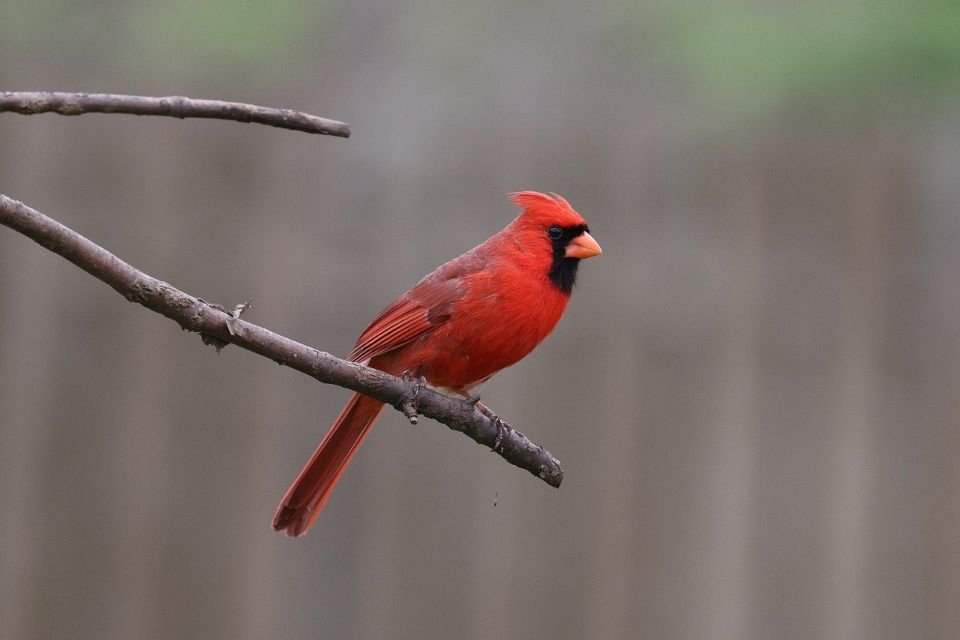
Northern Cardinal: The Showstopper
Male cardinals are impossible to miss with their brilliant red plumage and distinctive crest. This vibrant coloration comes from carotenoid pigments they ingest through their diet of wild seeds and berries.
Female cardinals sport more subtle brown tones with warm reddish highlights on their wings and tail. This understated appearance serves as essential evolutionary camouflage to protect the bird from predators while tending to eggs.
Spotting tips for cardinals:
- Listen for their clear birdy-birdy-birdy whistle
- Look for thick orange beaks perfect for cracking hard seeds
- Check dense shrubs where they prefer to build hidden nests
- Watch feeding stations during early morning and late afternoon hours
Reviewing the comprehensive guide on where do northern cardinals build their nests helps clarify how their intricate branch construction timelines function across different territories.
According to data archived in the official Audubon Magazine Common Birds Index, these resilient songbirds rank among the most frequently recognized and widely distributed backyard species throughout North America.
Blue Jay: The Neighborhood Loudmouth
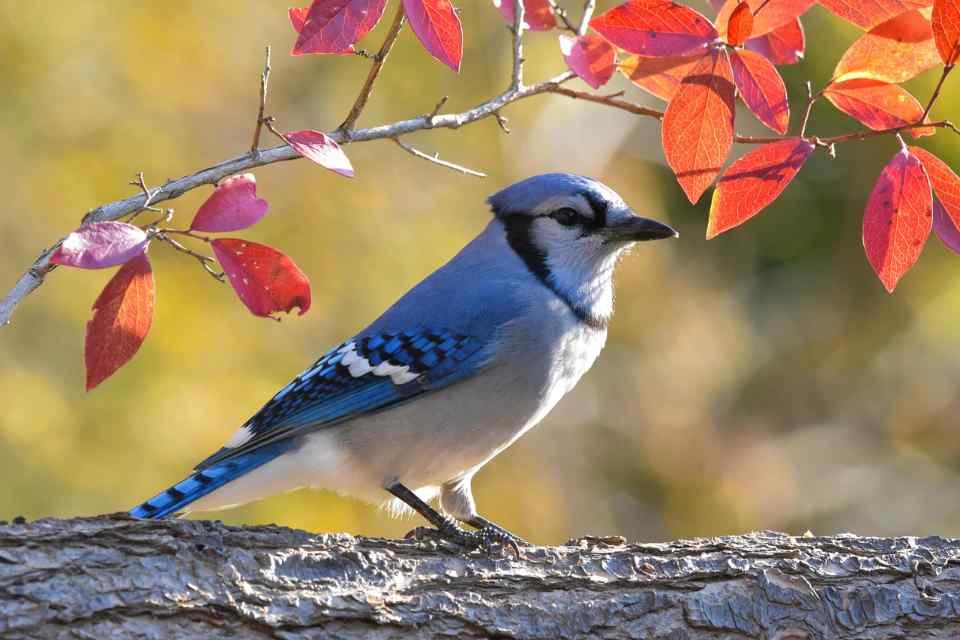
These bright blue beauties make sure everyone knows when they arrive across your property lines. Their raucous alarm calls function as a natural notification system across the neighborhood.
What makes this species truly remarkable is their complex vocal mimicry defense system. They intentionally imitate Red-shouldered Hawk screams to frighten competing birds and clear out feeding stations.
Reviewing data published by the Travis Audubon Bird of the Week Profile confirms their advanced cognitive problem-solving abilities when navigating urban bird feeders.
Reviewing our complete guide on interesting facts about the blue jay clarifies how their high intelligence limits foraging rivalries across urban habitats.
Key blue jay identification features:
- Brilliant blue back and wings with white undersides
- Distinctive blue head crest they raise when excited
- Bold black markings wrapped around the face and neck
- Loud varied vocalizations including their signature jay call
American Robin: The Early Bird Champion
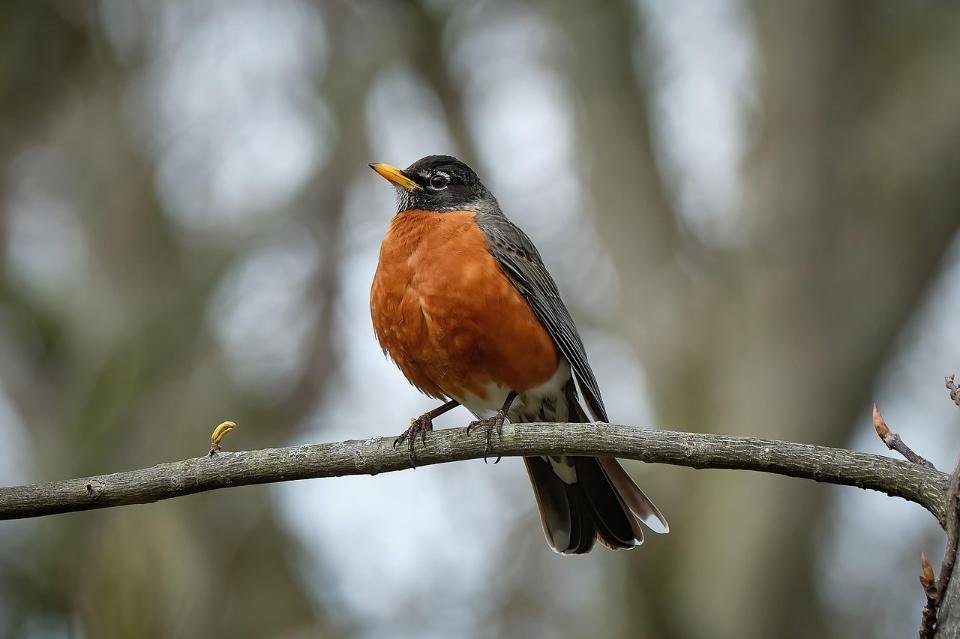
These orange-breasted beauties are often the first birds you will hear singing at dawn and among the last to call it quits at dusk. They maintain an upright torso posture that makes them look significantly taller than smaller crouching ground sparrows.
Males display a deep rich brick-red coloration, while females exhibit a noticeably muted paler orange chest tone. Reviewing our comprehensive guide on how to identify an american robin clarifies how these specific plumage variations shift across different life stages.
According to behavioral tracking data detailed in the official Audubon Magazine Sensory World Guide, these birds tilt their heads to listen intently for underground movement before executing a swift pounce.
Research confirms that while they use sharp vision, they rely heavily on hearing to isolate the faint rustles of moving earthworms beneath open lawns.
Robin identification markers:
- Rich orange to red breast coloring
- Dark gray to black upper feathers
- Vibrant yellow or orange-pink bill
- Distinct hop-stop-head-tilt movements on open turf
The Tiny Powerhouses: Wrens, Chickadees, and Nuthatches
Isolating high-velocity yard visitors requires a sharp focus because small species move rapidly and vanish into dense canopy cover. Mastering their distinct physical structures and unique movement patterns ensures you can easily classify these highly active birds on your property lines.
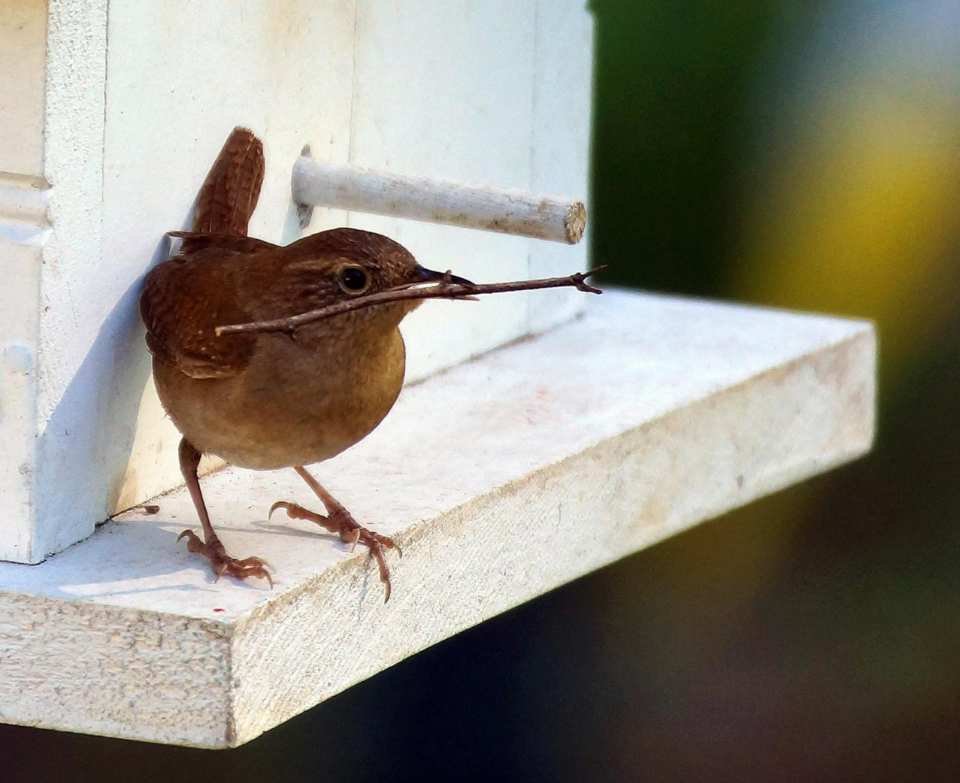
House Wren: The Energetic Architect
These small songbirds feature plain brown plumage with subtle dark barring across their short wings and tails. What they lack in prominent chest coloration, they quickly make up for with intensely aggressive territorial behaviors during the summer breeding season.
As specialized secondary cavity nesters, they utilize empty woodpecker holes, artificial nest boxes, and small enclosed spaces around human properties.
According to reproductive field data managed by the Cornell Lab of Ornithology Northern House Wren Profile, males build dummy nests by stuffing multiple cavities completely full of rigid twigs before a female selects her final brooding location.
House wren spotting guide:
- Small compact brown body with a flat head
- Short tail frequently held cocked in an upright stance
- High-velocity movements while zipping through low brushy tangles
- Loud bubbling song introduced by abrupt harsh scolding notes
Black-Capped Chickadee: The Acrobat
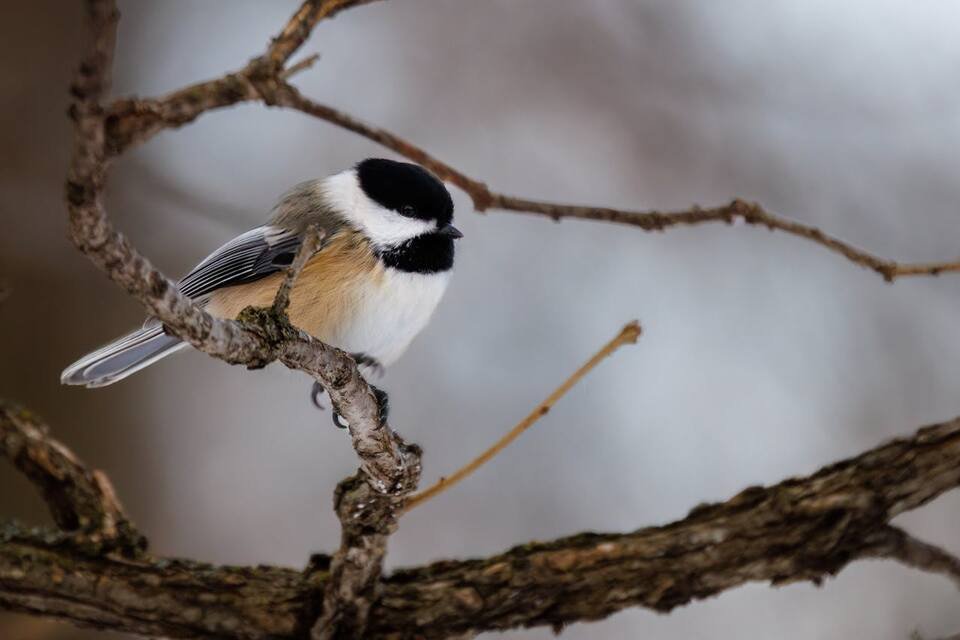
These bold songbirds act as the true gymnastics champions of the backyard bird world. They comfortably execute complex, upside-down feeding maneuvers while clinging to swaying outer pine cones and vertical bark crevices.
Their structural layout displays a jet-black cap extending cleanly to eye level paired with crisp white cheeks. Reviewing our deep dive on what do chickadees eat reveals how their omnivorous diets adapt seamlessly across changing seasonal windows.
According to cognitive neurology data published in the official Springer Animal Cognition Study, these birds possess a specialized working memory system resistant to heavy distractions.
Individual test subjects comfortably maintained precise spatial accuracy during complex multi-tasking challenges that caused non-hoarding bird species to fail entirely.
They systematically transport single sunflower seeds away from feeding trays to tuck them securely into deep bark fissures for winter storage. This advanced survival instinct relies on an expanded hippocampus that allows them to accurately recall thousands of distinct coordinates weeks later.
Chickadee identification points:
- Jet-black cap extending cleanly down to eye level
- Crisp white cheeks contrasting with a black throat
- Solid slate-gray wings completely lacking pale wing bars
- Classic rhythmic chick-a-dee-dee-dee territorial flock call
White-Breasted Nuthatch: The Tree Walker
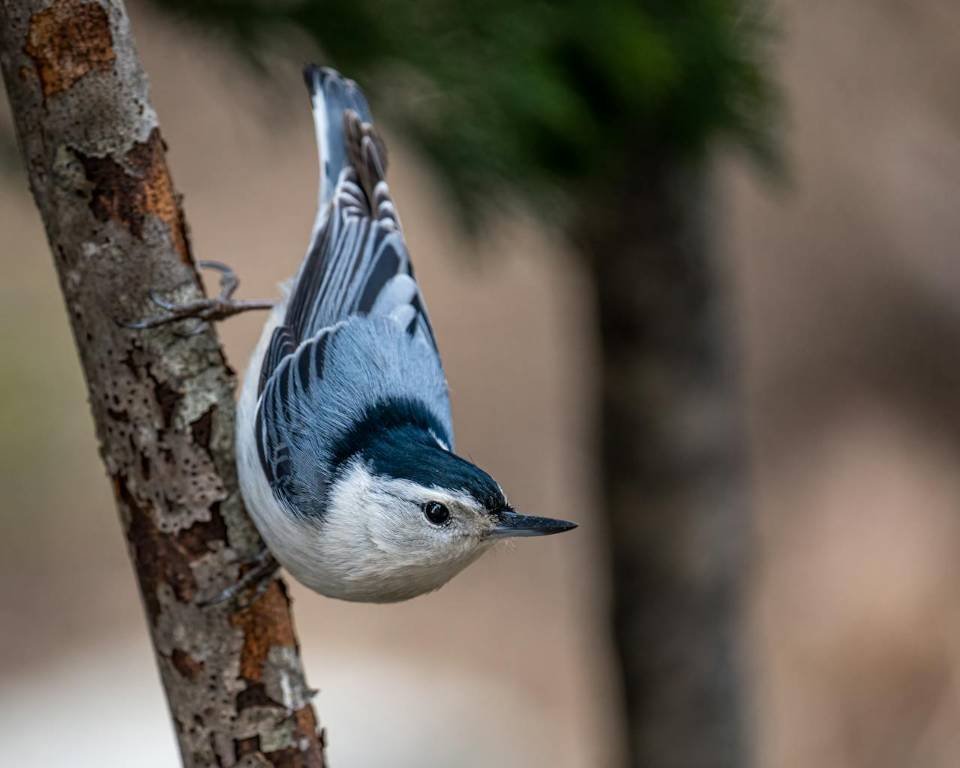
These unique birds earn the nickname upside-down bird due to their specialized gravity-defying movement habits. They regularly walk headfirst down tree trunks to navigate the complex gravitational mechanics of vertical bark foraging.
This distinct inverted foraging position allows them to spot hidden insect eggs that upward-climbing woodpeckers miss entirely.
Reviewing the comprehensive Cornell Lab Nuthatches Shape Guide clarifies how their compact body profiles and specialized feet compare to alternative tree-clinging species.
Their distinctive nasal yank-yank communication calls carry surprisingly long distances across the canopy line. These high-frequency acoustic signaling loops allow birdwatchers to map out localized winter territories before making a visual sighting in the field.
Nuthatch identification features:
- Solid blue-gray back plumage with clean white underparts
- Jet-black cap on males or slate-gray cap on females
- Elongated pointed bill slightly upturned at the tip
- Extremely short tail feathers with a stocky compact torso
The Ground Crew: Sparrows and Juncos
Isolating ground-foraging birds requires an intentional evaluation because multiple species display overlapping brown coloration traits at first glance. Mastering their specific ground-feeding gaits and bold body contrasts ensures you can quickly classify these subtle winter visitors along your lower property lines.
House Sparrow: The Urban Survivor
These introduced songbirds deserve significant credit for their extreme environmental resilience across modern developed spaces. They thrive deeply inside bustling urban ecosystems and concrete city centers where less adaptable native species struggle to survive.
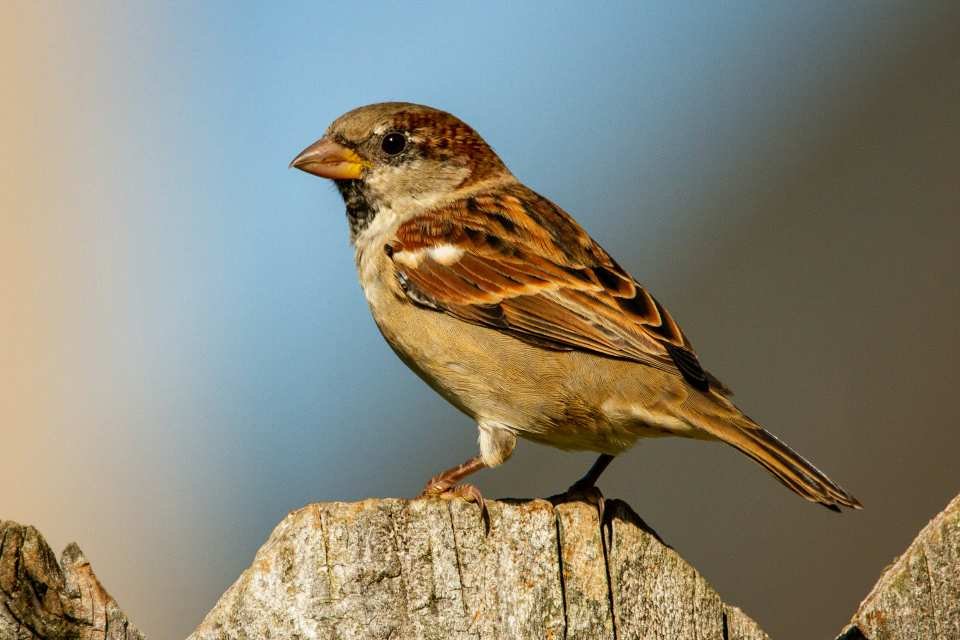
Adult males feature a prominent black throat bib, crisp white cheeks, a slate-gray crown, and a rich chestnut nape. Reviewing the official Audubon House Sparrow Field Guide confirms that their global success relies entirely on nesting around manmade structures rather than unaltered wild forests.
Conversely, adult females display muted, streaky brown and buff plumage variations across their backs to provide excellent natural camouflage.
Reviewing our comprehensive guide on what do house sparrows eat clarifies how their highly flexible foraging habits allow local populations to rapidly scavenge residential bird feeders and open commercial grounds.
House sparrow identification points:
- Stocky robust build with a thick conical seed-cracking bill
- Broad black throat bib and rich chestnut neck patches on males
- Dull streaky gray-brown bodies with a pale buff eyebrow line on females
- High-density ground-feeding flock behavior near neighborhood properties
Dark-Eyed Junco: The Snowbird
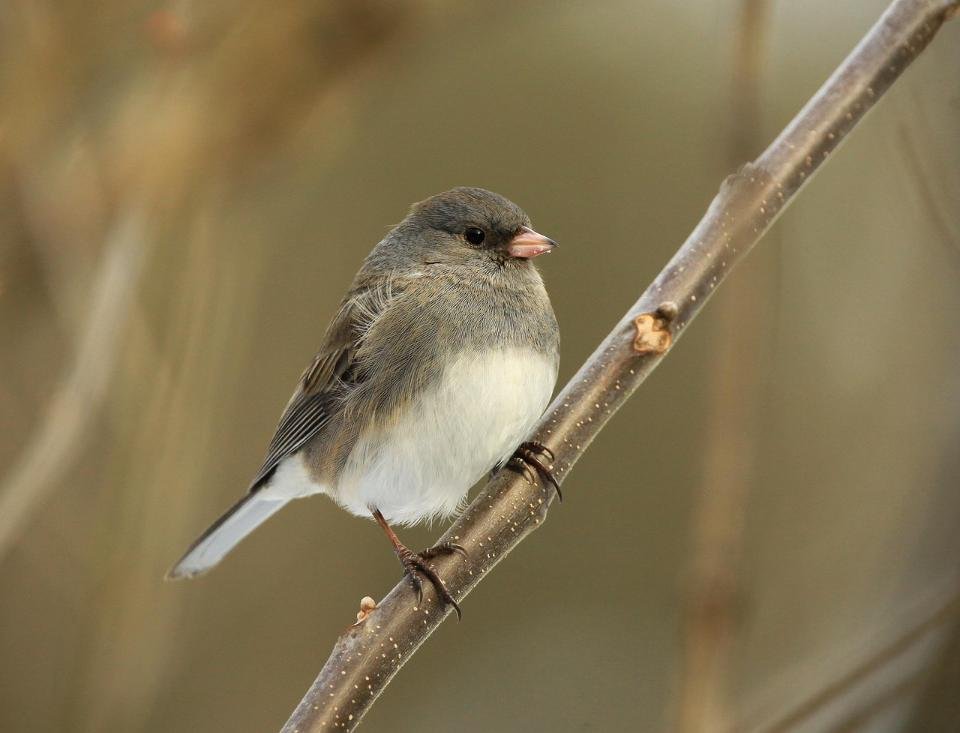
These crisp, ground-dwelling sparrows frequently earn the nickname snowbirds due to their predictable arrival across winter feeding stations. Eastern wintering flocks consist of the slate-colored variant, displaying a smooth gray hood that cuts a clean contrast line against a snow-white underbelly.
What makes this species fascinating to observe is the functional biology of the double-footed scratch foraging technique. They forcefully leap forward and sweep both feet backward simultaneously across leaf litter or snow, exposing hidden seeds and overwintering insects that other foragers miss.
Reviewing the official Audubon Dark-eyed Junco Field Guide confirms that their winter flocks continuously issue sharp, metallic ticking calls to maintain tight group boundaries. When startled into flight, they instantly display bright white outer tail feathers that serve as a visual warning flag to the rest of the flock.
Junco spotting characteristics:
- Solid slate-gray hood and back contrasting sharply with a white underbelly
- Flashing white outer tail feathers highly visible during sudden flight bursts
- Conical pink or light-coloured bill designed for crushing small weed seeds
- Rhythmic ground scratching movements across open lawn perimeters
The Opportunists: Crows, Starlings, and Grackles
Isolating high-density resource scavengers requires a focused evaluation because multiple opportunistic species display aggressive feeding tactics across residential areas. Mastering their unique vocal mimicry systems and complex social flock hierarchies ensures you can cleanly differentiate these intelligent birds along your property perimeters.
American Crow: The Einstein of Birds
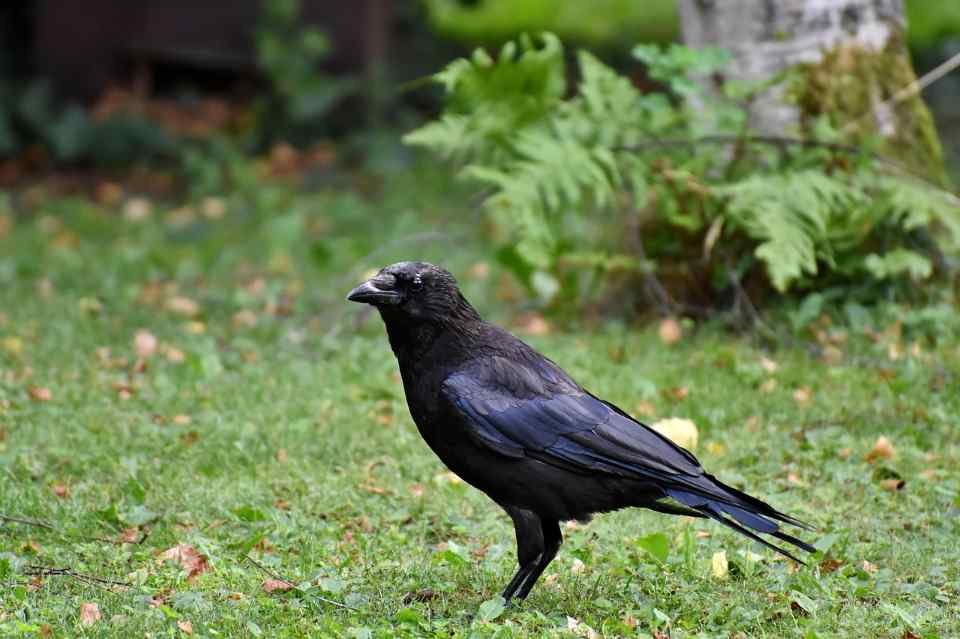
These entirely black songbirds operate as absolute problem-solving geniuses across both urban and rural environments. According to specialized corvid research archived in BirdWatching Daily Crow Grudge Reports, these birds possess advanced cognitive abilities that allow them to memorize individual human facial structures.
If a homeowner threatens a local nesting site, the resident flock will encode that specific face into their memory. They actively broadcast harsh warning alarms to transmit that threat profile across multiple generations of birds.
Reviewing the definitive Cornell Lab American Crow ID Guide illustrates how their streamlined, medium-sized frames navigate human developments with exceptional efficiency. To easily separate passing lone corvids from lookalike wilderness species, birdwatchers inspect subtle structural beak depth markers and vocal pitches.
Crow identification basics:
- Medium frame wrapped entirely in deep violet-glossed black feathers
- Symmetrical straight beak perfectly proportional to a sleek head profile
- Uniform tail feathers forming a clean rounded fan shape in flight
- Loud sharp caw-caw vocalizations issued in rapid alarm clusters
European Starling: The Shape-Shifter
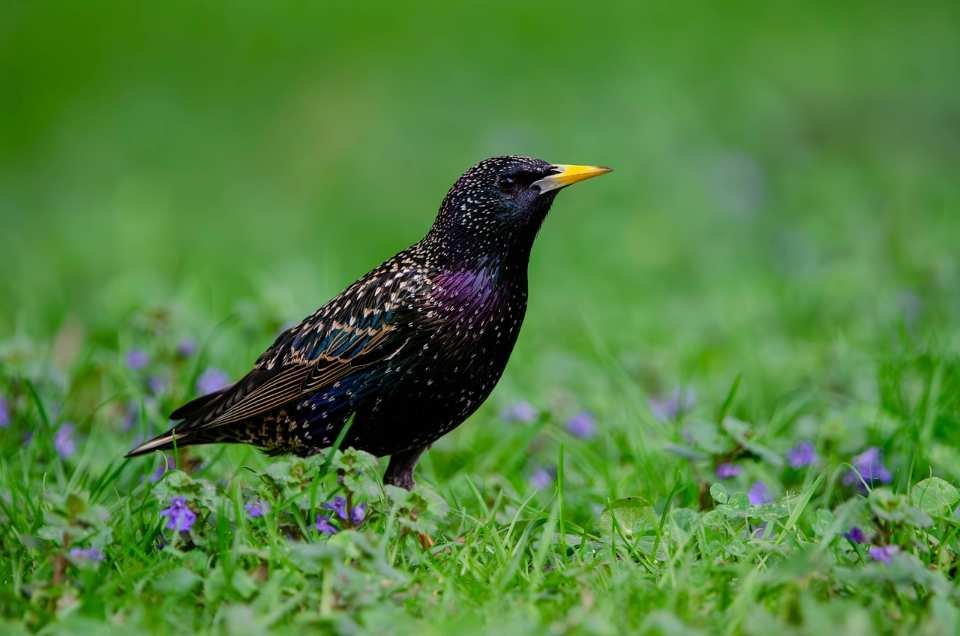
These introduced songbirds operate as true biological chameleons across both urban and rural environments. Their appearance shifts dramatically throughout the year, cycling from a glossy black profile with intense iridescence to a heavily spotted winter coat.
During the spring breeding season, they develop bright yellow bills driven entirely by circulating reproductive hormones. According to the definitive Cornell Lab European Starling Overview, their deep iridescent green and purple sheen transitions to a heavily white-spotted plumage profile and a dark beak during the winter months.
Reviewing our detailed field guide on how to identify European starlings clarifies how this striking transformation occurs through structural feather wear rather than a traditional spring molt. On open turf grass, they move with a highly distinct waddling walk rather than a typical hopping gait to efficiently access subsurface lawn insects.
Starling identification markers:
- Chunky medium frame with a long dagger-shaped bill
- Iridescent black plumage reflecting purple and green highlights
- Notably short and squared-off flight tail silhouette
- Purposeful alternating walking gait across open lawns
Seasonal Visitors: Migration Patterns in Urban Areas
Urban bird populations shift constantly throughout the year as billions of migratory species navigate through modern city landscapes. Exploring the interactive Audubon Bird Migration Explorer map database allows you to easily track these complex multi-state movements across your specific region.
Learning these predictable seasonal patterns ensures you know exactly when to monitor your lower canopy layers for rare incoming travelers. This targeted field strategy helps you confidently identify unusual transient species before they exit your property boundaries.
Spring Arrivals: Warblers and Flycatchers
Spring migration brings dense waves of high-velocity warblers and active flycatchers directly through crowded suburban grids. These traveling insectivores capitalize heavily on city parks and mature residential backyards to replenish vital fat reserves deeply exhausted by long night flights.
Reviewing our comprehensive field manual on spring birdwatching tips for beginners provides key strategic shortcuts to help you maximize your sighting success during peak early May tracking windows.
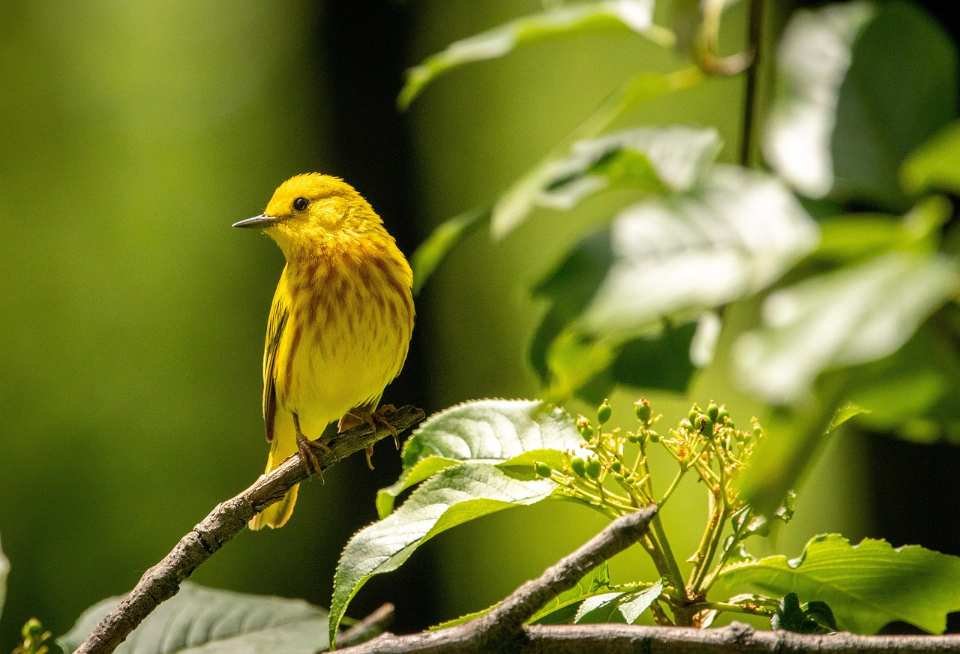
Bright yellow warblers operate as one of the most highly visible spring indicators across local property lines. They strongly prefer foraging inside thick, damp shrubbery where they systematically glean native insects from the undersides of leaves.
Fall Travelers: Mixed Flocks and Rarities
Autumn migration paths operate on a much more gradual timeline than rapid spring surges as birds intentionally slow down to maximize resource accumulation. This extended tracking window offers your absolute best annual opportunity to document unusual transient species that rarely penetrate deep metropolitan borders.
Highly organized mixed foraging flocks combining multiple diverse species continuously glide through urban green spaces during late autumn drops. You can easily spot chickadees, nuthatches, kinglets, and brown creepers all traveling in a tight social canopy wave to maximize their collective protection from local predators.
Creating Bird-Friendly Backyard Spaces
Attracting diverse avian populations requires the intentional delivery of three vital environmental layers including reliable nourishment, active hydration, and secure breeding canopies. Implementing these core survival assets transforms standard property lines into a premium regional sanctuary for migratory species.
Food Sources That Work
Different bird species possess specialized bill structures engineered to process highly specific organic resources:
- High-fat sunflower seeds feed heavy-billed northern cardinals
- Dense suet cakes support energy-intensive insectivorous woodpeckers
- Fresh orchard fruits sustain ground-foraging american robins
- Raw sugar nectar fuels high-velocity migrant hummingbirds
Cheap retail seed configurations frequently incorporate low-grade filler grains that native wildlife completely ignore. Reviewing the official Cornell Lab Seed Selection Guide demonstrates how investing in premium, high-oil kernel varieties optimizes your foraging traffic counts.
Water Features That Attract Birds
Dynamic moving water features isolate target bird populations significantly better than standard static backyard basins. Integrating a low-profile solar dripper or a small circulating waterfall grid creates continuous splashing audio frequencies that draw distant canopy flyers.
This acoustic signaling loop immediately alerts traveling flocks to a safe, reliable bathing destination. Migrant warblers that routinely bypass grain trays will drop out of the sky exclusively to utilize an active water source.
Shelter and Nesting Opportunities
Planting native vegetation provides superior protection and dense foraging structures compared to introducing exotic ornamental foliage. Berry-producing woody shrubs like elderberry and serviceberry deliver vital antioxidant fuel sources while adding structural security to your property lines.
Leaving dead tree snags standing where safety permits offers premier nesting architectures for specialized secondary cavity-nesting species like wrens. These dense wood fibers supply critical protection for delicate seasonal broods throughout the annual reproductive calendar.
Common Identification Mistakes and How to Avoid Them
Every birder makes identification errors, especially when starting out across new suburban environments. Utilizing our identify birds by size framework to isolate specific physical reference points prevents common visual tracking traps. Shifting your focus away from basic snapshot estimations ensures your daily property counts remain highly accurate.
Size Estimation Errors
Bird size can be deceiving, especially when you are viewing them at highly variable field distances. Compare unknown visitors to familiar backyard species rather than trying to estimate actual linear dimensions on a blank sky.
Use common house sparrows as your baseline small bird reference point to scale hidden garden targets. For larger silhouettes, utilize our structural comparison guide on telling a crow vs raven apart to master real-world sizing anchors.
Lighting and Distance Challenges
Poor lighting conditions can completely change how structural bird colors reflect into your binoculars. A muted brown bird might actually be a nesting female cardinal variant caught in a shadow, while bad glare masks the true bill proportions needed to solve a tricky woodpecker field puzzle.
Position yourself strategically near active food or water stations and let the flocks approach your location naturally. This low-impact observation technique protects your clarity without causing territorial birds to scatter from their preferred perching lines.
Seasonal Plumage Changes
Many urban birds dramatically alter their appearance through continuous hormonal cycles or mechanical feather wear. To safely navigate these challenging shifts, you can check behavioral signals to confidently separate lookalike house sparrows or identical titmice in the field.
Reviewing our complete guide on how to identify birds by color helps clarify how ambient light alters these seasonal shifts.
Checking the contrasting chest boundaries of winter bluebirds prevents common confusion, while isolating crisp flank streaks helps you separate tricky house finches and purple finches down your property lines.
Tools That Actually Help (And Ones That Don’t)
You do not need expensive equipment to start identifying urban birds, but a few basic tools make the process much more enjoyable. Prioritizing reliable core optics over specialized tracking machinery ensures you invest in high-utility assets that last across multiple seasons.
Essential Equipment
Binoculars represent the single most important tool for accurate species identification. You do not need professional-grade optics, but decent eight-by-forty-two binoculars make a massive difference in resolving tiny field marks from a distance.
Field guides and mobile birding applications help confirm tricky sightings while providing vital regional range statistics. Utilizing digital audio recognition software allows you to instantly isolate distinct song signatures before a bird even exits your thick canopy layers.
Overrated Gear
High-end spotting scopes are complete overkill for typical residential property lines and garden watching. Save your financial resources for premium, comfortable neck straps and highly durable binocular lenses instead.
Expensive cameras fitted with massive telephoto glass can enhance your hobby enjoyment, but they are entirely unnecessary for learning basic avian anatomy. Start with simple baseline optics and upgrade your hardware later if digital field photography transitions into a true personal passion.
Building Your Urban Bird List
Keeping track of species you have identified adds goal-oriented fun to birdwatching. Start with common species and gradually expand your knowledge as you become more experienced.
Create a simple list including:
- Species name and date first observed
- Location within your yard or neighborhood
- Notable behaviors or characteristics observed
- Seasonal patterns you notice
Systematic record-keeping transforms casual observation into scientific documentation. Tracking these daily visits allows you to contribute real data to global citizen science projects.
Transforming Your Daily Backyard Wildlife View
Urban bird identification transforms your daily outdoor view into a deeply rewarding natural classroom. These common resident species provide an incredible connection to local wildlife without requiring specialized travel or expensive field excursions.
Start by mastering the distinct physical profiles of the most prominent yard visitors before expanding into high-velocity smaller species. Focus entirely on tracking fixed structural landmarks, unique foraging behaviors, and rhythmic vocal pitches rather than attempting to memorize every feather detail at once.
Every expert field observer started with the exact same learning curves and visual illusions that you encounter today. Misidentifying transitional plumages or tracking empty branches is a normal part of developing professional birding automation.
The entire natural system operates right outside your website windows completely free of cost throughout all four seasons. Step outside with your core optics, scan your current property perimeters, and document the diverse wildlife sharing your modern suburban space.
Once you learn to recognize the basic species visiting your property, utilize our comprehensive backyard bird checklist to systematically document your daily counts. This active logging routine helps you effortlessly track seasonal migratory shifts and map out local population trends with absolute diagnostic accuracy.